We’re not recording our next episode until Saturday, but if you’re reading ahead, we’ll be discussing chapters 8-13 of The Caves of Steel, corresponding to the second installment that was published in Galaxy Science Fiction in November 1953.
Galaxy SF, 11/1953
It’s an interesting issue. Asimov didn’t score the cover this time. The cover references the non-fiction piece about the famous experiment that saw complex amino acids generating spontaneously when the conditions on primordial Earth were recreated in a laboratory.
Also of interest is “Galaxy’s 5-Star Shelf.” which reviews a compilation of Olaf Stapledon’s work, the non-fiction Man in Space by Heinz Haber, Second Stage Lensman by E. E. (Doc) Smith, Against the Fall of Night by Arthur C. Clarke and Second Foundation. In that last review, Groff Conklin calls the now-completed Foundation Trilogy “Our first great sociological space opera.” He compares it favorably with Smith’s Lensman series saying, “…Asimov’s work, based as it is on fairly sound social principles and the activities of fairly normal human beings, has a pressing sense of reality that Smith’s fairy tales lack…” He concludes “it is a thoroughly satisfying and adult play of the scientific imagination.”
But back to The Caves of Steel. Here’s the promotion for this installment in Galaxy’s October Issue.
And here are some pages from the story.
i
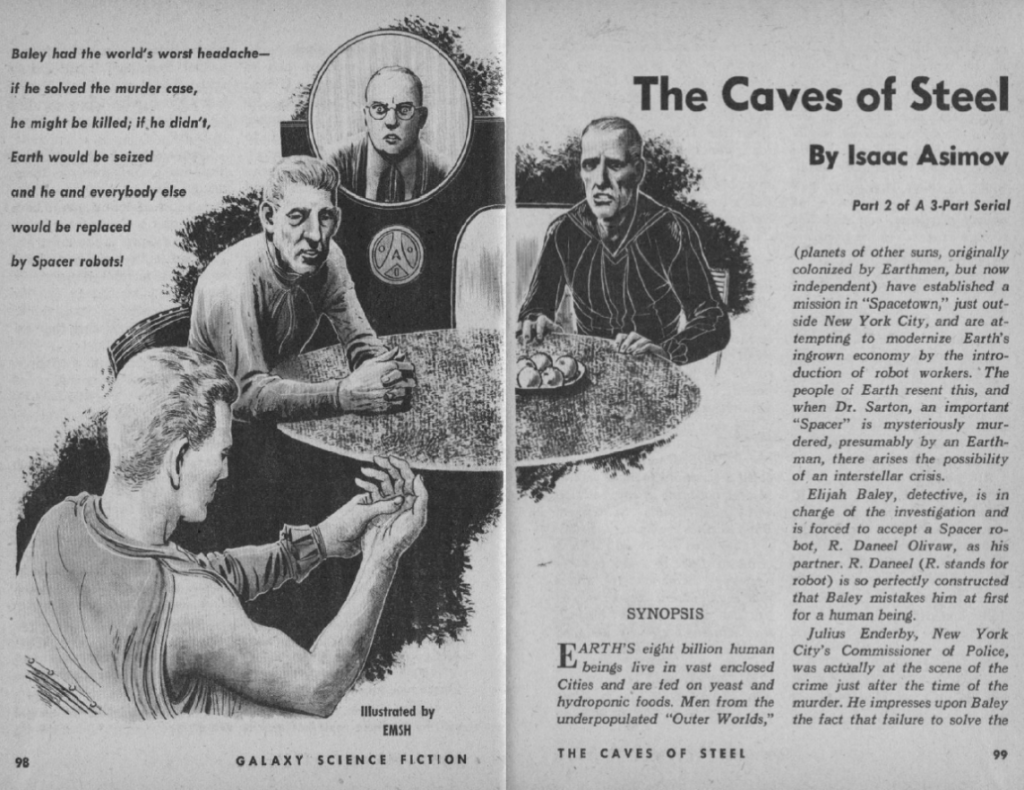
I’m particularly liking the opening two-page spread, with artwork once again by Ed Emshwiller. It depicts the encounter in Chapter 8. The synopsis is nicely done as well and continues for the entire next page. Here’s the remainder in case you want to remind yourself of the last installment before continuing to read this one.
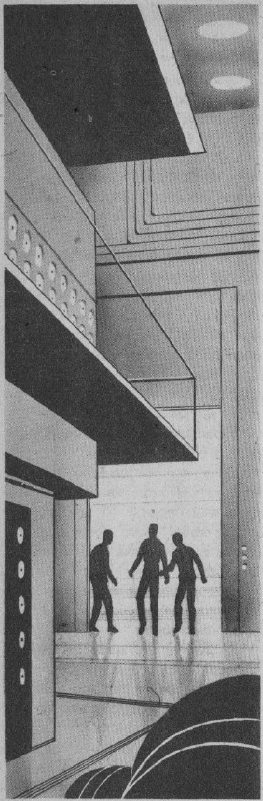
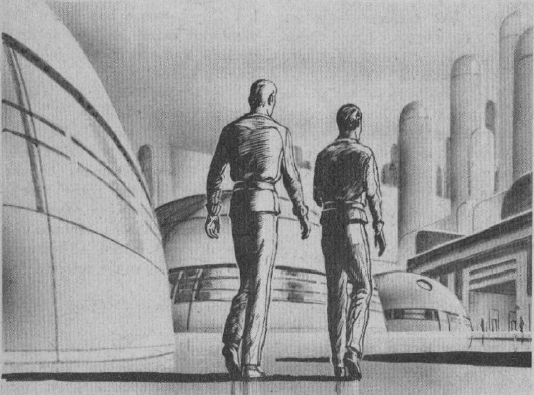
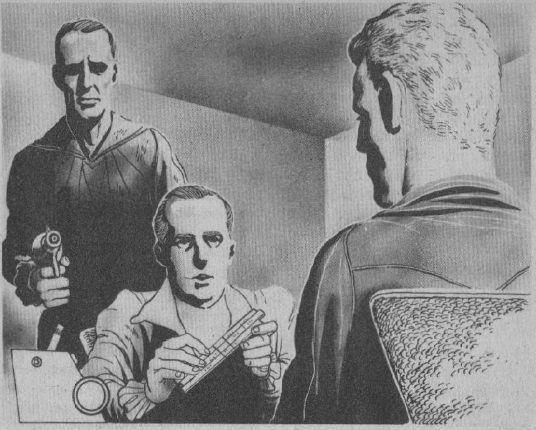
Finally, here are the rest of the illustrations from the story. We have Lije and Daneel leaving Space Town (top right), traveling through a power plant (left), and Daneel being examined by Dr. Gerrigel, a roboticist.
Unlike E03 I remember this one from last year. The description kind of gives away the fact that there’s a twist. That’s annoying. The teaser is startlingly short. I’ll be vague but spoilers are unavoidable.
Chakotay’s shuttle is shot down and he finds himself in a war zone amongst some of the combatants. They seem decent and welcoming. A lot of effort was put into their speech patterns. Interesting & charming but somewhat stilted they give the impression of alienness.
The enemy soldiers look like Naussicans to me. When we see them they’re brutal. Too much of the episode is about Chakotay being drawn into the conflict and he’s an enthusiastic participant by the time he’s rescued. No mention of the prime directive.
In retrospect, the twist is fairly obvious in an episode about propaganda and the fog of war. Outside the propaganda, the episode gets points for neither sanctifying nor demonizing the two sides. Still, it pales in comparison to “Chain of Command” which explores similar themes.
It’s an engaging episode, but unbalanced. We see Chakotay’s descent, but not his redemption. We needed to explore the aftermath, but it’s dismissed with a banal one-liner. Entertaining in the moment, but unsatisfying unless you’re content with a punch-line.
It’s been a while since I’ve posted anything about the Stars End Podcast here. There is a couple of reasons for that. The first is that it’s a bit of a pain in the neck to copy a post from one WordPress site to another; that’s one of the few things I really don’t like about WordPress. The second is that, as the academic year progressed, I became worried about this site turning into “All Asimov all the time.” That’s better than what did happen though which was months with very little content here. If 2022-2023 turns out anything like 2021-2022 that could happen again. Long story short, I’m reversing that policy. If you want to follow the Stars End Podcast you’ll be able to do that here apart from some occasional exclusives.
So, let’s get caught up.
Last December as we were wrapping up our discussions of the Apple TV+ series we made our first collective guest appearance on another podcast, The Starbase 66 podcast from the Infinite Potato Alliance.
This was especially nice for me as the host, Rick is one of my oldest friends. He also guested on Stars End last month.
Also, you might notice that we have a spiffy new logo. The spirals were created using four logistic functions plotted on the polar coordinate system using Maple, a professional-grade mathematics program. That gives us a stylized representation of the Milky Way Galaxy. The starburst was taken from one of the early images published from the James Webb Space Telescope. It represents the location of Trantor, the capital of Asimov’s Galactic Empire. It’s as close to the black hole at the center of the galaxy as a star can be which is why Trantor is known as “where the stars end.” The background, fleshing out our stylized galaxy is a public domain image of the Horsehead Nebula.
How about all of our episodes? We’ll jump back to the beginning of the podcast in case there are some new listeners here. If you want to get caught up or get started, you can use these links.
In season one, Dan <@MrEarlG> and Jon <@jblumenfeld100> and I read through and discussed Asimov’s original Foundation Trilogy in anticipation of Apple TV+’s Foundation series. We also tracked show news when we could find it and had a fun segment called Asimov Trivia.
Our season two coincided with season one of Foundation. There’s a prelude, a discussion on each episode, a season overview, and our first-ever Hari Awards!
We’re in the middle of season three right now and it will continue until Apple TV+ decides to grace us with more new episodes. We’ve gone back to reading Asimov’s work; so far this season we’ve worked our way through the prequels, Prelude to Foundation and Forward the Foundation. We’ve just started reading and discussing the robot novels beginning with The Caves of Steel.
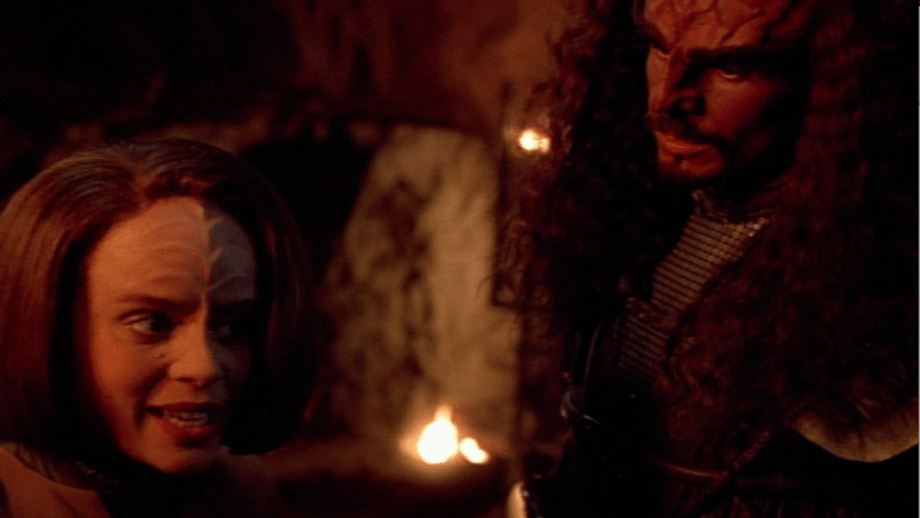
The title and description tell me this is a Klingon episode. Not wild about that; IMO the Klingons become less interesting the more we learn about them. I watched this not too long ago and remember nothing, also a bad sign.
But there’s Vorek; I do like Vulcans. Torres was going to undergo a Klingon ritual for sentimental reasons which is a nice piece of irony. Meanwhile, Seven requests a duty assignment & wants to work in engineering. That’s the set-up. The Caatati are the first thing to seem familiar.
Blood pie is orange hummus. The Day of Honor ceremony starts with communion. Star Trek engineers are essentially warriors but Torres has no good answer to how she’s distinguished herself. When she leaves the holodeck, a character tries to force her to stay; this show has consent issues.
It’s all peculiar but then we get to leave all the Klingon nonsense behind. I have a mixed impression of the Caatani. Mostly they’re too simplistic, but they spur Seven to become more human and their forgiveness foreshadows the crew’s eventual acceptance of her.
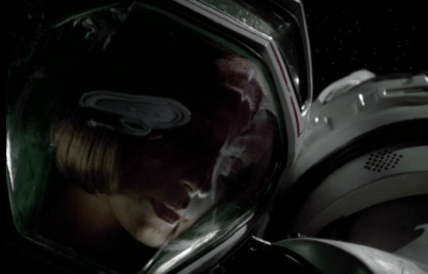
There’s some dumb stuff as well, like using “ion turbulence” to explain an air leak when there was an EXPLODING SHUTTLECRAFT nearby. The “Torres and Paris float in space” story syncs poorly with the Caatani story. My favorite part of the episode is the final visual, where Voyager arrives to save Tom and B’Elanna but is only seen as a reflection in B’Elanna’s helmet.
Mostly forgettable, but it works somewhat as a vehicle to drive development for Seven and to jumpstart the relationship between Belanna and Tom. Overall, not great, not terrible. Mediocre.
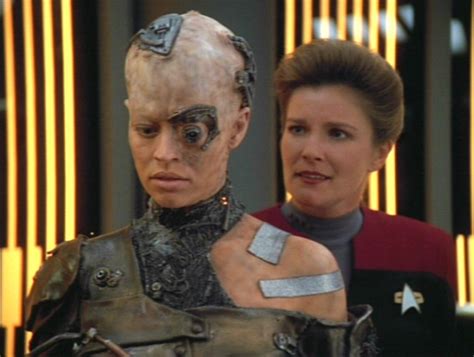
It’s interesting to see Seven adamantly determined to return to the Collective. This might have built some suspense, but everyone knew Jeri Ryan was joining the cast and Jennifer Lien was leaving. If not, the credits give it away.
(Directed by Anson Williams?! Potsie Webber? IMDB says yes.)
This episode has two parallel threads. Kes’ waxing mental powers, and Seven’s waning Borgness. In particular, Kes’ arc couldn’t be explored until she was leaving the show. Too powerful, she’d obviate the rest of the crew. She’d either solve everything or they’d need some contrivance as to why she couldn’t. Instead, we get a contrivance that gets Kes off the ship, thick with mysticism & technobabble, but still somewhat entertaining.
Meanwhile, Seven is made more human against her will and the show explores the grey area between consent and competence. It walks that line fairly well. It’s a powerful scene when Seven starts to process her individuality and starts using singular pronouns.
The visuals are a nice touch as well. We can see Seven becoming more human, not just with the removal of the Borg tech but through subtler things like changes in skin tone. The two threads weave together. As one character becomes more a part of the crew, the other less. As one comes into herself the other loses her identity. One has choices the other has none.
It’s a bookkeeping episode that does what it needs to do, namely manage the cast changes, but it’s better than that. This is a well-thought-out episode that is ultimately pretty satisfying. I’m glad Kes didn’t just disappear to Mandyville.
Happy 4th of July! We’ve made it a tradition to begin flying a historic American flag each July 4th. In 2018, it was the “Betsy Ross” flag. In 2019 we flew the Bennington Flag. Then came the Star-Spangled Banner and the Bunker Hill flag. This year we’re flying the flag that flew over Fort Sumter in 1961.
The Fort Sumter flag is a 33-star variant with the stars in a striking pattern. Twenty-five stars are arranged in a diamond centered in the canton with the remaining 8 placed in the four corners in pairs.
The historical significance of the flag is, of course, obvious. Two flags of this type flew over Fort Sumter during the bombardment marking the Civil War’s first engagement, the Garrison Flag and the smaller storm flag.
Major Robert Anderson was allowed to lower the flags and take them with him when he surrendered the fort on 13 April 1861. The stripes of the garrison flag were in tatters but in an impressive happenstance of symbolism, the canton, representing the union of the then 33 states, remained virtually untouched. The coincidence defies belief but certainly foreshadows the end of the war; that the union would persevere.
The storm flag, in better condition, became a patriotic symbol. Major Anderson brought the flag to a rally in New York City on 20 April. With more than 100,000 people in attendance, it was the largest gathering in the U.S. up until that time.
This flag was brought from city to city after this and used, not just to inspire patriotic fervor but as a fundraising tool. The flag was “auctioned” to raise money for the war with the understanding that the winner would donate the flag back to the country so the process could repeat itself in the next town. The storm flag became a famous and salient patriotic symbol for the Union over the course of the war.
Almost exactly 4 years after the surrender of Fort Sumter, Robert Anderson, now a Major General, raised the flag over the fort once again. Henry Ward Beecher, the main speaker at the event, expressed a hope now embodied in the flag.
…Terrible in battle, may it be beneficent in peace [and] as long as the sun endures, or the stars, may it wave over a nation neither enslaved nor enslaving…. We lift up our banner, and dedicate it to peace, Union, and liberty, now and forevermore.”
Rev. Henry Ward Beecher
Both flags are in the care of the National Park Service and the Storm Flag is on display at the Fort Sumter Museum.
Happy Juneteenth! We’re flying the Juneteenth flag for the second time and I’m happy to report that this year Elmira College has designated the day as an official college holiday.
“Juneteenth,” also known as “America’s second independence day,” is a recognized holiday in all 50 states since South Dakota recognized it this February. It’s an official state holiday in 24 states and the District of Columbia. It commemorates the end of slavery in the US after the Civil War.
The name “Juneteenth” is a contraction of “June nineteenth” or a “portmanteau” if you want to be all fancy about it. It’s been a national holiday since President Biden signed the “Juneteenth National Independence Day Act” into law on 17 June 2021. That was long overdue; we should be celebrating the moments when we actually got closer to the ideals the US is supposed to represent.
Some History
President Lincoln issued the Emancipation Proclamation and it took effect on 1 January 1863. It proclaims that “all persons held as slaves within any State or designated part of a State, the people whereof shall then be in rebellion against the United States, shall be then, thenceforward, and forever free.” This changed the character of the war, transforming it from a conflict that could be perceived as an internecine squabble to a quest to expand basic human rights, Of course, it wasn’t that simple. But it meant that the tide of freedom advanced as the Union gained territory.
The Army of the Trans-Mississippi was the last major Confederate force to surrender. On 19 June 1865, when General Gordon Granger arrived in Galveston, Texas to take command of the Army forces there, one of his first actions was to issue General Order 3, which informed the citizens of Texas that slavery there was ended. It read in part:
“The people of Texas are informed that in accordance with a Proclamation from the Executive of the United States, all slaves are free. This involves an absolute equality of rights and rights of property between former masters and slaves, and the connection heretofore existing between them becomes that between employer and hired laborer.”
Celebrations erupted as Granger’s men traveled forth announcing the order. A few months later, slavery finally ended throughout the US on 18 December 1865 when the 13th Amendment officially became part of the Constitution. One year after General Order 3, the first commemoration took place in Galveston as “Jubilee Day.” That became an annual tradition.
The Flag and its Symbolism
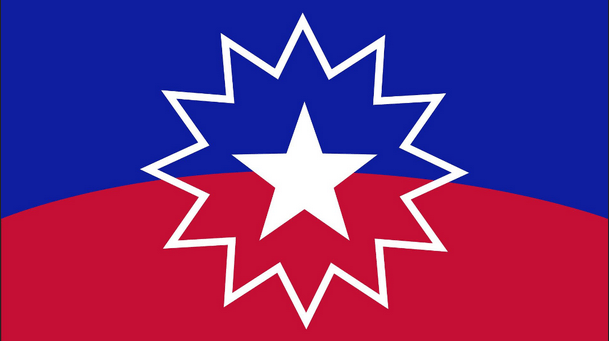
The Juneteenth flag is stunning! it was originally designed by Ben Haith in 1997 and refined by graphic designer Lisa Jeanne Graf. The symbolism of the flag is profound.
The colors are an intentional callback to the American flag emphasizing that the people freed that day and their descendants were, are, and remain Americans.
The central five-pointed star not only represents the freedom of African-Americans in all 50 states but also symbolizes Texas, the Lone Star State, where the celebration originated.
The burst that surrounds the star is a nova, a new star that represents a new freedom, a new people, and a new beginning for African Americans.
Finally, the arc depicts the horizon; a new horizon representing the promise and opportunities that lie ahead.
A quick note: I lost track of this project after a quick 12-hour sentence in Twitter jail when my pending tweets about an episode got erased. It was a terrible episode (worse than this one) and I didn’t have the heart to watch it again. But I think I can face that now. So let’s get back to it.
Seven punches an arms dealer because he deserved it.
Janeway disciplines her without hearing both sides. “You have to learn the difference between having an impulse and acting on it” is particularly troubling a quarter of a century later.
We take a sharp turn into memory suppression, and Seven has an anxiety attack. The Doctor is insufferably smug; he created and implemented a new, untested psychiatric subroutine. Memories are recovered of Arms-Dealer-Guy stunning Seven and removing Borg tech from her implants.
We never really know what happens, but the crew decides that the repressed memories were false on some thin circumstantial evidence. They claim that they were supportive of Seven but weren’t really. They claim to have been impartial in their investigation but weren’t that either.
There’s too much to unpack here. Lots of dubious choices and bad logic. Janeway makes a series of bad decisions and the resolution seems at odds with the tone of the episode and the actions of the characters.
We circle back and blame the Doctor’s subroutine which never should have been used without testing. It bugs me that Seven is remorseful even though it’s not clear she was wrong. What the point here is unless it is to showcase how awful these situations can be in real life? Bleh.
There’s a good Asimov story lurking underneath here as the Doctor causes a lot of harm by being impetuous. It would be interesting to see what would have played out differently had he been governed by the Three Laws of Robotics.
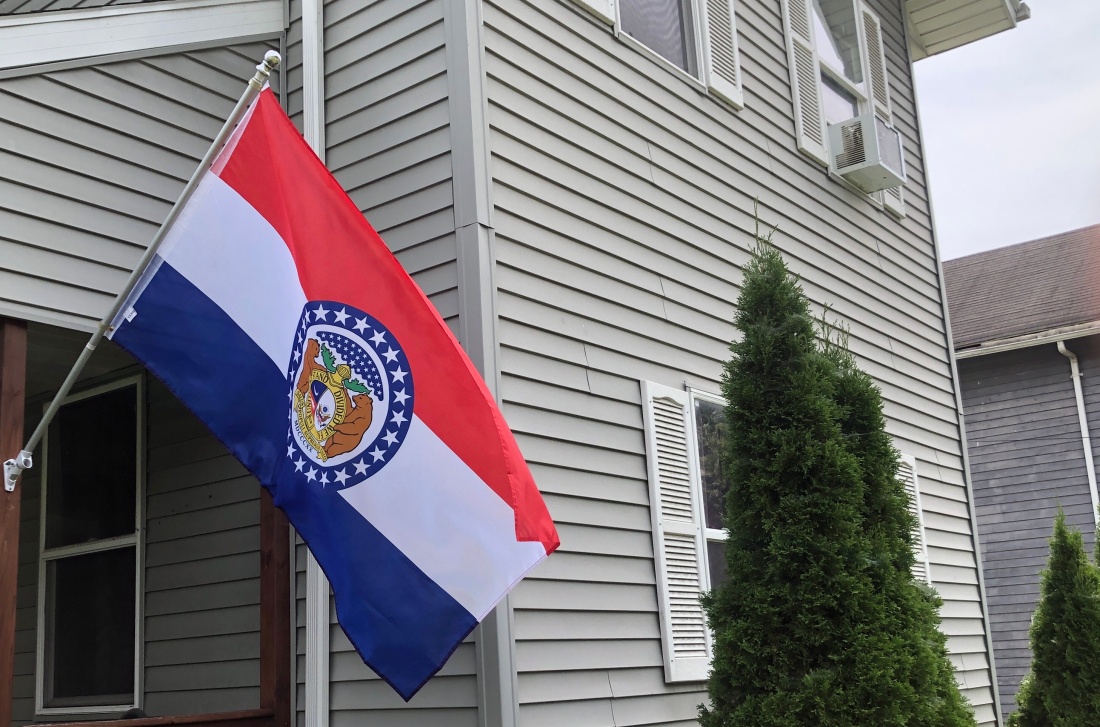
Happy (belated now) Flag Day 2022! We’re flying the Missouri state flag for the occasion.
Columns. They seem like a good idea at the time, but then things get busy and you start to feel self-consciously like Doctor Who (the program). It’s been altogether too long since your last episode and you’re hoping that people are going to lose interest. But you have a season of Sherlock to do, or whatever it is that Chris Chibnall did in between seasons. You get the idea.
Without further ado, here’s our latest installment on State Flags. If you recall our first installment, we’re dividing the US state flags into four categories
Flags that need no changes
Flags that only need very slight changes
Flags that have well-established and aesthetic alternatives and
Flags that require significant changes.
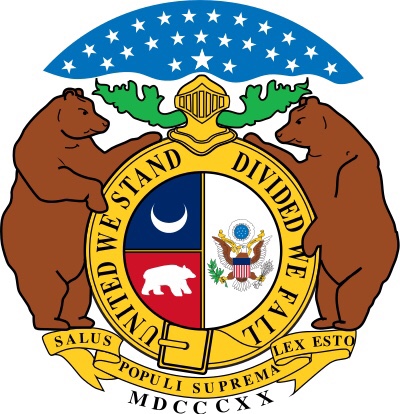
The Great Seal of Missouri
We’ve run through the top category in our first two installments but today we’re jumping ahead to category four because we’re flying the Missouri flag as we did for the Bicentennial of Missouri becoming a state last August when I started this post.
You might recall that Missouri was admitted to the union as part of the Compromise of 1820. It was a very similar situation to today. Today a potential state can’t become a state, even if it makes perfect sense for it to be one because it’s likely to elect Senators and Representatives from the wrong party. It was the same deal in 1819 except we cared about whether a state would support slavery or not. The Compromise of 1820 allowed Missouri and Maine to enter the union together one as a free state, the other as a slave state.
The Union Civil War Banner
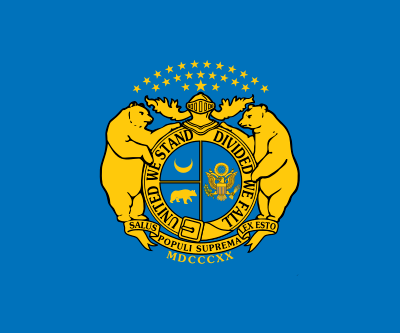
It took nearly a century for Missouri to adopt a state flag although there were many unofficial flags flown by Missouri regiments fighting on both sides of the Civil War. These included flags with the state’s Great Seal in gold on a blue background, which is a quintessential seal on a bedsheet. The confederate version of this flag has the cloud of stars reduced to just a single star to symbolize Missouri as an independent state.
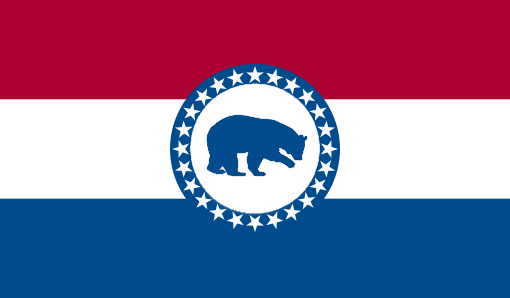
The creation of the official state flag started in 1908 when the Daughters of the American Revolution in Cape Girardeau noticed the need for a state flag. They set up a committee and appointed Marie Elizabeth Oliver its chair. Oliver researched state flags extensively, especially the methods for their design and adoption. She came up with her own design starting with the state coat of arms with the cloud of stars recycled as a blue circle with white stars surrounding the rest of the design. This was then superimposed on a red, white, and blue horizontal tri-color. This design was proposed to the state legislature in 1909 and 1911 before finally being adopted in 1913.
The Flag inherits a lot of symbolism from the Great Seal. The cloud of stars signifies that Missouri was the twenty-fourth state to join the union while two bears on either side of the central shield represent courage and strength. The belt buckle is an interesting element; it’s part of the circle that proclaims “United We Stand Divided We Fall.” That a belt with that motto could be unbuckled seems like a bit of a mixed message. One source I consulted suggests that the buckle combined with the helmet stand for the idea that Missouri is a strong state that must be free to solve its own problems while another explicitly ties the buckle to the possibility of secession. The crescent moon holds out hope for the future.
The additional elements of the flag enhanced the symbolism. As quoted by US Flag Supply:
“…The Oliver flag embraced national pride and at the same time expressed characteristics of Missouri and Missourians. The three large stripes were symbolic of the people of the state was the blue stripe represented vigilance, permanency and justice, the red represented valor, and the white stripe symbolized purity. The Missouri coat-of-arms appeared in the center of the flag, signifying both Missouri’s independence as a state, and its place as a part of the whole United States. Having the coat-of-arms in the center of the national colors represents Missouri, as she had the geographical center of the nation. By mingling the state coat-of-arms with the national colors of red, white and blue, the flag signified the harmony existing between the two. Twenty-four stars surrounded the coat-of-arms, representative of Missouri’s position as the 24th state admitted to the Union.”
Using the tricolored background makes Missouri’s flag more attractive than the typical state flag that just utilizes a seal on a solid background. Still, it’s far from ideal. The seal with its small sections and text is too detailed to be discernible from any distance.
In considering a redesign of the flag, it makes sense to maintain the best elements of the flag while using them in a simplified design and incorporating some more modern symbols. I started with the wavy blue and white lines from the flag of St. Louis to represent the Missouri and Mississippi rivers. The arch, as it does for St. Louis, can represent Missouri’s importance in the exploration and settlement of the American West. As I was writing this I encountered a claim that not only is St. Louis the westernmost eastern city in the US, Kansas City is the easternmost western city in the nation. The colors, the bear, and the crescent can maintain their original meanings.
Full disclosure here: I’ve seen similar proposed flags, lots of which predate this one, on the Facebook group U.S. State Flags – Current, Historical, and Proposed. That group is worth checking out if you’re interested in state flags and/or flag design.
My wife, Joanne was born and raised in Missouri and her favorite element of the state flag is the bears, particularly the two larger ones. Here’s an earlier attempt including one. Unfortunately, I don’t have the skill that I would need to have the bear hug the arch like it does the disk. As an interesting side note, the bears on the Missouri flag are described as Grizzlies even though the only species of bear that is native to Missouri is the American Black Bear. The use of Grizzlies may have been inspired by encounters that Missourians Hugh Glass and Jed Smith had with the creatures. Those harrowing stories can be found here.
Finally, you might think that a less radical redesign is in order, in which case I would suggest something like this, cleaning up the design by replacing the seal with a single element contained within it. Again I’m sure that there are many proposals similar to this one and I’ve seen one with a fleur de lis. There are many potential options for that central element. I’m deferring to the Missouri native in the family; we’re going with the bear.
It’s been a while since I’ve had the time to post; I just finished an especially grueling and busy school year. Thanks for being patient!
But now summer break is upon us and I’ll be back at the keyboard for the foreseeable future. I thought I’d start back with another installment of our “First Comics” column.
You see just as I’ve had a hiatus from writing on the blog, there was a hiatus in my comic collecting as well. In the summer of 1976, comic books reached the egregiously high price of 30¢ and I had to finally do a cost/benefit analysis. At the time a paperback novel cost about 75¢ and that was a few hours of entertainment. Two comics were about a half-hour of enjoyment if you don’t count rereading and I stopped buying comics altogether. Cold-turkey you might say.
Fast-Forward to the early part of 1980. In the local 7-11, I noticed a comic cover that was instantly recognizable. “The New Avengers vs. The Old Avengers” it proclaimed! I remembered the cover because I had seen a house ad for Avengers Special #2 in Silver Surfer (1968) #2. Boy, how I wanted to read that! And here it was (well, the first half anyway) reprinted a decade later in Marvel Super Action #16! The 40¢ sticker price now didn’t bother me a bit; I plunked down some coinage and brought my find home.
And it was great! The story was written by Roy Thomas and drawn by the always-excellent Don Heck and Werner Roth. Don had drawn a lot of the Avengers stories I had read when they were reprinted in Marvel Triple Action; this was what a classic Avengers story was supposed to look like. The eye-catching cover was drawn by John Buscema.
The story is classic time-travel tale #3; something has gone wrong with the timeline and our heroes need to set things straight. Still, it’s a disservice to say only that.
So what happens? The Avengers traveled back in time to make sure Bucky actually had been killed in World War II. At the time, he had been.
This creates the opportunity for the Scarlet Centurion (who had been the Pharaoh Rama Tut and later became Kang the Conquerer back in issue #8) to alter the timeline. He encounters the original Avengers and tells them that Earth is threatened by a Cosmic Imbalance caused by an overabundance of superbeings.
There could be a virtual paradise created, the Centurion claims, if the Avengers eliminate them all and they do so, becoming ruthless dictators in the process. He would help make that happen.
In part 2 of the Special (or Marvel Super Action #17), the then-current Avengers search for Dr. Doom’s Time Machine to set things right. It’s been broken into three pieces and so the team splits up to retrieve them on one of those homages to All-Star comics that Roy Thomas does so well; Hawkeye and the Black Panther defeat Iron Man and the Hulk, Captain America manages to take down Thor and Goliath and the Wasp get the better of Giant-Man and the other Wasp. After assembling the time machine, the Avengers defeat the Centurion and (with a quick cameo by the Watcher to explain what’s going on) return the timeline to its normal shape. Everyone involved in the time travel hijinks moves forward with their lives with no memory of what has evidently been dubbed Earth-689 retroactively.
But boy, that was FUN! It made me remember my love of comics! And it might have ended there. I now had a collection of four (count ’em! 4!) comics, Super Action #s 16 and 17 and Amazing Spider-Man #s 185 (because graduating from college is a big deal) and 188 (no idea why probably because the cover was cool). There might be another universe out there where I still own only those four comics. Not in this universe though.
In this universe, I took a trip to the Palm Coast Plaza and visited the Two-On-A-Shelf Bookstore, a used bookshop I visited often. On this particular visit, I found a few brown paper bags filled with comics for 25¢ each.
One was filled with issues of Marvel Tales, from about issue 74 to 105 reprinting issues of Amazing Spider-Man from the 90s through the 120s. What a find, starting with Stan Lee’s final few issues but extending into the Gerry Conway/Ross Andru run! I knew these stories. I loved these stories. In fact, from my first go-round as a collector, I cannot remember a run of stories that I loved more. And now I had the chance to read them all back to back to back. And they held up; every bit as good as I remembered! If you wanted to remind me of how much I loved comics, this was the way to do it and random chance dropped it in my lap.
But what was in the other brown paper sacks? When I returned to Two-On-A-Shelf I found one other bag that interested me.
It contained the first 35 or so issues of Peter Parker, The Spectacular Spider-Man. These were a lot of fun too! The first three issues were again written by Gerry Conway and Sal Buscema was on the title as penciler for quite a bit longer. “Our Pal Sal” as he was called has become one of my favorite artists over the years. This run introduced me to some things I’d missed over the past few years: White Tiger, Moon Knight, and a team called the Champions to name just a few.
And so I started doing something new. Looking for issues of these titles at the 7-11 and the local newsstands. With fewer than 100 comics to my name, I’d become a collector again, more so in fact than I had ever been. Forty-two years and nearly 20,000 comics later I’m still collecting albeit a bit more slowly than I had been. And I’m still enjoying the books. I still have to wonder about that alternate universe. How different my life might be without those chance encounters with that eye-catching Avengers cover and that paper bag full of Marvel Tales. At the very least there would be a free room in our house and I probably would have never gotten to teach a class on comic books. Probably a lot more different than that though. And though I wonder, I wouldn’t want to make the trade.




















 Comics, the Universe, and Everything

