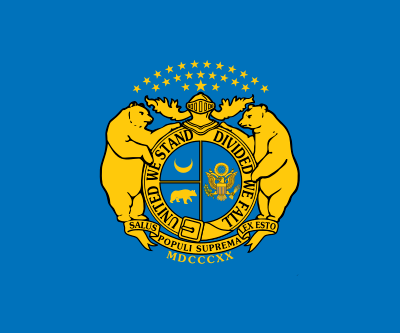
Happy (belated now) Flag Day 2022! We’re flying the Missouri state flag for the occasion.
Columns. They seem like a good idea at the time, but then things get busy and you start to feel self-consciously like Doctor Who (the program). It’s been altogether too long since your last episode and you’re hoping that people are going to lose interest. But you have a season of Sherlock to do, or whatever it is that Chris Chibnall did in between seasons. You get the idea.
Without further ado, here’s our latest installment on State Flags. If you recall our first installment, we’re dividing the US state flags into four categories
Flags that need no changes
Flags that only need very slight changes
Flags that have well-established and aesthetic alternatives and
Flags that require significant changes.
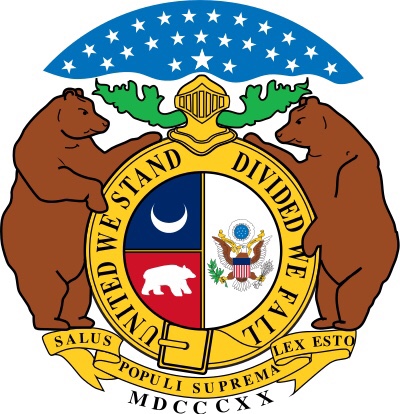
The Great Seal of Missouri
We’ve run through the top category in our first two installments but today we’re jumping ahead to category four because we’re flying the Missouri flag as we did for the Bicentennial of Missouri becoming a state last August when I started this post.
You might recall that Missouri was admitted to the union as part of the Compromise of 1820. It was a very similar situation to today. Today a potential state can’t become a state, even if it makes perfect sense for it to be one because it’s likely to elect Senators and Representatives from the wrong party. It was the same deal in 1819 except we cared about whether a state would support slavery or not. The Compromise of 1820 allowed Missouri and Maine to enter the union together one as a free state, the other as a slave state.
The Union Civil War Banner
It took nearly a century for Missouri to adopt a state flag although there were many unofficial flags flown by Missouri regiments fighting on both sides of the Civil War. These included flags with the state’s Great Seal in gold on a blue background, which is a quintessential seal on a bedsheet. The confederate version of this flag has the cloud of stars reduced to just a single star to symbolize Missouri as an independent state.
The creation of the official state flag started in 1908 when the Daughters of the American Revolution in Cape Girardeau noticed the need for a state flag. They set up a committee and appointed Marie Elizabeth Oliver its chair. Oliver researched state flags extensively, especially the methods for their design and adoption. She came up with her own design starting with the state coat of arms with the cloud of stars recycled as a blue circle with white stars surrounding the rest of the design. This was then superimposed on a red, white, and blue horizontal tri-color. This design was proposed to the state legislature in 1909 and 1911 before finally being adopted in 1913.
The Flag inherits a lot of symbolism from the Great Seal. The cloud of stars signifies that Missouri was the twenty-fourth state to join the union while two bears on either side of the central shield represent courage and strength. The belt buckle is an interesting element; it’s part of the circle that proclaims “United We Stand Divided We Fall.” That a belt with that motto could be unbuckled seems like a bit of a mixed message. One source I consulted suggests that the buckle combined with the helmet stand for the idea that Missouri is a strong state that must be free to solve its own problems while another explicitly ties the buckle to the possibility of secession. The crescent moon holds out hope for the future.
The additional elements of the flag enhanced the symbolism. As quoted by US Flag Supply:
“…The Oliver flag embraced national pride and at the same time expressed characteristics of Missouri and Missourians. The three large stripes were symbolic of the people of the state was the blue stripe represented vigilance, permanency and justice, the red represented valor, and the white stripe symbolized purity. The Missouri coat-of-arms appeared in the center of the flag, signifying both Missouri’s independence as a state, and its place as a part of the whole United States. Having the coat-of-arms in the center of the national colors represents Missouri, as she had the geographical center of the nation. By mingling the state coat-of-arms with the national colors of red, white and blue, the flag signified the harmony existing between the two. Twenty-four stars surrounded the coat-of-arms, representative of Missouri’s position as the 24th state admitted to the Union.”
Using the tricolored background makes Missouri’s flag more attractive than the typical state flag that just utilizes a seal on a solid background. Still, it’s far from ideal. The seal with its small sections and text is too detailed to be discernible from any distance.
In considering a redesign of the flag, it makes sense to maintain the best elements of the flag while using them in a simplified design and incorporating some more modern symbols. I started with the wavy blue and white lines from the flag of St. Louis to represent the Missouri and Mississippi rivers. The arch, as it does for St. Louis, can represent Missouri’s importance in the exploration and settlement of the American West. As I was writing this I encountered a claim that not only is St. Louis the westernmost eastern city in the US, Kansas City is the easternmost western city in the nation. The colors, the bear, and the crescent can maintain their original meanings.
Full disclosure here: I’ve seen similar proposed flags, lots of which predate this one, on the Facebook group U.S. State Flags – Current, Historical, and Proposed. That group is worth checking out if you’re interested in state flags and/or flag design.
My wife, Joanne was born and raised in Missouri and her favorite element of the state flag is the bears, particularly the two larger ones. Here’s an earlier attempt including one. Unfortunately, I don’t have the skill that I would need to have the bear hug the arch like it does the disk. As an interesting side note, the bears on the Missouri flag are described as Grizzlies even though the only species of bear that is native to Missouri is the American Black Bear. The use of Grizzlies may have been inspired by encounters that Missourians Hugh Glass and Jed Smith had with the creatures. Those harrowing stories can be found here.
Finally, you might think that a less radical redesign is in order, in which case I would suggest something like this, cleaning up the design by replacing the seal with a single element contained within it. Again I’m sure that there are many proposals similar to this one and I’ve seen one with a fleur de lis. There are many potential options for that central element. I’m deferring to the Missouri native in the family; we’re going with the bear.
It’s been a while since I’ve had the time to post; I just finished an especially grueling and busy school year. Thanks for being patient!
But now summer break is upon us and I’ll be back at the keyboard for the foreseeable future. I thought I’d start back with another installment of our “First Comics” column.
You see just as I’ve had a hiatus from writing on the blog, there was a hiatus in my comic collecting as well. In the summer of 1976, comic books reached the egregiously high price of 30¢ and I had to finally do a cost/benefit analysis. At the time a paperback novel cost about 75¢ and that was a few hours of entertainment. Two comics were about a half-hour of enjoyment if you don’t count rereading and I stopped buying comics altogether. Cold-turkey you might say.
Fast-Forward to the early part of 1980. In the local 7-11, I noticed a comic cover that was instantly recognizable. “The New Avengers vs. The Old Avengers” it proclaimed! I remembered the cover because I had seen a house ad for Avengers Special #2 in Silver Surfer (1968) #2. Boy, how I wanted to read that! And here it was (well, the first half anyway) reprinted a decade later in Marvel Super Action #16! The 40¢ sticker price now didn’t bother me a bit; I plunked down some coinage and brought my find home.
And it was great! The story was written by Roy Thomas and drawn by the always-excellent Don Heck and Werner Roth. Don had drawn a lot of the Avengers stories I had read when they were reprinted in Marvel Triple Action; this was what a classic Avengers story was supposed to look like. The eye-catching cover was drawn by John Buscema.
The story is classic time-travel tale #3; something has gone wrong with the timeline and our heroes need to set things straight. Still, it’s a disservice to say only that.
So what happens? The Avengers traveled back in time to make sure Bucky actually had been killed in World War II. At the time, he had been.
This creates the opportunity for the Scarlet Centurion (who had been the Pharaoh Rama Tut and later became Kang the Conquerer back in issue #8) to alter the timeline. He encounters the original Avengers and tells them that Earth is threatened by a Cosmic Imbalance caused by an overabundance of superbeings.
There could be a virtual paradise created, the Centurion claims, if the Avengers eliminate them all and they do so, becoming ruthless dictators in the process. He would help make that happen.
In part 2 of the Special (or Marvel Super Action #17), the then-current Avengers search for Dr. Doom’s Time Machine to set things right. It’s been broken into three pieces and so the team splits up to retrieve them on one of those homages to All-Star comics that Roy Thomas does so well; Hawkeye and the Black Panther defeat Iron Man and the Hulk, Captain America manages to take down Thor and Goliath and the Wasp get the better of Giant-Man and the other Wasp. After assembling the time machine, the Avengers defeat the Centurion and (with a quick cameo by the Watcher to explain what’s going on) return the timeline to its normal shape. Everyone involved in the time travel hijinks moves forward with their lives with no memory of what has evidently been dubbed Earth-689 retroactively.
But boy, that was FUN! It made me remember my love of comics! And it might have ended there. I now had a collection of four (count ’em! 4!) comics, Super Action #s 16 and 17 and Amazing Spider-Man #s 185 (because graduating from college is a big deal) and 188 (no idea why probably because the cover was cool). There might be another universe out there where I still own only those four comics. Not in this universe though.
In this universe, I took a trip to the Palm Coast Plaza and visited the Two-On-A-Shelf Bookstore, a used bookshop I visited often. On this particular visit, I found a few brown paper bags filled with comics for 25¢ each.
One was filled with issues of Marvel Tales, from about issue 74 to 105 reprinting issues of Amazing Spider-Man from the 90s through the 120s. What a find, starting with Stan Lee’s final few issues but extending into the Gerry Conway/Ross Andru run! I knew these stories. I loved these stories. In fact, from my first go-round as a collector, I cannot remember a run of stories that I loved more. And now I had the chance to read them all back to back to back. And they held up; every bit as good as I remembered! If you wanted to remind me of how much I loved comics, this was the way to do it and random chance dropped it in my lap.
But what was in the other brown paper sacks? When I returned to Two-On-A-Shelf I found one other bag that interested me.
It contained the first 35 or so issues of Peter Parker, The Spectacular Spider-Man. These were a lot of fun too! The first three issues were again written by Gerry Conway and Sal Buscema was on the title as penciler for quite a bit longer. “Our Pal Sal” as he was called has become one of my favorite artists over the years. This run introduced me to some things I’d missed over the past few years: White Tiger, Moon Knight, and a team called the Champions to name just a few.
And so I started doing something new. Looking for issues of these titles at the 7-11 and the local newsstands. With fewer than 100 comics to my name, I’d become a collector again, more so in fact than I had ever been. Forty-two years and nearly 20,000 comics later I’m still collecting albeit a bit more slowly than I had been. And I’m still enjoying the books. I still have to wonder about that alternate universe. How different my life might be without those chance encounters with that eye-catching Avengers cover and that paper bag full of Marvel Tales. At the very least there would be a free room in our house and I probably would have never gotten to teach a class on comic books. Probably a lot more different than that though. And though I wonder, I wouldn’t want to make the trade.
Getting caught up on these, still: Spoiler Alert! You know what to do!
That’s a crazy opening! C14 tries to commit suicide. I guess it didn’t take long for the mental health of the Cleon’s to become an issue. Maybe they should have let C11 live a bit longer and tried again.
Personal Shields Can Come in Handy.
He doesn’t die, but the young lady gardening runs away from him.
Funeral. For whom? “Faith is a sword forged in the fires of the infinite.” These ladies remind me of the Sisterhood of Karn from Doctor Who.
This is an odd sequence. It looks like some things are launched from the funeral which impact on a gas giant, making it all wibbley wobbly. The funeral must be taking place on one of the moons. Shift to Demerzel watching remotely.
Sexy time for C13. The Cs have a Kinetic field. Maybe Junior didn’t try to commit suicide after all. But he sure scared the crap out of that girl.
Demerzel interrupts sexy time. Brother Day is needed.
“Proxima Opal has passed.” That must be who the funeral was for. There is debate about her successor in the Conclave. It’s basically the political version of technobabble but the Cs aren’t happy about a possible candidate. Something about “Primary Octavo.” Unsurprisingly there’s a religious dimension to the Cs claim to rule.
“Luminism” must be a religion. Primary Octavo states that only individual beings have souls, excluding the Cs. No souls for you! Why not counter with the Cleons having a single soul? That makes the dynastic succession that much stronger. None the less it threatens their rule.
Back to Salvor and the Anacreonians.
The Anacreonians claim they want a navigation module. Salvor finally shows some indication of being smart. But “If you were going to kill me, you’d have done it already” reminds me of a bunch of things, not the least of which is Clara in “Deep Breath” (Doctor Who), which was a lot better.
Salvor and Phara go through the gate. “If she isn’t back within a watch, we’ll raze your city to the ground,” which wouldn’t take that much.
The Anacreonians are acting like terrorists.
Salvor sees the boy, but Phara does not.
Using the Vault to incapacitate Phara was smart.
“The stories about Salvor Hardin? They usually begin here. The warden and the ghost.”
We get a Direct refutation of old Hardin. Abbas says “Violence is the last refuge of the incompetent.” Salvor calls it “an old man’s doctrine.”
Questions about the plan.
Abbas: “If you were better at math, you’d know that repeated luck was more than just luck, Salvor.” Maybe. Except that random events can cluster in a way that seems non-random to our brains.
Back to Trantor. We meet Shadowmaster Olbrecht. C14 wants the name of the girl in the garden. Was he trying to manufacture a meet-cute with a faux suicide attempt?
Salvor is channeling Rosencrantz and Guildenstern are dead with the coins. Does she have some kind of mental powers?
Neutron bombs. 50% of the population on Anacreon died off within a week, 20-30% in the remaining year. But the use of neutron bombs changes a lot of assumptions; most of the infrastructure should be intact.
Salvor seems to intuit things about Phara. She wants to die. She wants everyone to die. Larken Keaen was the greatest hunter of Anacreon, so Phara must be the Grand Huntress of Anacreon.
Hologram Hari? Finally! But no, not that one.
The Outer Kingdoms are starting to fray away from the Empire. “Seldon all but gave you a to-do list and you ignored him!”
It’s even clearer that the “middle throne” is the actual emperor. I can’t believe these guys are a Kiwanis Club. President-Elect, President, and Immediate Past President.
Arguments about the plan. “I may be an outlier, Lewis, but I’m not the one screwing up the plan!” Lol, even though I’m feeling a bit sorry for Lewis.
Kubbra Sait is excellent. Real gravitas. “A weapon is only as good as the man who’s wielding it.” The music is briefly reminiscent of a motif in Doctor Who.
Trantor again. Gardener girl is Akuta Something? C14 is being a dick to her even as she’s being kind.
“If you’re not dead within the hour, have a kilogram of these sent to my quarters.”
Salvor has a vision of Seldon’s library. There’s THAT kid with THE knife. We’ve been seeing images of Raych.
Then they tell us what they’ve already shown in case we didn’t understand it.
Churchill from Doctor Who is a statistician. Thousands working. No results after 30 years? Claims the predictive models of Seldon are “counter factual.” Brother Day is having none of it. Lee Pace is fantastic here as he yells a statistician to death. Probably.
The philosophical divide seems to be couched as “Free will” vs. “predestination” rather than “Great Man” vs. “Bottom Up.” Although maybe that’s the same thing.
C13 gives 12 a rash of crap for his actions in episode 1. An almost complete repudiation. The discomfort Brother Dawn felt with the executions comes home to roost. “I will save our legacy.” Demerzel reinforces C13. “Certainly now the empire will no longer be rent by impulsive action.” He probably doesn’t get the sarcasm.
We see Dorwin. He’s sent to investigate the communications buoy and told to pay a visit to the Foundation. “The Empire will not be kept in the Dark.” Wowd Dowwin doesn’t sownd wight thow.
Meanwhile C14 is spying on Akuta using a drone that looks like a dragonfly. Creepy, but she doesn’t seem to mind.
Phara makes an argument that they really want the navigation module. To relocate from Anacreon. “You can’t negotiate with someone who’s willing to set the board on fire.”
Salvor thinks there’s a bigger picture that she’s missing. Reassessing is a sign of smart. She puts it together that the Vault is connected to Hari.
The Anacreonians are preparing to raze the city such as it is. Like a strong wind couldn’t do that.
“And the beginning of the end, as befitting its name, took place on Terminus.”
And in a Marvelesque precredits scene, a ship approaches Gaal Dornik’s escape pod.
You know how this works. Random thoughts about Episode 3, no post podcast revelations this time.
Cleon 1 with Demerzel 400 years previous. He’s dying and wistful, annoyed that although they’ve started the clone dynasty his ego will not persist. Your continuity is assured Dermerzel tells him. It looks like she gets to hold things together while Cleon 2 grows up.
19 years after the StarBridge bombing. The timing is interesting given that we’re just off the 20th anniversary of 9/11. Are we now looking at an analog of contemporary politics?
Sounds like it is Dusk’s final Day, foreshadowed by Cleon I’s flashback.
“The world is starting to see me at a distance” is a nice turn of phrase.
What is “ascension” exactly?
We parallel the passing of the torch metaphor with the tailor somewhat obviously.
Dusk is still questioning what happened with Anacreon and Thespis and pondering if he has anything left to say. “About anything. About whether any of this is truly within our power to control” juxtaposed against an image of Dusk casually swiping through holograms of planets.
They’re still thinking about Seldon though. Dusk is interested in preserving the “last remnants” of C1’s dream. Boy. This is maudlin.
Dusk is C11, “the Painter” on the pedestal where his bust will go.
The final gift is a visit to the remnant of the StarBridge. The three wax nostalgic about C1 and Dawn claims “we will build something greater in his honor. For you.”
Demerzel looks stricken and weepy. They destroy the final remnant of the StarBridge as they leave. Dusk nods his assent but it’s thematically opposed to what he wants. All that debris entering the atmosphere is going to look spectacular though.
It’s not clear; is that glowing thing a permanent memorial?
Jump Ball?
Dusk visits the gestation chamber, “Even if Seldon wasn’t right there is something unnatural in that.” Then he paints a final piece of the mural. Is it Dawn and Day raising a newly ascendent Trantor?
Demerzel: “You are enough. It’s just that you always leave me.”
“You have grown into our greatness, Brother Dawn, now Day.” “Brother Darkness.” Holy crap. He senses something is wrong with the baby as Demerzel pushes him toward the light.
If it wasn’t obvious already, “ascension” is a euphemism for a ritualistic suicide.
This half of the episode is filled with imagery of Demerzel as a driving force, including carrying 11 to his final rest and transferring his ashes to the baby.
17 years later, Day has the Mural erased. Demerzel looks on but can’t stop it. There’s a real thread here about repudiating the past.
“We ignore the dead at our peril.”
Cut to the colonists arriving on Terminus. The Vault is already there. Young Salvor spends a lot of time staring at it. Evidently, they don’t have Apple TV+ on Terminus. They barely have walls. Lots of hints that Salvor is wise. “She’s aware.” Show, don’t tell.
There’s got to be a better way to test the field around the Vault than to torture a bird.
Warden again. Versus mayor? I don’t like it.
Something is up with the field. And we see Granite Hari foreshadowing Hologram Hari.
The Encyclopedists’ conversations are odd. There’s little point in writing about base 10 and not base 12 and there’s little point in writing about the sundial as opposed to the water clock. I assume that they’re planning for the fall of civilization rather than writing the encyclopedia at this point, but isn’t the point of the encyclopedia to WikiHow all this stuff so everybody after the fall has that information?
See? Smug.
And why does Louis Pirenne look so damn smug here?
Also, this whole thing is dumb. Where will the survivors be? Freaking everywhere! What if the survivors are on a planet with no water? What if the planet circles more than one sun? That way lies madness. If the survivors are thrown back into complete barbarism they’re not going to have libraries anyway! And probably they’ll just be thrown back to the point where they think digital watches are a pretty neat idea.
And you CAN preserve every innovation because you’re writing a damn book! You have hundreds of years!
The field is expanding. Now with nose bleeds!
But Salvor is special in case you missed episode 1.
Hugo is supposed to be pretty likable, and either gives beer to children or tricks them into unloading his ship.
A sky full of spilled coins is a lovely image. But they’re using a telescope to look into space during the day. Tell me how that works or I’m going to assume that you screwed up the lighting.
There’s a kid and he’s running with a knife. That can’t be good. Teach your children not to run with scissors before you worry about water clocks.
Also, that looks like the knife that Rayce used to “kill” Hari. Significant? Maybe?
Hologram Hari appears in the Vault, No, not that one.
Anacreonian ships are appearing. And that thing seems more or less like an ordinary telescope. How does it work?
“Grow up Lewis!” Lol. Like in the books, he has more faith in the Empire than is warranted.
Jon’s observation: Salvor wants to know how much violence the colony can muster. In the book, Salvor is famous for “Violence is the last refuge of the incompetent.”
Jacunta pulls out the prime radiant and shows it to Salvor. Like maybe she can understand it with absolutely no training. MATH ISN’T MAGIC! And having an individual as part of the plan undermines the idea of psychohistory or convinces me that this character they want to present as smart isn’t.
For a person who’s supposed to be famously quotable, “Different is not the same as special” is a bit of a sophomore slump.
“The Empire feared Hari because he could forecast the future. But in reality, all he was doing was examining the past.” No.
There’s that kid with the knife again. How is he connected to Maybel?
Also, “Vulcan” is better than “Vulcanian” but I prefer “Anacreonian” to “Anacreon.”
“The ghosts of the dead… surround us. And they are hungry for what’s ours.”
If you followed my “Watching Loki” posts, you know what this is. Comments, thoughts and predictions as I watch the episode or maybe as I watch it again. Stuff I think is interesting. Not a review or even an essay, although I’ll give my immediate impression at the end. I’m doing these this time as I’m preparing for the Stars End Podcast but they won’t appear here until a couple of days after the newest episode is dropped. So, without further ado, here are the first two episodes.
S1E1 The Emperor’s Peace
Visually stunning. The opening reminded Joanne of the time travel scenes in ST4 but with much better graphics.
Partway through the figures, look as if they are made of sand and are eroding. That’s a nice visual indication of what is to come.
Wow, this looks good. But Star’s End isn’t at the edge of the Galaxy. Also, it doesn’t have an apostrophe.
Now, this looks like Star Wars with the land speeder.
There’s a creature called a Bishop’s Claw. As the kids approach “the Vault” I realize this is Terminus and we’re in for some non-linear storytelling.
Hmmm. “Kier.” “Gia.” “Poly.”
So, we meet Salvor Hardin before any other main character. Poly calls her “Warden.” I don’t know what that means. But the vibe here is strangely religious for Terminus and the Vault is altogether too mystical.
That is one impressive library.
“We have to remember the past and the ones who caused it all… A mathematician. A martyr. A murderer. And the most important player of all, Hari Seldon.”
There’s a sweet moment between Hari and Raych. Odd maybe, given what’s coming.
86,960,947 is prime.
86,960,957 is prime.
86,960,971 is prime.
86,960,987 is prime.
Gaal has to leave Synnax. “On Trantor, I’ll be safe.” More religion.
On the jump ship. Gaal meets Jerril who seems helpful. He mentions prayer stones.
There are odd scarred humans(?) attending to the passengers.
We see Gaal’s obvious genius when she talks about the grab generators. “I won a math contest.”
Interesting visual for preparing for the jump and the jump itself. Gaal wakes up in the middle. That’s not supposed to happen according to Jerril. Only spacers can endure that without being driven insane.
The space elevator is impressive and nicely takes the place of Gaal’s trip to the tower and hanging to see Trantor from Space. But here she seems more of a refugee than a tourist.
The projection of Brother Day has the same sand-like texture from the opening. That links the Empire to the erosion we saw earlier.
Caskets. From a “kerfuffle” between Anacreon and Thespis.
14 hours to descend and Gaal sees Trantor from space. Exposition 20:38.
We see the mural and Brother Day who is called Empire. That’s a nice device personifying the Empire so directly. Asimov did that especially well in the Mule story with both the Empire and Foundation.
And we see the empire as evil assholes quite dramatically. They’re paranoid of “Raven” Seldon and are harsh sensors. No ambiguity here. No shades of gray.
Brother Dawn learns a hunting song but it’s actually about “a boy’s first time with a woman.”
Day is again shown to execute people for tiny transgressions.
We see Demerzel. Nice visual Day, Dawn, and Dusk taking a bite in unison.
Gaal wants to see the Seer church on Trantor.
86,963,537 is prime.
86,963,549 is prime.
86,963,563 is prime.
86,963,567 is prime.
86,963,573 is prime.
It’s not praying. When Gaal’s nervous she “counts primes.”
Gaal meets Hari. The mathematics starts to bother me here. “Kalle’s Ninth Proof of folding.” Gaal solved Abraxas evidently how she won her “math contest.” That has religious overtones (see below). And no one thought to use the ninth proof in five hundred years.
Kalle writes poetically so “serious scholars don’t read her.” But “reading between the lines” she’s talking about “rings of integers in non-Archimedean local fields.” I think that kind of hangs together based on a quick Google search but it’s far from something that normal folks could glean by “reading between the lines.”
There are shades here of Hardy and Ramanujan. The show has given us two unspeakably brilliant mathematicians and it’s important that one of them is a young lady of color. And they certainly sound like mathematicians here… “there’s a non-zero chance… but it’s not a number worth discussing.”
We get a quick definition of Psychohistory true to the books. Might be word for word. But we lose the sense that mathematics is hard work.
The prime radiant is cool, but it reinforces the “math is magic” theme.
“You know math is never just numbers. In the wrong hands, it’s a weapon in the right hands, deliverance.” “Stealing is a mercy.”
The Ancreonians give Day a weapon while the Thepians give a book of ablution honoring the peace. Exposition on the disagreement.
Subtle messages in the gifts. 36:47. Day and Dusk are training Brother Dawn.
Gaal goes to the Seer church. “The heretic and I will talk.” The religion on Synnax is extreme and all-consuming. The floor is covered with water.
Gaal in water. A dream or a memory of the removal of her prayer stones. Also is it foreshadowing of the end of episode 2? The water is clearly a symbol of the Synnax religion. Gaal’s face turns out of the water as she has the prayer stones removed.
Those hoods they put on prisoners are brutal.
Courtroom scene. And Sig!
It “can only be proved to another mathematician conversant in ordinal analysis.”
Damn Harris is great! And intense!
This loses a lot of the mathematics from the book. And Seldon “thanks the gods.”
Jerril tries to bribe Gaal and gives her the Prime Radiant. The Empire threatens to kill her. There’s water surrounding them as he tempts her to disavow the mathematics.
Spectacular shot.
She was awake on the jump ship. She’s special.
The prime radiant again reinforces the idea that mathematics is magic.
Back to the trial. Encyclopedia Galactica. Saving our story.
It’s a nice moment when Gaal gets to speak truth to power.
It bothers me that one of the terrorists looks middle eastern. The other one doesn’t but still.
The orbital tower is falling snapped off the top. On earth, the geosynchronous orbit is 22,300 miles. Stretched out that’s most of the way around the planet. (C = 24,900 miles).
Nice attention to detail; the fake sky is pixelated as the tower smashes through it.
I really think they understated the amount of damage this devastation would cause. Compare it to the size of the asteroid that killed the dinosaurs. This should be an extinction-level event.
“The tether wrapped around the planet like a Garrote.” Yup.
86,963,777 is prime.
86,963,791 is prime.
100 million deaths. Has Raych lost faith?
Lee Pace has a surprising amount of gravitas. More than as Ronan which was overdone. It’s a lot subtler here. I would not have expected this watching Please Don’t Eat The Daisies.
Gaal bluffs Day. If you kill him the fall accelerates.
Seldon: “I see the value in difference, in the new.”
There’s something called a slow ship. A fundamental difference from the world in the stories.
“You lied.” “I hypothesized.” that’s pure Wrath of Khan stuff right there.
The seas on Synnax were rising. So Gaal Dorrnik here is a cross between Greta Thunberg and Srinivasa Ramanujan; a mathematical prodigy who wants to save her planet from destruction. The water doesn’t merely represent her home planet’s religion; there’s a lot of levels here. On Synnax the rising water signals , one presumes, the growing threat of global warming AND the rampant anti-intellectualism that’s hastening the crisis.
Episode:
⭐⭐⭐⭐⭐
Rating: 4.5 out of 5.
S1E02: “Preparing to Live”
On a dwarf planet: a brutal take down of a biohacking facility. And some torture to extract information.
Day (wanting to blame the Foundation): “Say they did it every hour on the hour until it becomes the air that we breathe.” These guys are the Bush administration.
800 odd days? Or 54 months?
Gail and Raych are like crazed weasels.
Then we have the Kobayashi Maru in a simulated cave. We get to see a bishop’s claw looks like first hand.
There were robot wars.
These assholes really are the Bush administration. More brutality. There is circumstantial evidence against the Anacreonian and Thepians. But that about it.
Brother Dusk is declining.
Gaal deposits an embryo, then talks to an engineer who refuses.
Dusk visits the Synnax priest. Wants to know if Gaal is a seer who can predict the future. Demerzel is injured on the way out. So not slow playing the Robot thing.
“The most advanced Math is like a sixth sense.” No, not necessarily.
Seldon seems to be using Tony Stark’s computer system.
Lots of aphorisms “Shame grows in darkness.”
Seldon never thought he’d be on the ship and he’s uncomfortable with the growing familiarity amongst the colonists.
Gaal says the mathematics is not complete. Rayce is upset.
Encyclopedia Meeting. Gaal is asking questions. This base 10 thing is a bunch of nonsense. It’s not the same thing as a different language. I get the point that they’re trying to make but damn it, that’s different. The writers must have scanned “The Crest of the Peacock” and didn’t understand it.
They’re shoehorning in as much math as they can. They either need to get a better consultant or to listen to the good consultant they already have.
Demerzel repairs herself. We see she’s a robot.
Demerzel: “The rest of my kind didn’t die. They were destroyed by your kind.”
Dusk criticizes Cleon I (who has been stuffed) for arrogance. Not sure what the point of Taxidermy Cleon is, it’s odd.
“The Empire going to kill you,” says Dusk to the Anacreonian and Thepian ambassadors. But there’s plenty of reason to think Seldon is behind the Terrorist Attack
The Laundry. Yawn. Hari gets to make a speech.
“A theorem so abstract it might as well have been a prayer.” Damn it. Mathematics isn’t magic.
This handshaking thing is kind of trite.
Raych is out of sorts. Hari is trying to be gregarious and showing Raych to be a thief angers him.
Raych cries talking to Gaal in the holodeck.
Who’s really behind the star bridge? They don’t know. “The best face we can project outward now is one of strength.”
More brutality. Really over the top and disturbing and directed at people who aren’t responsible. These guys really are the Bush Administration.
Still, the little kid shows some humanity. Unfortunately, Demerzel tells him he’ll grow out of it.
A composite number means what? Raych “kills” Hari and takes something from behind Hari’s ear. Gaal is left in space counting primes (in water yet again) and the episode ends? What the hell?
———-
Some thoughts from after we recorded the podcast. I think most people felt confused after this episode. In retrospect, I’m liking this episode more because it’s been so much fun to ponder what was going on in a Total Recall kind of way.
So, here’s a narrative that I think makes sense.
The key moment is when Gaal realizes that the math is incomplete. But here’s the thing: the math didn’t “have holes in it” because Hari didn’t finish. It was incomplete because he and Gaal are in the colony. We know from the books that predictions about the Foundation won’t work correctly if there are Psychohistorians on Terminus. They have to go.
So Hari realizes that he has to be murdered (or fake his death… something). He makes plans with Raych to do it. Then his personality shift, the wandering around the ship, reminiscing about his “son,” missing his favorite shirt, and awkwardly saying goodbye to people including the laundry workers all make sense as the actions of a condemned man or a man who’s planning suicide.
Raych’s behavior now makes sense too. Gaal gets the wet pneumatic tube treatment but she’ll still be gone. It explains his weepiness on the Holodeck during the sunset; he knows they’re not going to have those kids together. This also explains why Raych is suddenly so peevish with Hari.
The psychohistorians are now gone and the Foundation can develop as intended. This may not be right but it holds together, explains all the stuff that feels weird, and is consistent with the books. Where do we see Gaal again? I bet she’ll be central to founding the Second Foundation. Maybe Hari too. Eventually we’ll learn that this was the ultimate plan all along.
⭐⭐⭐⭐
Rating: 3.5 out of 5.
Some Stuff From Wikipedia:
Abraxas (Biblical Greek: ἀβραξάς, romanized: abraxas, variant form ἀβρασάξ romanized: Abrasax) is a word of mystic meaning in the system of the GnosticBasilides, being there applied to the “Great Archon” (megas archōn), the princeps of the 365 spheres (ouranoi).[1] The word is found in Gnostic texts such as the Holy Book of the Great Invisible Spirit, and also appears in the Greek Magical Papyri. It was engraved on certain antique gemstones, called on that account Abraxas stones, which were used as amulets or charms.[2] As the initial spelling on stones was Abrasax (Αβρασαξ), the spelling of Abraxas seen today probably originates in the confusion made between the Greek letters sigma (Σ) and xi (Ξ) in the Latin transliteration.
Gnosticism (from Ancient Greek: γνωστικός, romanized: gnōstikós, Koine Greek: [ɣnostiˈkos], ‘having knowledge’) is a collection of religious ideas and systems which originated in the late 1st century AD among Jewish and early Christian sects.[1] These various groups emphasized personal spiritual knowledge (gnosis) above the orthodox teachings, traditions, and authority of traditional religious institutions. Viewing material existence as flawed or evil, Gnostic cosmogony generally presents a distinction between a supreme, hidden God and a malevolent lesser divinity (sometimes associated with the Yahweh of the Old Testament)[2] who is responsible for creating the material universe.[3] Gnostics considered the principal element of salvation to be direct knowledge of the supreme divinity in the form of mystical or esoteric insight. Many Gnostic texts deal not in concepts of sin and repentance, but with illusion and enlightenment.[3]
Anacreon (/əˈnækriən/; Greek: Ἀνακρέων ὁ Τήϊος; c. 582 – c. 485 BC)[1] was a Greeklyric poet, notable for his drinking songs and erotic poems. Later Greeks included him in the canonical list of Nine Lyric Poets. Anacreon wrote all of his poetry in the ancient Ionicdialect. Like all early lyric poetry, it was composed to be sung or recited to the accompaniment of music, usually the lyre. Anacreon’s poetry touched on universal themes of love, infatuation, disappointment, revelry, parties, festivals and the observations of everyday people and life.
This is an excerpt from a previous post, but if I want to introduce someone to the grouping number method, they don’t need all of the commentary about the AC method.
Are you looking for a nice and intuitive method for factoring quadratics when the leading coefficient isn’t one? Most people were probably taught to break these these things down by trial and error. That isn’t awful once you’ve developed some intuition, but if you haven’t, trial and error quickly becomes tedious. What should we start with instead? The grouping number method works well, especially if you’re just starting out.
To set up the Grouping Number Method, let’s think about what happens in the following polynomial multiplication.
Normally, you’d just skip the second step, but it’s important to realize that what you’re really doing is using the distributive property twice. Additionally, let’s think about the -12 and the -2. It’s clear that they add up to the final coefficient of x, but it’s also true that their product (-12)(-2) = 24 is the same as the product of the leading coefficient and the constant term, (8)(3). Notice this has to be true. In either case, it’s the product of 4, -1, 2 and -3, merely in a different order.
So, how do we go in the other direction? That is, how do we factor instead of multiply? We’ll demonstrate the grouping number method on the polynomial .
The grouping number of a quadratic polynomial is the leading coefficient multiplied by the constant term.
So, in this case, it would be .
Next, you want to look for two factors of your grouping number that add up to the coefficient of . In this case, and . We use these two numbers to rewrite the middle term to get the following.
.
In other words, to rewrite the polynomial in this way, you find two factors of your grouping number that add up to the coefficient of and use those to break down the middle term.
Why rewrite the polynomial in this way? Because it sets us up perfectly to factor by grouping.
Factoring by grouping is a technique for factoring a polynomial with four terms. In a nutshell, to factor by grouping, you remove the greatest common factor from the first two terms, then remove the greatest common factor from the last two terms. If the resulting binomial factors are the same you can factor this out to get the product of two binomials. Notice, that’s using the distributive property twice, just in the opposite direction as before.
Therefore, to finish factoring the polynomial we can factor by grouping.
Notice this exactly reverses the steps of the multiplication with which we started.
In short, as long as you have no common factors, the quadratic polynomials where the grouping number can be factored into two numbers that add up to the middle coefficient are exactly the ones that can be factored by grouping. All the others are prime.
If you’re keeping up with the Stars End Podcast, Episode 8 has been out for about a week and Episode 9’s release is imminent. In these two episodes, we discuss the entirety of “The Mule” as we know it from Foundation and Empire. If you’re reading along, of course, it’s pretty easy to find a copy of the book including on Archive.org.
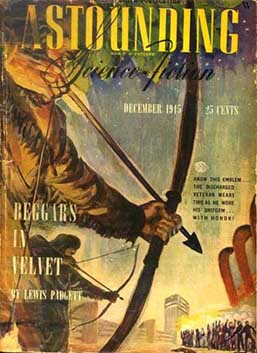
If you want to read this story as it first appeared in Astounding Science Fiction, it appears in the November and December issues from 1945. Not-at-all coincidentally it’s broken up just as we did it on the podcast. The first installment covers the Foundation and Trader Worlds first learning about the Mule and then considering how to respond. It corresponds to Chapters 11 (Bride and Groom) through 18 (The Fall of the Foundation) and ends, as you might guess from the title, with quite a dramatic moment. The December installment covers the remainder of the story and completes the tale with a search for the Second Foundation. Asimov’s writing had gotten better here as evidenced by two nice touches; Mayor Indbur III on Terminus and Emperor Dagobert IX on Neotrantor are excellent personifications of their respective dominions.
As we’ve been seeing, Asimov changes very little from Astounding to the novels. As was the case with “The General” The obligatory Encyclopedia Galactica entry that serves as a prologue is absent, replaced in the first part, by this teaser, probably written by John W. Campbell.
First of two parts of Asimov’s first serial of the Foundation — and of the one factor that even Hari Sheldon could not predict — could not defend the Foundation against. The defenses were based on human psychology; The Mule was a mutant!
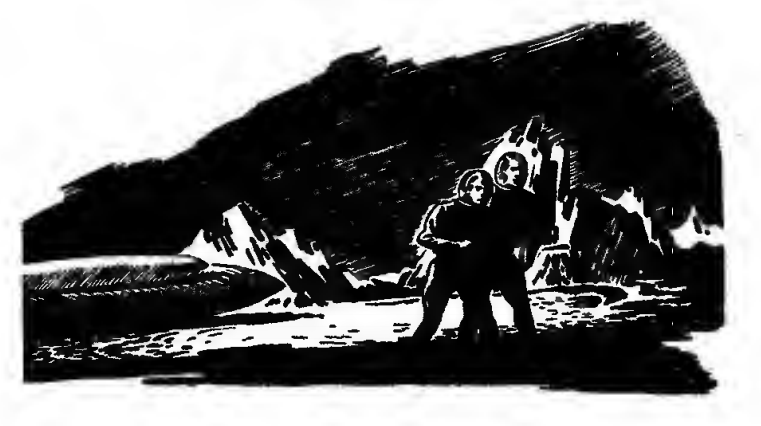
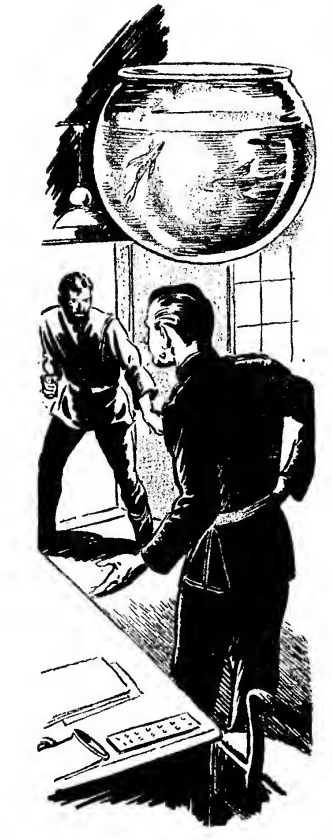
Unlike the for “the General,” unfortunately, the layouts have largely reverted to being rectangles and a lot of the images are tiny. We can hope they do a bit better in part two.
Once again there are some nice illustrations in both parts by Paul Orban. Unfortunately the scans of these issues aren’t as clean as the previous installments have been so the image quality is uneven.
Second of two parts. Across the ruined, dying Galactic Empire , fleeing from a conquered Foundation, three frightened people and the hunted jester of the new conqueror, the Mule, sought the Second Foundation — the only hope, but it must be warned
That’s followed by a summary of part 1, which you can find here: Astounding Science Fiction, December 1945 if you’d like to read it. Paul Orban’s illustrations are below. They’re larger and more textured than the illustrations from part 1.
There are a few anniversaries of major historical events at this time of year. A couple of weeks ago we had the anniversary of humankind’s first landing on the Moon. That commemorated a momentous occasion. Speaking on CBS News, Robert Heinlein called the Moon Landing the “greatest event in all the history of the human race up to this time.” “This is New Year’s Day of the year one,” he continued; if we don’t change the calendar, certainly others in the future will change it for us. Heinlein saw in the Moon Landing the very survival of our species. “The descendants of all of us will be in colonies elsewhere, the human race will not die. Even if we spoil this planet, the human race will not die. It will go on and on and on…”
Even if we spoil this planet, the human race will not die. That’s a theme he returned to in his writing; it’s not true as of yet, but it may well be true in the future. It was a hopeful moment.
Yesterday was the anniversary of a less hopeful moment but one that probably had a far greater impact on day-to-day life in much of the world. Not the dawn of the Atomic Age precisely, but it was the day that the world at large learned that the Atomic Age had begun. It’s likely the reason that the survival of the human race was foremost on Heinlein’s mind mere moments before Armstrong took his first step onto the Lunar Surface. August 6th is the day the United States dropped the Atomic Bomb on Hiroshima.
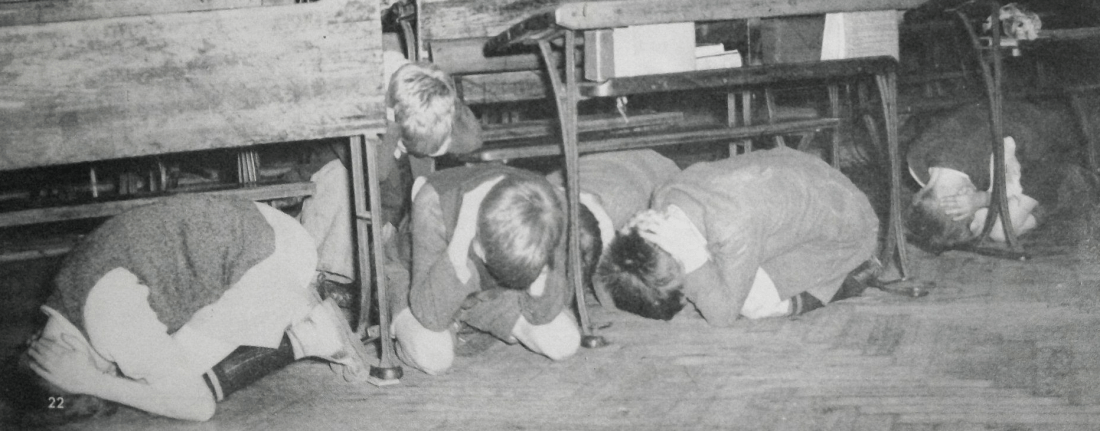
It’s hard to overstate the changes that came about as a result of the Atomic Age. The Soviet Union detonated its own “device” on 29 August 1949. The Cold War followed, as did nuclear proliferation, civil defense drills, duck and cover, the red scare, proxy wars, and fall-out shelters.
Asimov’s Foundation is one of those Science Fiction series that, as much as anything else, deals with the long sweep of history. While we were preparing for our next episode of The Stars End Podcast we realized that the story for the episode appeared in the first issue of Astounding that was published after that initial atomic bomb and John W. Campbell dedicated his monthly editorial to the event and we chat about it a bit on the podcast. It’s not every day that you run across a primary source of this salience.
Why? Well as Campbell points out, unlike the general public who were learning about nuclear energy for the first time, the SF community had been thinking about it for years. It’s a major plot point throughout the Foundation series for example; Asimov uses it as a metaphor for modernity. Campbell mentions three short stories specifically, two by Heinlein and one by Lester Del Rey. All three of these stories were published in Astounding, “Blowups Happen” in 1940, “Solution Unsatisfactory” in 1941, and “Nerves” in 1942. All three were prescient. “Blowups Happen” and “Nerves” foresaw the possibility of incidents like Three Mile Island, Chernobyl, and Fukushima while “Solution Unsatisfactory” preconfigured the debate about the United Nations’ role in preventing this use of Nuclear Weapons.
Here’s the editorial in its entirety. This issue went on sale on 16 October 1945, so I’d guess this was written in mid to late August. It’s a fascinating read, mixing common-sense proposals with a realistic fatalism about what’s possible before the people are ready for it. It reminds me of the debates about taking COVID precautions vs. reopening the economy and it reminds me of the Rolling Stones’ Street Fighting Man. “For where I live the game to play is compromise solution… well now, what can a poor boy do, ‘cept to sing in a rock-n-roll band?”
The Atomic Age
by John W. Campbell, Astounding Science Fiction, November 1945
There’s a considerable lapse between the time Astounding goes through make-up and the time it appears on the newsstands, as you are well aware. We are not, nor have we tried to be, a news magazine. This time it made a difference, of course; not knowing beforehand when the news would be released made us a little behind the times for a change.
The atomic bomb fell, and the war was, of course, ended. During the weeks immediately following that first atomic bomb, the sciencefictioneers were suddenly recognized by their neighbors as not quite such wild-eyed dreamers as they had been thought, and in many soul-satisfying cases became the neighborhood experts.-Perhaps they’ve been able to do some good — give the people near them, who had no intellectual forewarning of what was coming, some idea of what it means. I recommend, as most salutary little lessons, the stories “Nerves”, “Blowups Happen” and “Solution Unsatisfactory” — particularly the latter. It is of some interest that, at the moment, there is considerable agitation toward the idea of a world peace force, a United Nations set-up, using the atomic bomb as a weapon to enforce peace. The precise proposal made by “Solution Unsatisfactory”.
It might work as a stopgap, and, at the moment, all we can hope for is a stopgap. The troubles to come have their roots in two factors, factors already quite evident in the world today.
People do not realize civilization, the civilization we have been born into, lived in, and been indoctrinated with, died on July 16, 1945, and that the Death Notice was published to the world on August 6, 1945.
The second factor is this: it is a basic characteristic of people that they refuse to accept change when it arrives.
On that latter point, which is, of course the most important, you can readily observe by the various newspapers and magazines that the Socialists go on being socialists, and see in the atomic bomb and its consequences the opportunity to spread and enforce socialism. The Communists see in it the final proof of the necessity of being communist. The Anarchists naturally see it as the perfect way of obtaining the annihilation of all government. And, of course, the reactionary sees it as the way we can finally teach those blasted revolutionaries to behave themselves.
People simply go on trying to be just what they were before, with the same old viewpoints, the same demands, the same prejudices and intolerances. Each sees the atomic bomb only as a way of enforcing more violently his own particular will.
The natural result is that they are trying very hard to patch up the old civilization. It won’t work, of course. The chicken has been beheaded; it still runs squawking across the world, acting very much alive, and not yet knowing it is dead. But you can’t sew the head back on, no matter how hard you try. You can’t simply outlaw the atomic bomb, and expect, thus, to thrust it back into the limbo of undiscovered things.
Civilization — the civilization of Big Power balances, of war and peace and bad international manners, of intolerance and hates, of grinding poverty and useless luxury — is dead. We are in the interregnum now, the chaos of moving our effects, our ideas and our hopes from a blasted edifice into a new structure. If we can make it in one move, we are an extremely wise, sane, and fortunate race. Probably we will require about three to six moves, from one unusable structure of world order to another before we find one that can work.
Each time we move — as in moving from one house to another — we will leave behind a few more things that we find we don’t need, can’t use, or were even responsible for the ills we knew in the old place.
The interregnum is beginning now, and we do not have a Hari Seldon to predict the ways in which sociopolitical psychology will work out. What structure the new culture will have, we can’t imagine, because we know too little of what atomic powers can be made to do. It’s conceivable that we might discover, in a period of a few brief weeks, the secret of the force-wall — something that can establish an absolutely impenetrable barrier. In that case, rather minor modifications of our culture would be possible.
If we do not — and I do not expect it — cities are impossible. At least until such time as the human race has learned to get along without intolerance, without hatred, and without their inevitable concomitant — vigorous, even violent, proselytizing.
What the world most needs is a breathing spell long enough to permit the peoples of the world to absorb the basic facts that we of science-fiction have at least a fair appreciation of. Too many people see the atomic bomb as simply a Bigger and Better, New-Type Bomb. There is only one appropriate name for the atomic weapon: The Doomsday Bomb. Nothing known to man can stand against its power. Some writers have proposed that this will mean “cities of the future, if they are to be safe, must be underground” — which is sheer balderdash. It’s a perfect acknowledgment that the writer doesn’t even vaguely know the score. The man who says any such thing is blatantly admitting that he believes that mere mechanical strength of material can defeat the power of the atomic bomb.
Of course, part of the reason for that misapprehension is that the bombs dropped on Hiroshima and Nagasaki were the first ever made. They were the weakest, crudest, least effective atomic weapons that will ever be used. Those who have followed the discussions of atomic power and atomic weapons in Astounding will certainly recognize that the United States Army, in applying its available atomic arsenal to the purpose of forcing the Japanese to defeat, consciously and carefully selected the least damaging, gentlest application of the terrible agency at their disposal. Then that manifestation of the weapon — the simple energy bomb — was applied in the least damaging possible manner; it was set off in the air, not on the ground.
Talk of cities safe underground is nonsense for the very simple reason that atomic powers are such that, if the rock is solid enough to resist the titanic blow of atomic detonation, the delicate isostatic balance of the Earth’s crust can always be upset. If the city can’t be reached directly, it can be destroyed by earthquakes.
Personally, I’d prefer being above ground, a long, long way from any target of sufficient concentrated value to merit the attention of the atomic bomber.
Everyone knows that the first atomic bomb was the death of the city of Hiroshima.
It would probably save a lot of lives if they would recognize that it was, equally, the death of every big city, the death of an era, and the death of a cultural pattern based on a balance of military power, controlled exclusively by big and wealthy nations.
Atomic war is as suicidal as a duel between two men armed with flame-throwers in a vestibule. Neither party can have the slightest hope of surviving.
The atomic weapon is, to nations, what the revolver was to the men of the old West — the Equalizer. It didn’t make any difference how big you were; the gun makes all men the same size. The atomic bomb makes all nations the same size.
And, just as the revolver produced an era of good manners or sudden death, the atomic bomb must, inevitably, force upon us an era of international good manners and tolerance — or vast and sudden death.
When the peoples of the world fully — both intellectually and emotionally — realize that, we may get somewhere.
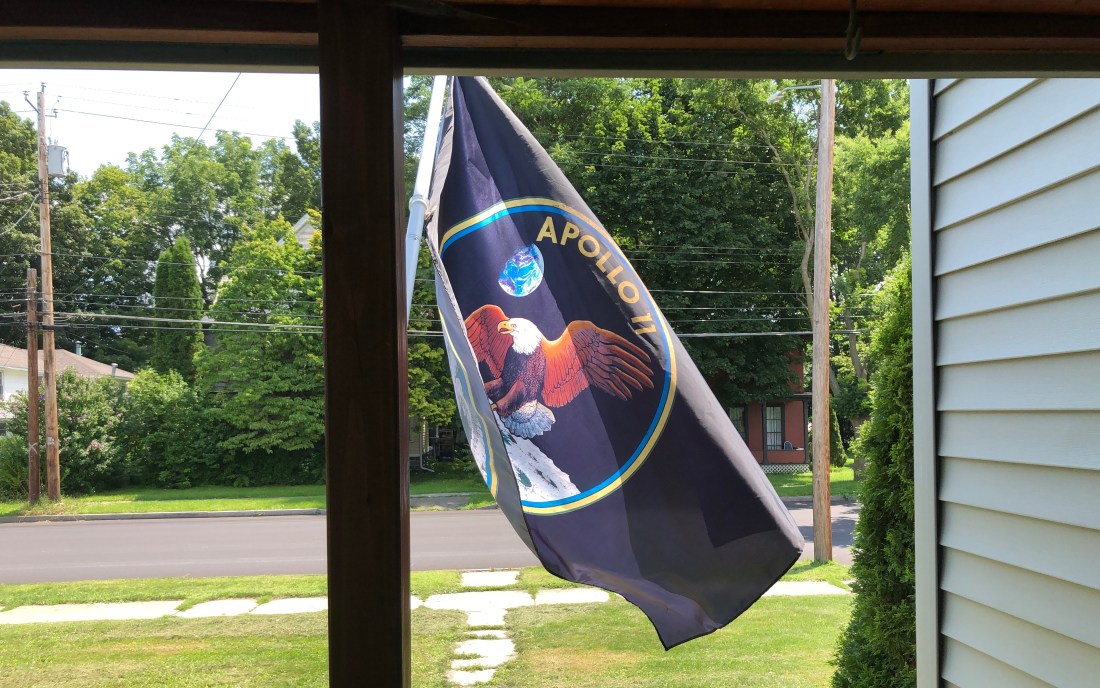
Each year, on 20 July, we fly a flag to commemorate when the first humans landed on the Moon. Two years ago was the 50th Anniversary. That was a lot of fun and also a good day for the blog. We flew the NASA flag, wrote about the probable state of the flags still on the Moon, and watched a lot of the coverage in real-time, just 50 years removed. I’ll share those posts below.
This year, we are flying an Apollo 11 flag. Well, kind of. We’re flying a flag that was marketed as an Apollo 11 flag. But it’s probably something that was cooked up for the semicentennial. It’s just the Apollo 11 mission patch on a black background. Vexillologists would call this a seal on a bedsheet like most of the state flags in the US.
But honestly, it’s better than those for a few reasons. First, the background is black, while most seals on a bedsheet have a blue background. Most predominantly black flags are black-and-white, so this one is distinctive in both of those groups.
The “seal,” as noted, was a mission patch, and unlike most state seals, patches are designed to be visible on clothing from across a room. That gives the design a simplicity that’s missing from most state seals. It’s clear what you’re looking at even from a distance. That makes it work much better as a flag.
Thirdly, the symbolism is clear and straightforward. The black background represents space, while the meanings of the Earth in the background and the lunar landscape in the foreground are self-evident. The eagle carries an olive branch in his talons to denote the spirit of peaceful exploration. The plaque left behind in the Sea of Tranquility is moving, “We came in peace for all mankind.” The eagle itself can be seen as a representation of its namesake, the lunar lander. Of course, the eagle, a national symbol of the United States, also proclaims that it’s the United States that got there first. Peaceful exploration is all well and good, but it’s impossible to deny the underlying motivation; the US had a Cold War to win.
There are also a couple of things that would mark this flag down according to the North American Vexillological Association (NAVA) standards from Good Flag, Bad Flag. and so, I decided to play with the image.
The first is that there’s text. The NAVA standards point out that text is problematic on Flags. It’s both notable and gracious that Armstrong, Aldrin, and Collins declined to have their names incorporated into the patch. That allowed it to represent all of the thousands of people who had a part in the endeavor. But it still says “Apollo 11.” How does the flag look without it? Pretty damn good. We don’t need the text to tell us what this is about; that’s undeniable.
The other place that this doesn’t meet the NAVA standards is in the colors. NAVA recommends no more than 4, but this flag has at least ten. That presents a question. Do we need the circles? Here’s a version without them.
I replaced the moonscape and background with part of one of the photos from the mission. This looks a little bland. I think I would be inclined to enlarge the Earth and eagle. And I’d make the background either a black and light grey bi-color or an extended drawing of the Lunar surface from the patch.
The other thing that I did on the 20th was to watch this again, the CBS interview with Arthur C. Clarke and Robert Heinlein. It’s always a treat.
My initial plan for this article was to transcribe this video and annotate it. There’s some great stuff there, but that turned out to be a time-consuming process. That might be the plan for next year.
For now I’ll leave you with this portion of the interview:
At about 3 minutes into the video, Cronkite muses, “I can’t imagine a moment to equal this. The only thing I could imagine is if some fella came forward and could say, positively, that we’re not going to have any more war.” “I think this is a step in that direction,” Clarke responds, “because this sort of thing is making our stupidities here on Earth seem more and more intolerable. And I think this might be the greatest result of the Space Program.”
That Hirogen is @TonyTodd54! Even under all that make-up the voice gives it away. The hunting other sentient creatures motif remains distasteful to me but the EMH teaching Seven social graces on the other hand is nicely comedic and sets up the core of the episode.
The crew gets a big data dump on the Hirogen, stuff that was already obvious. They remain One-dimensional cookie-cutter villains. Meanwhile, we learn more about Species 8472, intriguing mainly because the show has the sense not to tell us too much. Trek should leave things mysterious more frequently.
The heart of “Prey” is Janeway’s interactions with Seven. Janeway’s initial stand on helping the Hirogen is odd, more
about the learning than the compassion. When the conversation shifts to saving the member of 8472 she remains dispassionate while Seven is intense. That’s a nice inversion, especially when coupled with Seven’s defense of her own individuality.
Todd is great but after “the Visitor” I wish there had been more to this character. It still isn’t enough to make the Hirogen interesting. There are some dubious (distracting) decisions along the way but overall this was a fun and enthralling episode.



















 .
. .
. . In this case,
  and
and  . We use these two numbers to rewrite the middle term to get the following.
 .
.