Election 2018: Vote Anyway.

I votedI have some intense opinions about politics and generally, I’m happy to engage.  But I don’t want to make this a blog about politics.  If someone stumbles on this blog wanting to read about comics or mathematics or whatever they may not be interested in my opinions about candidate X or birthright citizenship or the current occupant of the Oval Office.  And that should be fine.  Some politics may sneak in from time to time but I’d like this to be a place that’s free from the most divisive arguments we’ve seen in my lifetime.

On the other hand, I’ve been fascinated with elections since I was 12.  I’ve done some work in voting theory and I’ve tried my hand at prognostication.  It’s been my intention to eventually write about elections on this site.  But the problem, then, was what to write about?  We know the broad strokes of the 2018 election.  The Democrats are doing remarkably well in the Generic Congressional Ballot and appear to be poised to retake the House.  That’s pretty remarkable given how heavily gerrymandered a lot of states are. Some of that has to do with the intensity of emotion engendered by President Trump.  It also helps that some of the most egregious gerrymandering we saw after the 2010 election has been overturned in the courts.

In the Senate, it’s a very different story. This is the class of senators that was elected in 2006, a Democratic wave that gave them the majority for the first time in four years. In 2012, despite defending more than 2/3 of the seats up for election, the Democrats actually increased their majority by two. So the Democrats are faced with what fivethirtyeight.com calls “the most unfavorable Senate mapthat any party has ever faced in any election.” Of the 35 senate elections being held this year, only 9 are held by Republicans and only one of those is in a state that’s bluish, namely Nevada. Meanwhile, a lot of the seats being defended by Democrats are in deep red states like North Dakota and Missouri. Despite being ahead on the Generic Congressional Ballot, the Democrats will probably lose seats in the Senate.

Aside from the National stage, the most important elections happening this year are, in my opinion, the races for the State Legislature. We don’t see much national coverage of these elections, but they’re crucially important. This is our first opportunity to elect some of the people who will be drawing the political maps in the wake of the 2020 Census. The candidates we elect now could determine control of the House of Representatives and of State Legislatures for a decade or more.

But all of this is known and it hasn’t shifted much. I could have written the last three paragraphs a month ago. Or two.  But the thing that motivates this post is that I stumbled across this.

A lot of folks pay attention to polls.  The polls influence their tendency to vote.
silver-datalab-betterpolls-1

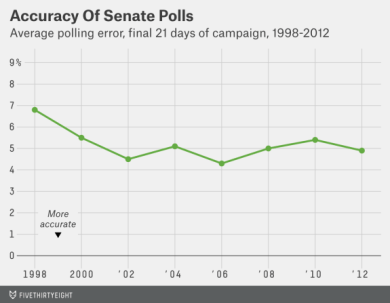
Democrats in Texas or Republicans in New York might decry their need to go to the polls because the opposition will “win anyway.”  But here’s the thing: according to this article (originally published in 2014) the average House poll has, since 1998, been off the final result by 6.2 percentage points.  Polls in senate races and gubernatorial elections have fared somewhat better, missing the final result by 5.1% and 5.2% respectively.  And polling is getting harder.  Response rates are declining making polls more expensive.  The decline in the prevalence of landlines along with laws about contacting people on cell phones are making it harder to get a representative sample.  You might think your Senate candidate is behind by three points, but the race could be a dead heat.
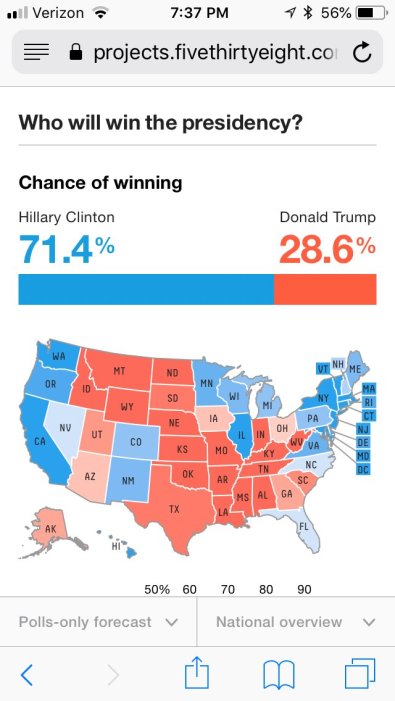
2016ProjectionI see this graphic on Twitter a lot in Nate Silver’s feed.  The implication here is that Silver “predicted” that Clinton would win the White House and so, 538 “got it wrong.”  That’s not what this says at all.  This is a probability.  What this says is that, if you could repeat the election a bunch of times, Clinton would only win about 71.4% of the time.  In 28.6% of the “elections” Trump would be elected.  A Trump election isn’t surprising.

Imagine tossing a coin twice.  Would you be surprised if you got two tails?  You shouldn’t be.  The probability of that outcome is 25%.  Sure, it’s more likely that one of the other three outcomes will happen, but it isn’t surprising at all.

The Trump victory, according to this analysis, is slightly less surprising than throwing two tails. The difference is that most people are not emotionally invested in the coins toss.

So, what’s the point?  Vote anyway.

Do you want the Democrats to win the Senate?  Current estimates say there’s only a 1 in 6 chance of that happening.  Vote anyway.

Do you want the Republicans to retain control of the House?  Fivethirtyeight says they’ll “need a systematic polling error” for that to happen.  We’ve seen those before.  Vote anyway.

Do you want Heitcamp to get reelected in North Dakota, but you’re afraid she’s fallen too far behind?  Vote anyway.

Do you want DeSantis to win the Governorship in Florida but think Gillum has pulled too far ahead? Vote anyway.

Not interested in the winner of the marquee race in your state?  The down-ballot races and the initiatives are at least as important.  Vote anyway.

Can’t bring yourself to vote for either of the major party candidates?  You don’t have to use your vote to help determine the winner.  For example, here in New York, the results of the Governor’s election determine which parties get dedicated ballot access.  You could vote to help the Working Families Party or the Conservative Party or the Green Party or the “The Rent is Too Damn High” Party get on the ballot.  Vote anyway.

Elections are important.  We’d be a profoundly different country if everyone who could vote did vote.  But to quote Arron Sorkin, Benjamin Franklin, or any number of people, “Decisions are made by those who show up.”  This one is really important.  No matter what you think is likely to happen, vote anyway.

What if Captain America became President?

Cap for President

First Published on Quora, 14 October 2019.

CaptainAmerica250

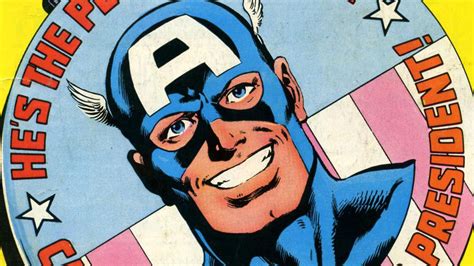
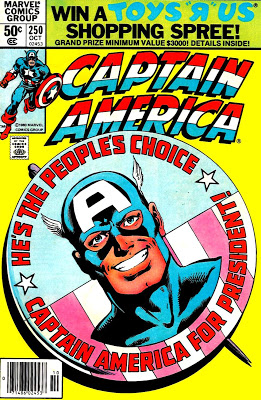
It’s worth pointing out here that this very idea has already been played around with in the comics. In Captain America 250 (October 1980) Steve is approached by the New Populist Party and asked to be their candidate for president. He gives it serious thought and spends most of the issue debating the pros and cons with his friends, Avengers and otherwise. The ending of the issue is bittersweet; Steve, of course, decides not to run for president and the enthusiasm that had been building within the NPP turns to a profound disappointment.


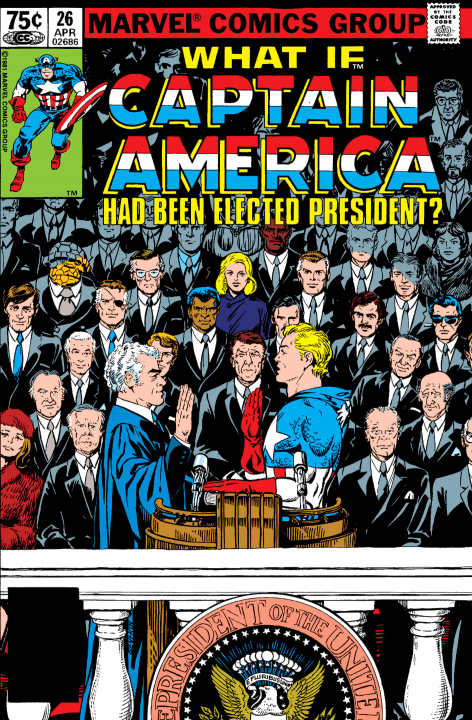
About six months later, Marvel itself answered this question in What If? #26. Of course, we don’t know whether WI#26 tells us what “really” would have happened in the Marvel Universe, but it’s at least as valid as what anybody else would have said. And in some sense, that’s the ultimate answer to the question at hand. It really depends on who gets to write the story.

Cap #250 is a classic. What if #26 is pretty good. Both are worth checking out and are available on Marvel Unlimited.

 
what-if-26.png

In my opinion, there are two things I think are worth addressing, how Steve would have governed and how the public would have been likely to respond.

Politically, I think Steve is likely to be a New Dealer. He was born in 1920 and came of age around 1940; FDR was popular and won a fairly lopsided electoral victory that year, although not nearly as lopsided as in 1936. I think what we’ve seen from Steve over the years bares this out, from Englehart’s run in the ’70s to his reason for stepping out of the role in “Captain America No More” to his stance in Civil War and beyond (Hydra-Steve notwithstanding). In foreign policy, he would be an excellent diplomat, able to find common ground with other nations and move forward productively. He would certainly be more apt to use military force than Jimmy Carter, but not nearly so apt as either of the Bushes. He would be relentlessly ethical.

However, the public’s response to Steve as president would be more indicative of his legacy as Commander-in-Chief than his political positions.

If he had been elected President in 1980 when “Cap for President” first hit the stands, conservative or liberal, I think President Rogers would have been a transformational figure. Six years out from Watergate and a bit more than a year after Carter’s malaise speech, the American Electorate was in flux. “Reagan Democrats” were becoming a thing while there was a candidate for the Republican nomination, John Anderson, who was arguably more liberal than the Democrats’ eventual nominee. If there’s one constant in all the portrayals of Steve Rogers, it’s in his ability to lead and inspire. Cap as president in the early 1980s would have changed the political landscape for a generation or more.

On the other hand, had Steve been elected in the current political climate, I don’t think any of that would have mattered. Ed Brubaker (I’m pretty sure, I haven’t been able to locate the quote) made a relevant remark about the time Steve “died” in the aftermath of Civil War. He said that it was tricky to write Cap. One side of the political spectrum mainly wants to see Cap beating up terrorists, while the other side likes to see him giving speeches about rights and fairness. If anything, this aspect has gotten more extreme over the past 11 years. Steve, as president in the 21st Century, probably presides over a lackluster presidency with one side of the aisle lauding his accomplishments and the other condemning his inadequacies, justly or unjustly.

And that, I think says much more about the state of politics in America today than it does about Captain America.

References:

Captain America #250 (October 1980)

What If? # 26

Captain America – Wikipedia

Man and Machine Man

First Published April 2018

It seemed natural to follow up on Kirby’s 2001: A Space Odyssey by reading his run of issues in Machine Man, #1-9. Indeed, the last three issues of 2001 are closer to being a prolog for this series than they are a coda for thatimg_8535.jpg one.

The first issue is a bit jarring. There’s a near-complete reset of supporting characters despite coming only seven months after 2001 #10. Visually, the first nine issues are pure Kirby goodness that escapes the excessive cheesiness that diminishes some of his other writing efforts. In these issues, it seems that the book isn’t intended to exist within the Marvel Universe. That makes sense as it continued from a licensed series that compared the character to the “Marvel Superheroes” in a way that doesn’t seem natural within that universe. The writing is kind of clunky in places. There’s a lot of what Star Trek fans would call “technobabble” as Machine Man demonstrates some new ability or other and Colonel Kragg (a character precisely in the General Ross motif) reminds us that he lost an eye battling the other robots in the X series virtually every single time that he appears. This is not a great collection of books, and it’s less interesting than the 2001 series it sprang from.  Still, it’s an enjoyable read.

The series seems to end here, promising a follow-up in Incredible Hulk. But the cancellation became a hiatus and the series was resurrected after a few months. More on that later. Probably.

Edit:
Jim Kosmicki inspired me to look at the timing of this. It turns out this is the very moment Jack left Marvel for the last time to work in animation. His last work for Marvel was Machine Man #9 and Devil Dinosaur #9, both cover-dated December 1978. Devil Dinosaur ended permanently. I don’t know if the Machine Man revival was planned or if he proved popular enough in the Hulk issues to justify restarting the book.

Not Kubrick or Clarke, but Kirby’s Space Odyssey

First published 20 April 2018

Finally finished this run on Saturday and read ‘em today. The first 7 issues are a lot of fun and… trippy.  The first few issues follow the pattern established in the movie.  The monolith encounters a creature in the far past; it then encounters a character in a near-future setting and that character is evolved into a star child.  The star child then moves on to other adventures.  The themes continue, but the narrative loosens as the series progresses.

It’s impresimg_3531sive to me that Kirby was able to draw on the concepts of the Movie and the novel in non-trivial, substantive ways. I’m not generally a fan of Kirby as a writer. The Inhumans run in Amazing Adventures is a great example; it’s hard to overstate how much better those got after Thomas and Adams took over. But Kirby had clearly grown a lot as a writer over the intervening 6-7 years. These were spot on and much better than I’d expected.

Machine Man is introduced in issue 8 and the 2001 stuff fades into the background as the book shifts to a standard superhero narrative. Still good though. Overall, a fun read.

Peter Parker’s Playlist

I just took a stab at answering the following question on Quora, and I thought I would share it here as well.

What would Spider-Man/Peter Parker’s music playlist be?

No definitive playlist, but some thoughts. The only mention I recall of Peter Parker’s music taste is from Marvel Team-Up Annual #4 from 1981.

Purple Man has Peter climb a lamppost to distract him and has him sing. His choice of music? Elvis Costello. Specifically “Oliver’s Army” from Armed Forces.

Extrapolating from this, here’s my guess. Peter probably listens to well regarded artists who are slightly out of the mainstream. Elvis Costello is established. Perhaps also artists like the Velvet Underground, Big Star, Nick Lowe or The Talking Heads.

Popular and mainstream artists might be less likely. Pulling from the same time period, maybe not Madonna, Michael Jackson or U2. These are mostly 1980’s examples since that’s when the comic came out, but you could extend the same thinking to other decades. It feels to me like it would hold true.

The one thing we can say for sure, is that Peter isn’t just listening to the top 40; he’s done some research and I suspect his tastes are fairly eclectic. It wouldn’t surprise me if he listened to some Big Band music if that was what he heard growing up with Aunt May and Uncle Ben.

It would be interesting

to see what other references to music we could find in the comics.

Update: Blaine Savini, a member of Old Guys who Love Old Comics on Facebook, Peter Likes Ella Fpointed  out that we also learn in the Comics the Peter likes Ella Fitzgerald.  This is from Amazing Spider-Man #136, September 1974.

The Album in question is likely Ella in London (4 1/2 Stars, allmusic.com) which is the only 1974 issue listed in her discography on ellafitzgerald.com. It contains songs by George and Ira Gershwin, Duke Ellington and Cole Porter.

Notice that MJ clearly implies that Peter doesn’t listen to much in the way of popular music.  He mentions that he’s a junior in college in this issue, if that means he’s 21, he would have been Spider-Man for about 6 years at this point.  In 1964 we would have been 11.

But,well regarded, check.  Out of the matinstream, check.  Ella Fitzgerald and Elvis Costello: Eclectic, check.

References:


Writing a Combinatorial Proof

This started life as a post on Quora, answering the question:

For any positive integer n, how do you write a combinatorial proof of the identity
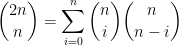
\displaystyle {2n \choose n} = \sum_{i = 0}^{n} {n \choose i} {n \choose n-i}?

To write a combinatorial proof, the idea is to describe how each side of the equation is actually counting the same set of objects.

Now, if you have a set of 2n objects, \displaystyle {2n \choose n} (that is 2n choose n) is the number of subsets of that set which contain exactly n of them.

Now pretend that you’ve taken your 2n objects and put them into two boxes with n objects in each. Think about what each of your terms on the other side of the equation, \displaystyle {n \choose i}{n \choose n-i} represent. Then consider what you get when you add all of these together. You should be able to explain that this really does count the same thing as \displaystyle {2n \choose n}.

Now when I wrote the above, I wondered if this was a homework question someone had posted to Quora.  I didn’t fill in all the details since, while I’m happy to help someone with their homework, I don’t want to do it for them.

But in case anyone wants to see a worked out example, here’s the standard initial example of a combinatorial proof.  This is the identity that makes Pascal’s Triangle work as nicely as it does.

Theorem: \displaystyle {n \choose k} = {n-1 \choose k} + {n-1 \choose k-1}.

Proof: Let’s start by thinking about the expression on the left.  If we have a set with n objects in it, \displaystyle {n \choose k} is the number of ways we can select a subset of k objects.  To say that another way, it’s the number of ways we can pick k objects out of our set without caring what order they’re in.

Now suppose one of our objects has decided to wear a hat.  If we’re looking to select a subset with k objects, we can decide to include or exclude the one wearing the hat.

Say we don’t want to include the guy with the hat.  In that case, all k objects, have to be selected from the n-1 objects that aren’t wearing hats.  We can do this in \displaystyle {n-1 \choose k} different ways.

Now suppose we decide to include the one with the hat.  Well then, to get k objects altogether, we need to select k-1 more from the set.  There’s \displaystyle {n-1 \choose k-1} ways to get the rest of the objects that you need.
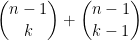
Putting these two together we see that \displaystyle {n-1 \choose k} + {n-1 \choose k-1} is also the number of ways to select a subset of k objects from a set containing n things.

Therefore, our identity must be true.

If you’d like to try one on your own, \displaystyle 2^n = \sum_{i = 0}^{n} {n \choose i} is another nice example.

Not Your Father’s Comic Book Box or Something Clever About Cardboard

First Published 28 January 2018

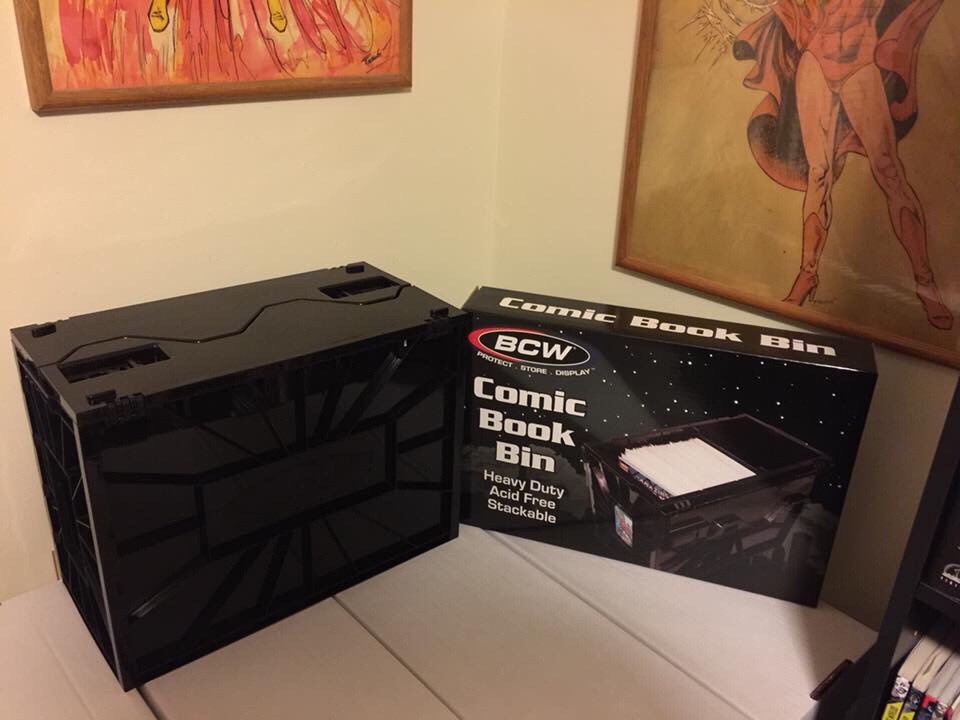
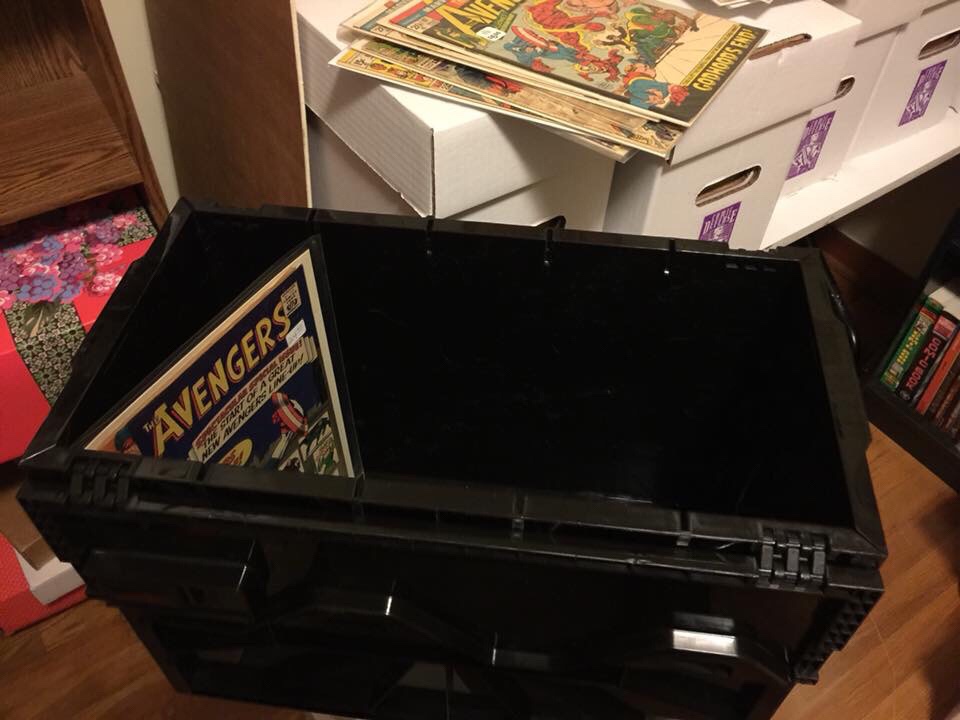
I got one of BCW’s new comic bins for my “Good Stuff.” Here’s a few impressions.

The bin is just slightly too tall for my shelves (designed for long boxes) and not quite wide enough for comics in mylar sleeves. Neither of those things was unexpected, but a pleasant surprise would have been nice. If BCW markets a magazine-sized bin, I’ll probably pick one up.

The bin wasn’t too hard to assemble, but the on-line video was little help; it was pretty vague and didn’t address the things that weren’t intuitively obvious. I would have preferred printed directions. I noticed there was a certain amount of static electricity present and that attracted dust. The next one gets assembled in the cat-free comic room.

The removable dividers are ideal for keeping your books upright even when the box is not-quite-full.
Once assembled, the bin feels sturdy and looks nice. A set of them would give you good storage that uses space efficiently. It’s not airtight, so I don’t think condensation is likely to be an issue.

A set would likely be cost-prohibitive for a large collection, but I think a few bins for high-end books would be a good investment.


The Credit Where it’s Due Department: Why no Byrne Variants?

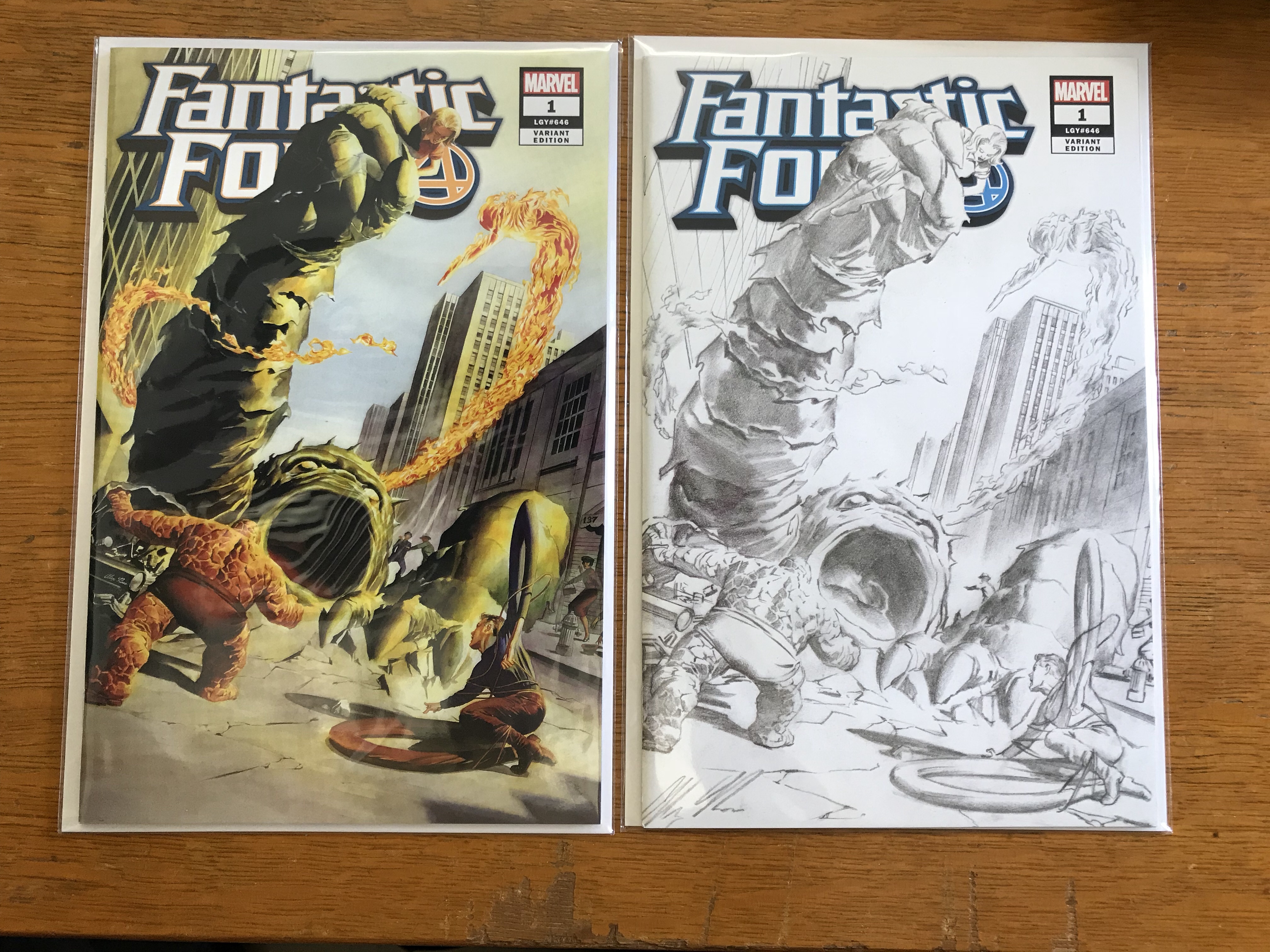
A happy mail call today. I got my Alex Ross variants of the new Fantastic Four #1. These look great. Both honor one of the most iconic covers of all time; the first FF #1 from 1961. I’m not usually one to be enthused about variant covers, but I’m really happy to get these. It’s a fitting tribute to Lee and Kirby who created the team and set the standard for everything that came after that first book. It’s also nice to mark the occasion of the FF’s return to the Marvel Universe with something special. That’s a big deal to me and I think it’s a big deal to a lot of people.

But I seems to me that this variant nonsense has kind of gotten out of hand. There are literally something like forty different versions of this book. Many different artists, homages to many different eras. Lots of them look great. Many of them don’t. The anatomy in some of the artwork makes me cringe. They metaphorically raised Mike Weiringo from the dead so he could have his own variant.

Don’t get me wrong. Mike Weiringo deserves his own cover. More than almost anyone else whose artwork was featured. As I said, I’m not really one for variants, but I want one of those too.

But here’s the thing: in the last 57 years, there have been three really well regarded runs on the World’s Greatest Comic Magazine. The first was Lee/Kirby. The third was Waid/Weiringo. The second? John Byrne. Byrne took over FF after a long run of inconsistent creative teams; the quality had been uneven and interest in the book had waned. Byrne almost singlehandedly reinvigorated the title as writer, artist and inker and returned the FF to both popularity and importance.

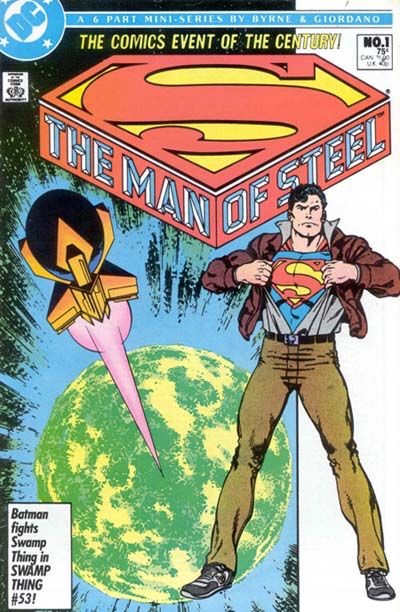
So why isn’t there a John Byrne variant of the new FF #1? Did Byrne refuse? Is there bad blood between Byrne and Marvel? Is he just too hard to work with or was this an intentional slight? I for one would like to know. Eschewing a Byrne variant is a strange and indefensible oversight. It’s especially strange given that the same thing happened with Action Comics #1000. A Byrne variant there would seem to be a no-brainer, especially with Schuster and Swan unavailable. Byrne’s impact on Superman was significant. But once again in a sea of uneven variants, Byrne gets overlooked. I wonder if he’ll even be asked back when NextMen gets revived. I think Byrne and his fans deserve better.

How do you prove a conjecture is false?

First posted to Quora on Friday, 7 September 2018

That depends on the nature of the statement.

If you have a universal statement, which is to say a statement that all of the things in some category share some property, you merely have to provide a counter-example.

So if you wanted to disprove the statement, “all prime numbers are odd” you’d merely have to point out that 2 is even and the statement cannot be true.

Disproving an existential statement is usually more work. These statements say that there is at least one thing that has a particular property. To disprove an existential statement, you need a general argument that that property can never happen.

So to prove that the statement “There is a pair of even integers whose sum is odd” is false, you must prove that the sum of any two even integers must be even.

Those are the cases “all” and “some.” The cases “none” and “some are not” are similar.

To disprove a statement like “None of the items in set A have property B” you simply have to find one that does. If you want to show a statement like “Some of the items in set A do not have property B” is false you need a general argument that everything in A has property B.

In any case, disproving a statement is equivalent to proving its negation.


Renovating an Old Comic

This was first posted on 11 July 2018

——-

IMG_8899I just finished up a fun project that I thought I’d share.
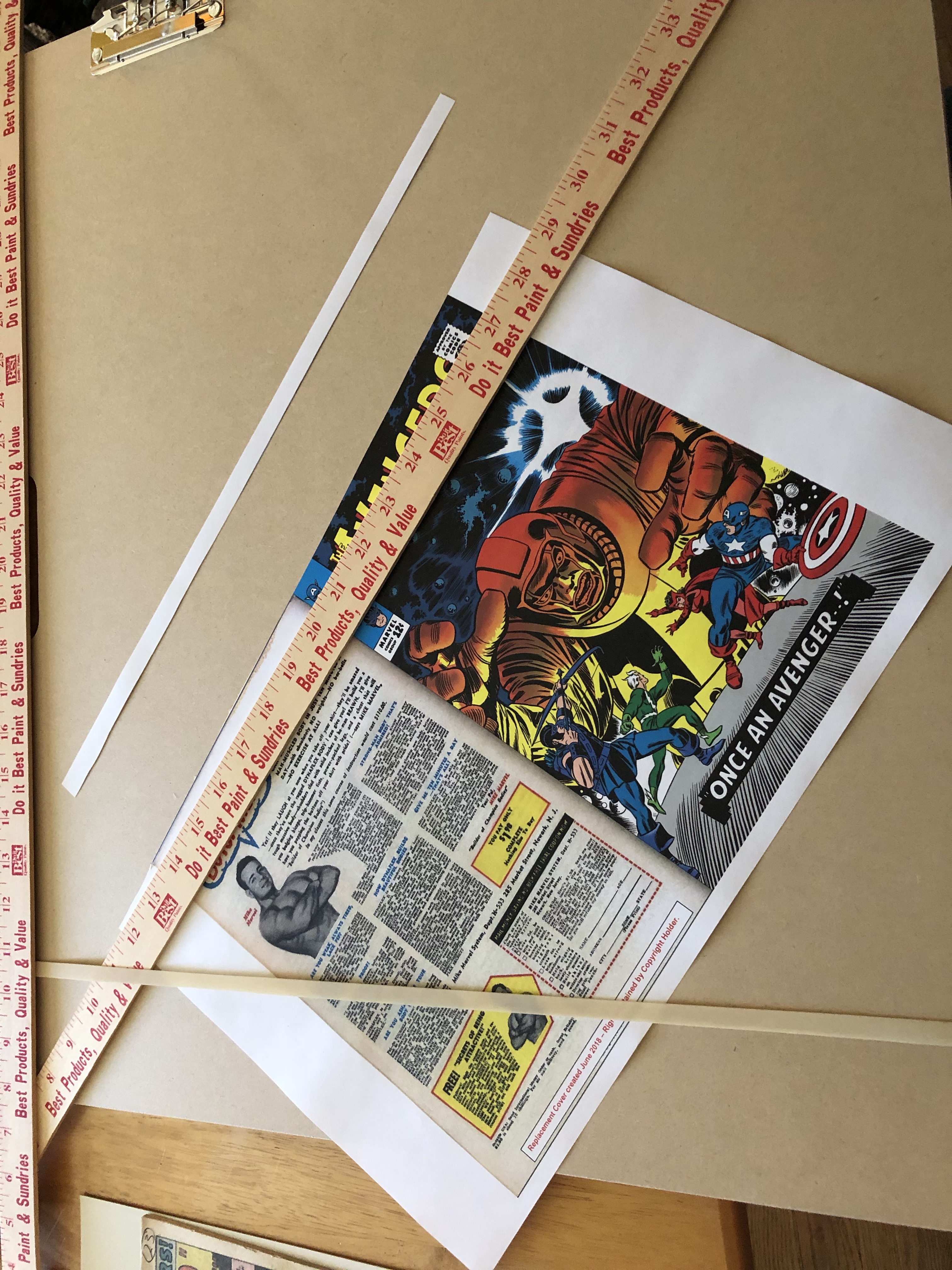
I got a coverless copy of Avengers 23 from my LCS (thanks, Jared Aiosa) last month. I decided to renovate it, so I:
* Found a scan online and recreated the cover.
* Printed and trimmed it.
* Attached it to the book.
* Trimmed the book a tiny bit and flattened it under some dictionaries.
IMG_8904I’m pretty pleased with the results.  With a bit of practice, I bet I could get much better at this.

It’s pretty obvious that the result isn’t a mint condition book.  Not only is the interior clearly an older book that has a lot of wear, the cover is printed on standard 24 lb. bond paper and is not glossy, although you get some gloss from the ink.  The paper is also too white to have been attached to newsprint for nearly 50 years.

Despite all of that, he cover is clearly marked as being a replica, which I believe is an essential step for a project like this.

You can check out the finished project here.

Coming soon… how to videos.