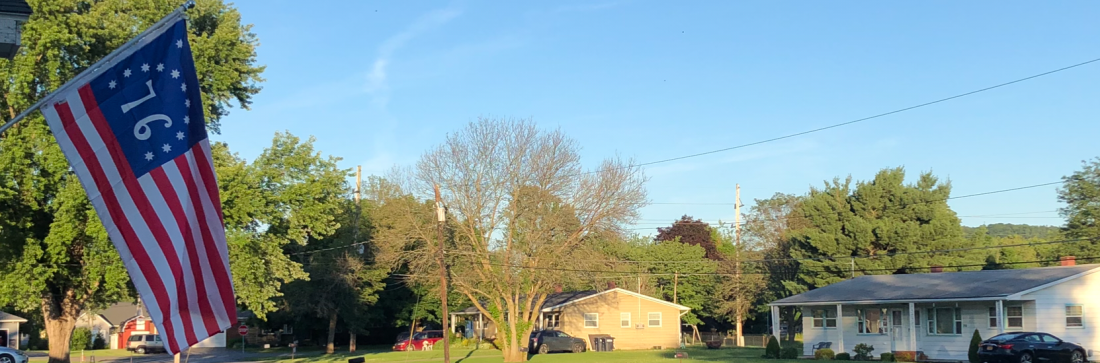
Happy Independence Day everyone! Last year to celebrate, we flew the Betsy Ross flag. This year we’re flying what is, at least according to legend, another Revolutionary War flag, the Bennington Flag. Legend has it that this flag was flown by General John Stark and his men at the Battle of Bennington, which happened in Walloomsac, New York on 16 August 1777. General Stark’s forces, including troops from the Republic of Vermont, defeated the British forces under the command of Lt. Colonel Friedrich Balm. This was a turning point in the war, leading to the defeat of the British at the Battles of Saratoga.
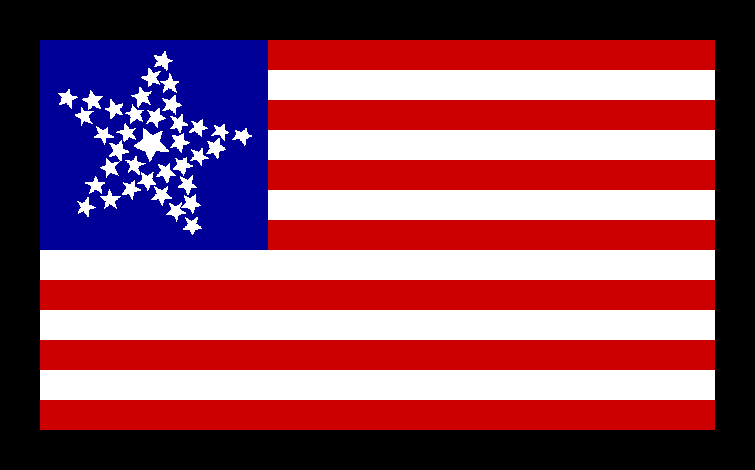
So, the Bennington Flag is purportedly an “early US” flag that stands beside many others. The “Betsy Ross” flag is probably the most recognizable but others include the Cowpens Flag (below, right) and the flag designed by Francis Hopkins for the US Navy which used 6-pointed stars and arranged the stars in rows with a 3-2-3-2-3 pattern.

Why so many? Well, on 14 June the Second Continental Congress passed the Flag Resolution of 1777.
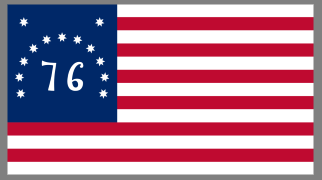
Resolved: That the flag of the United States be thirteen stripes, alternate red and white; that the union be thirteen stars, white in a blue field, representing a new constellation.This leaves a lot unspecified, namely the arrangement and orientation of the stars, the kind of star, the size of the union (or “canton”), and whether there are 7 red stripes or 7 white stripes. Individual flag makers made their own decisions on these points. That led to a plethora of variants. The Bennington Flag mostly adheres to the Flag Resolution with some distinctive variations, including the arrangement of the stars inside a canton that is taller than it is wide. The choices to make the outer stripes white and to use 7-pointed stars are also uncommon. The one departure is the addition of the large “76” in the canton to reference the passage of the Declaration of Independence.
The legend claims that the original Bennington Flag was flown at its namesake battle and was carried off the battlefield by Nathanial Fillmore He passed the flag onto his nephew, Septa Fillmore who carried it in the Battle of Plattsburg, the turning point in the War of 1812. Subsequently, the flag was passed down to other relatives including President Millard Fillmore and Philetus Fillmore who flew the flag during the centennial celebrations for American Independence and the Battle of Bennington. Because of its close affiliation with the family, this flag is also called “the Fillmore Flag.” If I were determining the nomenclature, I’d probably keep the term “Fillmore Flag” for the original flag that now resides in the Bennington Museum.

That Fillmore Flag was examined by Grace Rogers Cooper, Curator of Textiles at the Smithsonian Institution. She determined it to be of 19th-century origin and dated it to around 1820. The flag itself is made of cotton and sewn with cotton thread neither of which would have been readily available in 1777. Various theories exist as to its possible origin; it may have been made during the War of 1812 to evoke the spirit of the Revolution or it may have been made to celebrate the visit of Lafayette to the US in 1824 or the semicentennial of the signing of the Declaration of Independence. One thing that’s generally agreed upon is that that particular flag could not have been at the Battle of Bennington. What was flown at the battle? The “Green Mountain Boys Flag” shown above, is a regimental standard known to have been flown by General Stark and his men. The Green Mountain Boys Flag is currently the flag of the Vermont National Guard.
References:
- Betsy Ross and the American Flag accessed 29 June 2019
- Battle of Bennington accessed 30 June 2019
- Battles of Saratoga accessed 30 June 2019
- Flag of the United States accessed 30 June 2019
- Bennington Flag accessed 30 June 2019
- The Revolutionary Flags That Fell to the Stars and Stripes accessed 30 June 2019
Picture Credits:
- The Bennington Flag – By DevinCook (talk) – self-made, Public Domain, https://commons.wikimedia.org/w/index.php?curid=8320578
- The Cowpens Flag – This file was derived from: Cowpens Flag.svg, Public Domain, https://commons.wikimedia.org/w/index.php?curid=63613789
- Francis Hopkins Flag – By DevinCook (talk) – self-made, Public Domain, https://commons.wikimedia.org/w/index.php?curid=8320973
- Green Mountain Boys Flag – By Flag maker unknown, photo by Amber Kinkaid used with permission – English Wikipedia, Amber Kincaid, CC BY 2.5, https://commons.wikimedia.org/w/index.php?curid=2226845

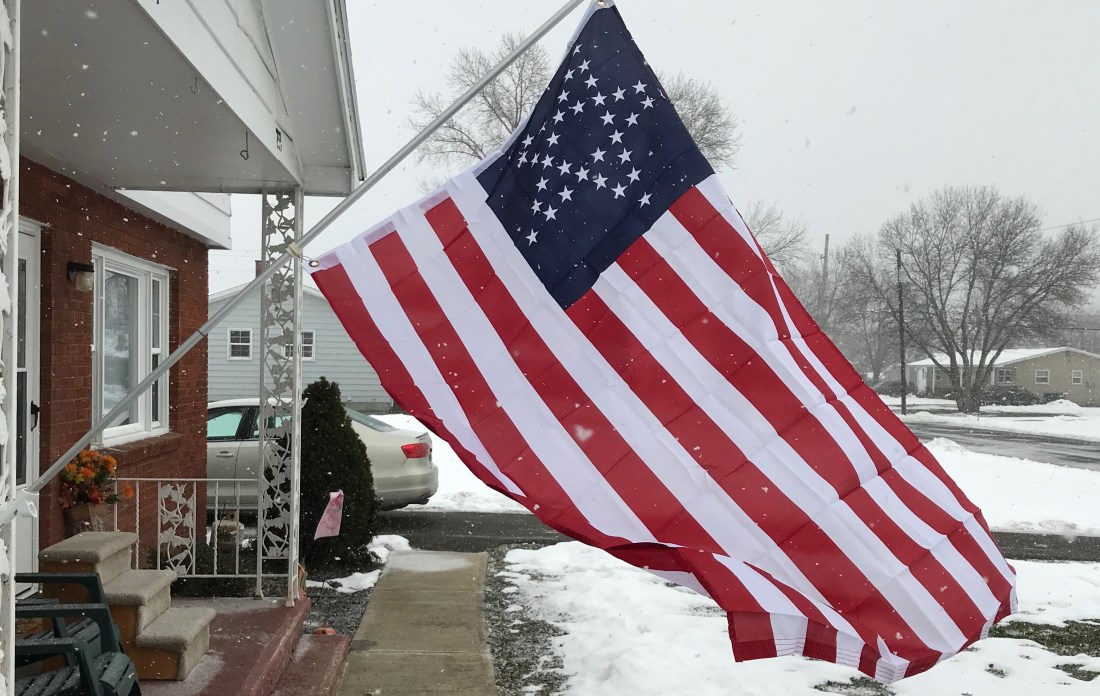

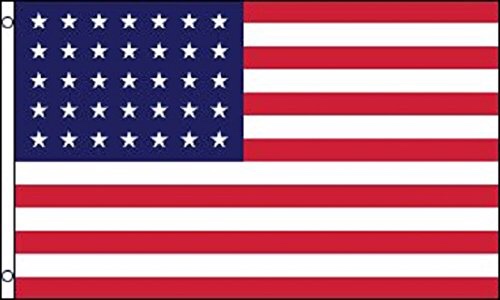 This was the national flag on that day.