A Probabilistic Look at The Presidential Election: 8 August 2024

Harris Takes Lead

Hello again!

The State of the Race

Since our last update, the Democratic Ticket has been campaigning across the country working to extend their momentum from the past two weeks. The big news there is the unveiling of Tim Walz as Harris’s running mate. They’ve been touring the swing states since the announcement and drawing large enthusiastic crowds.

JD Vance has been following them across the country trying to draw comparisons between the two campaigns. It’s been lackluster. The comparison is not helping the Republicans.

Meanwhile, Donald Trump has been mostly absent from the campaign trail; with only one sparsely attended rally in Montana and a press conference. I haven’t watched the press conference yet so I’ll reserve comments for now. The Trump Campaign holding a rally in Montana is mystifying. That’s a move you make when you’re on a clear path to victory and you can afford to spend resources on a Senate seat. His campaign has bigger issues. Was it about trying to get a rally with good attendance for a visual to counter those coming out of the Harris campaign? A positive event to get Trump back on the trail?

The narrative around the debates is mystifying as well. Trump began making up a possible debate on Fox News even before he debated President Biden. But the waffling, then canceling the debate, then insisting on the made-up Fox News debate, and finally canceling again all made Trump look frightened. Making up another debate and then insisting on three debates is a weird thing to do and is too little, too late.

The Harris/Walz tour of the swing states wraps up Saturday in Nevada.

Results:

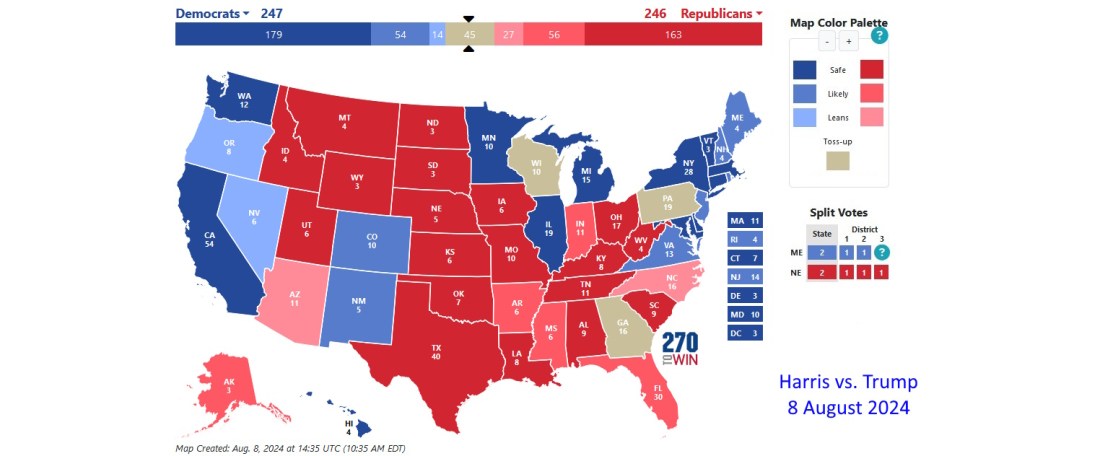
Once again we entered the polling data into our model and ran 40,000 simulated elections. If the election were held today, it looks like Donald Trump would have about a 35% chance of winning with Vice President Harris winning about 64% of the time. The remaining 1% were Electoral College ties.

Again, I would emphasize that this is an estimate. There weren’t many state polls in the last week and using our scheme had an interesting effect: it turned out that every state ‘average’ was determined by a single poll.

This had its greatest effect in Michigan as the one poll used there is probably an outlier (Harris led by 11), which would make the probability of a Harris victory an overestimate.

Given this data, Harris is in the lead and the odds of her winning the election could be as good as 3 to 2.

Our scheme for finding our polling averages and creating the map can be found here: Methodology.

Trends:

Trump was favored to win in our 21 July probability, and Harris pulled roughly even with him in our 31 July estimate. Now, for the moment, it’s safe to say that Harris has an edge. Strictly looking at the probabilities generated from the models, Harris’s probability of winning the election is roughly where Trump’s was on 21 July, between 63 and 64%. This is a complete turnaround in just under three weeks.

But that’s not the only evidence. Other predictive sites are showing similar results. Nate Silver now has Harris favored to win both the popular vote and the Electoral College. The New York Times/Siena College Poll released this morning has Harris leading Trump by 4 points in Wisconsin, Pennsylvania, and Michigan. The Cook Political Report has reclassified the race in Arizona, Georgia, and Nevada from “Lean Republican” to “Toss Up.”

The momentum remains on Harris’s side.

Last Words

It’s beginning to look like the campaign is the Democrats’ to lose. They have been able to dominate the news cycle and generate enthusiasm since the Republican Convention with President Biden’s withdrawal, followed by Harris introducing herself, the party unifying behind her, and then the announcement of Walz as Harris’s running mate. This could easily continue as the Democratic Convention will lead to hearings about Trump’s January 6th Election Interference Case which will bring us into early voting.

The Trump Campaign still seems unable to find its footing. They continue to throw whatever they can against the Democrats but nothing yet has really stuck outside of their MAGA base. With Vance drawing tiny crowds and Trump largely off the campaign trail it’s hard to see how they can turn this around. Right now it’s easy to find headlines like “Trump Campaign Bleeding Support…” or “Is Trump ‘Losing His Marbles.’

Still, this election could go either way. Even if the probability of Trump winning the election is really at 35% (and many sites have it higher) that’s still about 10% better than his chances of winning the 2016 election. In that election, he exceeded expectations at every turn. While the Republican Party’s overconfidence in July is partly responsible for the current state of the election other overconfidence could still shake things up dramatically.

A Probabilistic Look at The Presidential Election: 31 July 2024

Harris Has the Momentum

Hello! Thanks for joining me!

I’ve been publishing election projections for a few years now and I’ve been meaning to start publishing projections for 2024. With the big shake-up in the race, this seemed the ideal time to start.

This will actually be my second projection for this election. I did the first for my appearance on WETM’s Political Pundit Night on 9 May. At that point, Donald Trump would have had about a 66% chance of winning the election had it been held on that day.

But let’s get down to brass tacks as they say.

The State of the Race

It’s been a tumultuous few weeks after the race had been pretty stable for quite a long time. Of course, the tremors started with the first debate. You can read my analysis of that here. What’s the bottom line? President Biden gambled that a strong debate performance would shake things up and allow him to go on the offensive. That was not at all what happened.

At the debate, President Biden, coming off an exhausting travel schedule and with a cold, seemed feeble. Still, he mostly made sense. Trump, in contrast, spewed a torrent of falsehoods. His voice however sounded confident and assertive. The narrative coming out of the debate was heavily skewed toward the candidates’ presentation rather than the content of their answers. Calls began for Biden to withdraw from the ticket and that received the lion’s share of the media’s attention. Trump’s lies deserved equal attention.

The Trump campaign was uncharacteristically disciplined as the Democrats tried to regain their footing after the debate. By the time their convention rolled around the GOP thought they were riding a wave of inevitability to certain victory. This only intensified after the assassination attempt. They pandered to the fringe of their party by picking the problematic J. D. Vance as their vice-presidential candidate and some Republicans over-reached by trying to blame the assassination attempt on democratic rhetoric. None of that, amazingly, moved the needle very much.

That all changed when President Biden stepped aside and, as he put it, passed the torch onto a new generation by endorsing Vice President Harris. Over the last ten days, the Democrats have achieved a level of enthusiasm they have not reached in quite some time.

Results:

After entering the polling data into our model and running 40,000 simulated elections it appears that if the election were held today, Former President Trump would have about a 45% chance of winning. In contrast, Vice President Harris would win with a probability of 54%. The remaining results were electoral college ties.

An estimated electoral map for the US Presidential Election as of 31 July 2024.

I wouldn’t put too much faith in the units’s digit in those probabilities. Indiana, for example, landed in the “leaning Republican” category because of a single poll that was taken back in April. If it were in the “strongly Republican” category the probability of a republican victory would be somewhat but not dramatically better.

The bottom line is that this is now a competitive race with the two major candidates having about equal odds of victory.

Trends: What a Difference 10 Days Make

To get an idea of how the race is changing, let’s look at where the race was on 21 July, the day President Biden ended his candidacy.

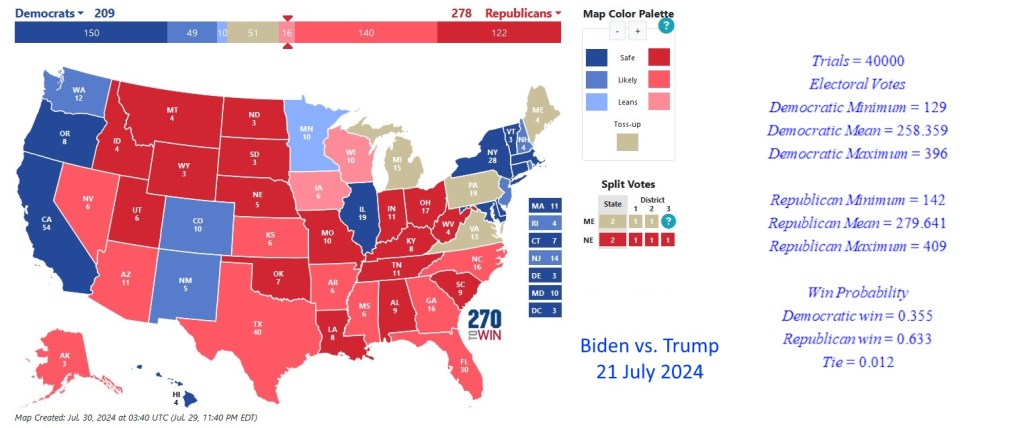
An estimated electoral map for the US Presidential Election as of 21 July 2024.

At this point, Trump had about a 63% chance of winning the election. This was down a bit from the 8 May projection mainly because on 21 July despite the setbacks on the democratic side there were more states in the “Strongly Democratic” category and fewer that were “Strongly Republican.” This is mainly due to minor changes in my methodology for processing the polling data.

The best way to parse this is that the probability of a Trump victory fell from about 2/3 to roughly 1/2. This is a significant change in favor of Vice President Harris and at this moment the momentum is clearly on her side. This might settle down at this level in which case we would be looking at a close election. There are plenty of reasons to think that the momentum in Harris’s direction will continue for a while. Her pick for Vice President is imminent and the Democratic Convention follows quickly. The Republican Convention had little effect on the state of the race but we’ve known Donald Trump for years now. Harris though is still introducing herself and the data here indicates that voters like what they’ve seen so far. The Democratic Convention could move the needle dramatically as people get to know her and her Vice Presidential pick.

Methodology

The Polling Averages:

I took polling data from Electoral-Vote.com which avoids using partisan polls.

For the July 31st estimate: I took the mean of all the polls released after 21 July to get each state’s polling average. If a state had no polls after 21 July the most recent poll was used.

The July 21st polling averages were determined by taking the mean of the four most recent state polls or the mean of all the state polls after 1 April if there were fewer than four.

The polling averages were fed into a US Presidential Election Calculator; an earlier version of which can be found at MapleSoft Application Center.

The calculator runs a large number of simulated elections. The probability of each candidate winning is estimated by the percentage of the simulations won by each candidate.

The Map:

The colors on the map are determined by The polling estimate rather than by the probability that a candidate will win a state. 

In each state, we use the polling estimate to find the conditional probability that an individual voter would choose either the Democrat or the Republican assuming they are voting for one of the major party candidates. Thus, to find, for example, the probability that a voter would choose the Democratic candidate, assuming they are voting for a major party nominee, we would calculate the following.

The formula for the probability that a voter would choose the democratic candidate given they are voting of a major party candidate.

The colors on the map are determined as follows:

  • Solidly Democratic (Dark Blue)         100%  > P(D|D or R) > 55%
  • Leaning Democratic (Light Blue)         55% > P(D|D or R) >   52%
  • Weakly Democratic (Pale Blue)         52% > P(D|D or R) >   51%
  • Toss-Up (Gray)                                     51%  > P(D|D or R) >   49%
  • Barely Republican (Light Red)          51%  < P(R|D or R)  <   52%
  • Leaning Republican (Light Red)          52%  < P(R|D or R)  <   55%
  • Solidly Republican (Dark Red)          55%  < P(R|D or R) < 100%

If a candidate is polling at 55%, the probability that he or she will win the state is actually quite a bit better than that.

For future installments, we’ll move this technical information to its own page and establish a consistent policy for creating state polling averages going forward.

Last Words

Although the Trump Campaign was smart to keep quiet as the Democrats argued over whether President Biden should withdraw from the race their response to having Harris at the top of the ticket has ranged from befuddled to panicky to weird. I didn’t expect that. It seemed to me the smart move would have been for Trump to declare victory. Something along the lines of “I’ve already beaten Joe Biden! He knew he was going to lose and he was too scared to stay in the race! I’ll beat the Democrats’ second choice just as easily.” That wouldn’t have been true but it’s a position of strength that would have been more effective than what we’re watching.

Waffling on the second debate was an unforced error. That’s a position of weakness that the Harris Campaign has been able to exploit. What would have been better? “Of course, I’ll debate Kamala. And you know what? I debated Biden and he was forced out of the race… who’s their next candidate going to be after I force her out of the race too?” This would take guts because if Harris wins that debate, and I think she will, it would be devastating. And there’s the rub. I believe that Trump is genuinely scared to debate her. Still, I’m happy to be wrong about Trump’s response to Biden’s withdrawal.

Where do we go from here? Trump and his campaign spent the Republican Convention trying to fire up their base. JD Vance was a choice intended to appeal to the right-wing fringe of the Republican Party. Vance isn’t going to bring any new voters to the Trump campaign but I suspect there are some Republicans who might feel motivated by his “childless cat-lady” comments.

With Harris at the top of the Democratic Ticket, the Trump Campaign needed to pivot and try to attract new voters. They should be walking back these comments. Instead, Vance doubled down on them.

And Donald Trump’s interview with the National Association of Black Journalists on Wednesday is more of the same. Trump was rude and belligerent. He attacked Harris for ‘changing her race’ whatever that means. We should, as a nation, collectively recoil from Trump’s remarks. Will we? This will not bring new voters to the Trump Campaign but Trump himself must think it will appeal to someone; he continued the racial attacks on Harris on Thursday. Even if we don’t recoil en masse, these remarks will repel most voters. If Trump doesn’t figure out how to run against Harris her momentum will continue and we’ll be looking at a landslide in November.

Foundational Readings: On The Edge

It’s been a while since we’ve done an installment of “Foundational Readings” or of “Next Time on Stars End.” I used those two columns to share the art that originally accompanied the stories we were reading. There’s a bit of unfinished business there, but today we have a bit of a surprise.

I remember what a big deal this was: the first Foundation novel in thirty-two years! But here’s something I didn’t remember or, more likely, wasn’t aware of at the time. Unsurprisingly, Asimov’s Science Fiction Magazine thought it was a pretty big deal too. So much so that the centerpiece of their December 1982 issue are the first two chapters excerpted from the book.

On Saturday we’ll release Stars End, Season 5, Episode 5. It’s our last installment about Foundation’s Edge; we’ve reached Gaia and the book’s climax.

But there’s lots more! There are two additional pieces of writing by the Great and Glorious Az himself, an editorial entitled “Susan Calvin” and a short essay entitled “The Story Behind the Foundation” under the masthead “Viewpoint.” I’ve read the latter before, although maybe not all at once; it is repurposed in an abbreviated form as a foreword (with the same title) to Foundation and Earth. The editorial, though, was new to me; I’ve never seen it anywhere else.

There are also commentaries from some of the biggest names in Science Fiction lauding the advent of a new Foundation novel including Arthur C. Clarke, Harlan Ellison, and Larry Niven. Those alone were worth tracking down a copy. Here’s a sample.

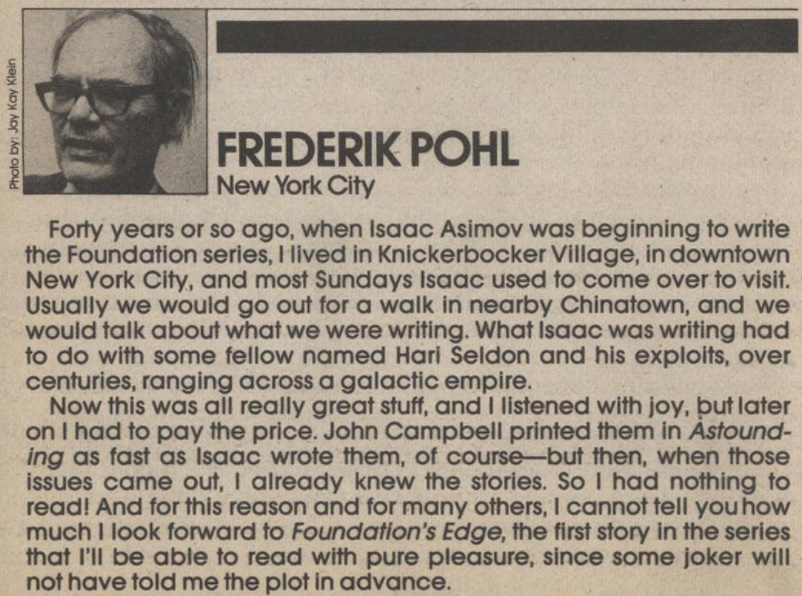
A commentary by Frederik Pohl, New York City

Forty years or so ago, when Isaac Asimov was beginning to write the Foundation series, I lived in Knickerbocker Village, in downtown New York City, and most Sundays Isaac used to come over to visit. Usually we would go out tor a walk in nearby Chinatown, and we would talk about what we were writing. What Isaac was writing had to do with some fellow named Flari Seldon and his exploits, over centuries, ranging across a galactic empire.

Now this was all really great stuff, and I listened with joy, but later on I had to pay the price. John Campbell printed them In Astounding as fast as Isaac wrote them, of course — but then, when those issues came out, I already knew the stories. So I had nothing to read! And for this reason and tor many others, I cannot tell you how much I look forward to Foundation’s Edge, the first story In the series that I'll be able to read with pure pleasure, since some joker will not have told me the plot In advance.

But of course, the main attraction here is the artwork: like the novel, these are the first Foundation illustrations in decades. Unlike the novel, these were not all that available in the subsequent forty-one years.

There are three nice images drawn by Vincent Di Fate. The first is the opening two-page spread of the excerpt.

The other two take up an entire page of the magazine each.

Two additional images reuse elements of images 2 and 3 above. This is lovely stuff and as I’ve said on our companion site, JosephFranké.com, great art deserves to be seen.

You can find out about Asimov’s Science Fiction Magazine online at www.asimovs.com. I scored my copy on eBay for a reasonable price.

Or, you can read the whole issue here: Asimov’s SF Magazine v06n12 1982-12.

All illustrations by Vincent Di Fate. You can learn more about his work at www.vincentdifate.com.

First Comics, Second Collection

Hi, everybody!

It’s been a while since I’ve had the time to post; I just finished an especially grueling and busy school year. Thanks for being patient!

But now summer break is upon us and I’ll be back at the keyboard for the foreseeable future. I thought I’d start back with another installment of our “First Comics” column.

You see just as I’ve had a hiatus from writing on the blog, there was a hiatus in my comic collecting as well. In the summer of 1976, comic books reached the egregiously high price of 30¢ and I had to finally do a cost/benefit analysis. At the time a paperback novel cost about 75¢ and that was a few hours of entertainment. Two comics were about a half-hour of enjoyment if you don’t count rereading and I stopped buying comics altogether. Cold-turkey you might say.

Fast-Forward to the early part of 1980. In the local 7-11, I noticed a comic cover that was instantly recognizable. “The New Avengers vs. The Old Avengers” it proclaimed! I remembered the cover because I had seen a house ad for Avengers Special #2 in Silver Surfer (1968) #2. Boy, how I wanted to read that! And here it was (well, the first half anyway) reprinted a decade later in Marvel Super Action #16! The 40¢ sticker price now didn’t bother me a bit; I plunked down some coinage and brought my find home.

And it was great! The story was written by Roy Thomas and drawn by the always-excellent Don Heck and Werner Roth. Don had drawn a lot of the Avengers stories I had read when they were reprinted in Marvel Triple Action; this was what a classic Avengers story was supposed to look like. The eye-catching cover was drawn by John Buscema.

The story is classic time-travel tale #3; something has gone wrong with the timeline and our heroes need to set things straight. Still, it’s a disservice to say only that.

So what happens? The Avengers traveled back in time to make sure Bucky actually had been killed in World War II. At the time, he had been.

This creates the opportunity for the Scarlet Centurion (who had been the Pharaoh Rama Tut and later became Kang the Conquerer back in issue #8) to alter the timeline. He encounters the original Avengers and tells them that Earth is threatened by a Cosmic Imbalance caused by an overabundance of superbeings.

There could be a virtual paradise created, the Centurion claims, if the Avengers eliminate them all and they do so, becoming ruthless dictators in the process. He would help make that happen.

In part 2 of the Special (or Marvel Super Action #17), the then-current Avengers search for Dr. Doom’s Time Machine to set things right. It’s been broken into three pieces and so the team splits up to retrieve them on one of those homages to All-Star comics that Roy Thomas does so well; Hawkeye and the Black Panther defeat Iron Man and the Hulk, Captain America manages to take down Thor and Goliath and the Wasp get the better of Giant-Man and the other Wasp. After assembling the time machine, the Avengers defeat the Centurion and (with a quick cameo by the Watcher to explain what’s going on) return the timeline to its normal shape. Everyone involved in the time travel hijinks moves forward with their lives with no memory of what has evidently been dubbed Earth-689 retroactively.

But boy, that was FUN! It made me remember my love of comics! And it might have ended there. I now had a collection of four (count ’em! 4!) comics, Super Action #s 16 and 17 and Amazing Spider-Man #s 185 (because graduating from college is a big deal) and 188 (no idea why probably because the cover was cool). There might be another universe out there where I still own only those four comics. Not in this universe though.

In this universe, I took a trip to the Palm Coast Plaza and visited the Two-On-A-Shelf Bookstore, a used bookshop I visited often. On this particular visit, I found a few brown paper bags filled with comics for 25¢ each.

One was filled with issues of Marvel Tales, from about issue 74 to 105 reprinting issues of Amazing Spider-Man from the 90s through the 120s. What a find, starting with Stan Lee’s final few issues but extending into the Gerry Conway/Ross Andru run! I knew these stories. I loved these stories. In fact, from my first go-round as a collector, I cannot remember a run of stories that I loved more. And now I had the chance to read them all back to back to back. And they held up; every bit as good as I remembered! If you wanted to remind me of how much I loved comics, this was the way to do it and random chance dropped it in my lap.

But what was in the other brown paper sacks? When I returned to Two-On-A-Shelf I found one other bag that interested me.

It contained the first 35 or so issues of Peter Parker, The Spectacular Spider-Man. These were a lot of fun too! The first three issues were again written by Gerry Conway and Sal Buscema was on the title as penciler for quite a bit longer. “Our Pal Sal” as he was called has become one of my favorite artists over the years. This run introduced me to some things I’d missed over the past few years: White Tiger, Moon Knight, and a team called the Champions to name just a few.

And so I started doing something new. Looking for issues of these titles at the 7-11 and the local newsstands. With fewer than 100 comics to my name, I’d become a collector again, more so in fact than I had ever been. Forty-two years and nearly 20,000 comics later I’m still collecting albeit a bit more slowly than I had been. And I’m still enjoying the books. I still have to wonder about that alternate universe. How different my life might be without those chance encounters with that eye-catching Avengers cover and that paper bag full of Marvel Tales. At the very least there would be a free room in our house and I probably would have never gotten to teach a class on comic books. Probably a lot more different than that though. And though I wonder, I wouldn’t want to make the trade.

100th “Issue” Special!

It’s been almost three short years, and here we are at the 100th post on Comics, The Universe and Everything! I hope you’ve been enjoying the ride!

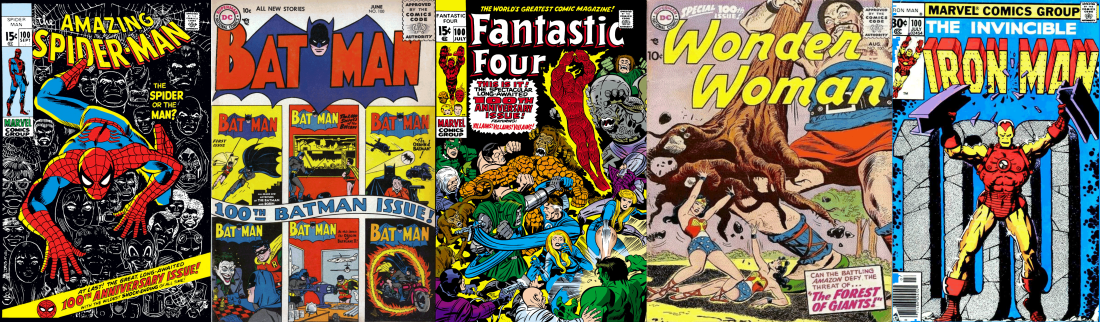
Anniversary Issues have become a big deal in the comics world, a universe where very few comics last long enough to have 100 issues. Indeed, some of the all-time most important series — All-Star Comics comes to mind — never made that milestone. And so we get big comics with epic stories and a plethora of guest stars or returning favorites. The Fantastic Four faced off against virtually all their foes! Spider-man became more spidery by growing 4 extra arms! I don’t remember what happened in Avengers 100 but the cover promises “the mightiest 100th issue of all!!” Also ten-damn-dollars for Amazing Spider-Man #800, but that’s another conversation.

For our 100th post spectacular, we’ll revive the “First Comics” column. I’ve written about my first comic as a collector (Action Comics # 425) and my first issue of Fantastic Four (#126). Today we’ll look at my First 100th issue, Justice League of America #100, August 1972. Ironically, #99 had been a double-sized issue. DC had tried to make their entire line of comics 52 pages for 25 cents but that experiment ended and issue 100 returned to the more modest size and price of 20 cents. A SPECIAL REGULAR-SIZED ISSUE!!

It was probably on the stands 49 years ago today as I write this and the next issue box from JLA #99 ramped up expectations!

This is about a year before, with all the seriousness a nine-year-old can muster, I decided I was a “comic book collector.” I only owned a handful of comics at this point but I knew I liked team books with lots of heroes and this one promised to fit the bill.

So let’s revisit the actual comic. It’s surprising how little happens in this issue.

It begins with some JLAers arriving at the team’s dusty, cobwebbed former headquarters ready to celebrate their hundredth meeting. That’s a bit on point, but okay. Green Arrow must have a dustbuster arrow or some nonsense that will help them clean up. Also, I have no idea why they’re holding this celebration in what looks like a cave while they have a perfectly good multi-million-dollar state-of-the-art satellite headquarters. Nostalgia, I suppose.

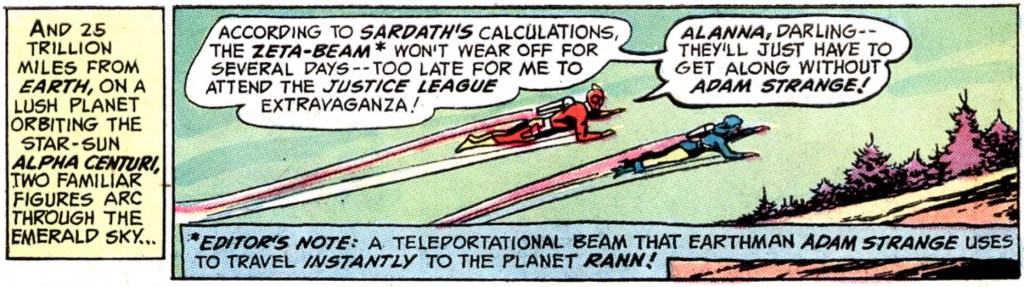
Their satellite, by the way, is in geosynchronous orbit which is 22,300 miles above the Earth’s surface and THAT is a fact that I learned from reading comics.

Everybody wants to attend the party. There are more than 2 pages of characters getting ready to go to, starting to go to, arriving at the cave, or bemoaning the fact that they can’t attend the party. DC takes the opportunity to pad the list of guest stars that they hyped in the last issue. Just saying, Adam Strange — one panel, Martian Manhunter — one panel, Snapper Carr — one panel. At least we see why Batman is too good to help clean up the cave; two low-level thugs need apprehending. Also, Diana Prince needs a lift. Doesn’t she have an invisible plane?

And there’s a cake with a big numeral on the top. Even at eight, I knew that was lame. Also, would someone please slap the crap out of Green Arrow?

Suddenly… as they say in the comics biz, everyone in the cave is teleported to Earth Two and we’re introduced to The Justice Society of America. America Two? I really like the JSA and for as long as I can remember I’ve liked them better than their Earth One counterparts. When I came back to comics in the 80s, I mostly read Marvel books before Crisis on Infinite Earths. Two of the exceptions were All-Star Squadron and Infinity, Inc. Because of the JSA connections.

That’s what makes this a personal key for me. As near as I can figure this was my introduction to the JSA as a group although I’d seen some reprints of their solo stories. Still, look at this! Cool gas mask, cool hood, cool goggles, cool helmet. Also, Wildcat has literal whiskers! Great stuff! And for me way more interesting than the everyday leaguers.

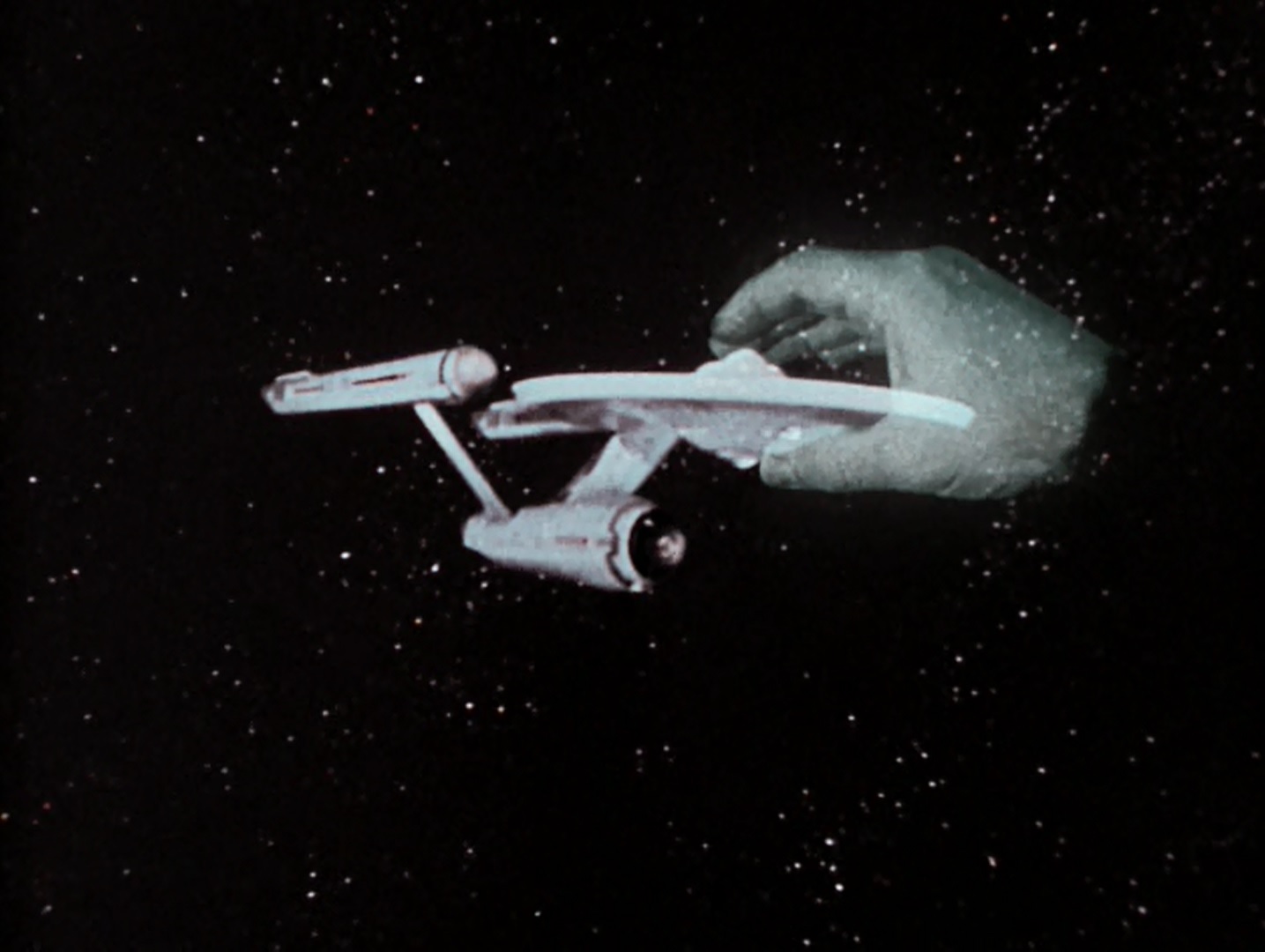
And here the book gets positively Asimovian. The JSA explains that their Earth is being gripped by a huge hand which has something to do with a villain called the Iron Hand. Clearly, Len Wein had been watching Star Trek.

With Zatanna’s help, Dr. Fate conjures an oracle who keeps on with all the long-winded explanations. The key to saving Earth Two from the Hand? Turns out it’s the Seven Soldiers of Victory (Well, eight really, but let’s say that’s about keeping the name alliterative and not about the fact that Wing was Asian). Anyhow, the 7SofV? Also pretty cool. But Stripsey? Bwah-haha! Oh, the 1940s, you can be so silly!

The last adventure of the Seven Soldiers had them encounter a menace called the Nebula Man who is somehow similar to that hand thing. We get an extended flashback. The 7SofV built a whatchamacallit to defeat the Nebula Man and that same thingamabob just might do the trick here. Luckily for their publicist, they’re victorious, although one of the soldiers sacrifices his life and the rest are taken out of time so they no longer exist. The contemporary Earth 2 heroes can’t really remember them.

Something almost happens; in an homage to the great JSA stories from All-Star Comics, everyone has to break into teams to retrieve the time-lost Seven Soldiers. In another homage, the Earth 1 Wonder Woman gets left behind to “brief anyone else who might arrive.” We get another flashback and now the coincidences are multiplying faster than the spiders in Miss Havisham’s wedding cake. That Iron Hand guy? He used to be known as merely “the Hand” and he was responsible for them becoming a team in the first place. We learn his early history with the team, which is ultimately their origin story.

Then something finally happens! We get to see the first team retrieve the first soldier from the depths of the past.

And as suddenly as the action began, it ends, because the pages have been successfully filled. We end with a couple of panels where the Iron Hand gives a typical over-the-top supervillain rant and vows that all these foolish heroes will not foil his plans. The next issue is hyped with a title that is almost a pun and the issue is over.

Overall this issue is mediocre; I poke fun but enjoyed revisiting the issue. The story, bringing two teams together to welcome a Golden Age group back into continuity is worthy of a 100th issue. But the pacing is a bit off and I wonder if this was planned for a double-sized issue and had to be reconfigured in a hurry when they decided to make all the titles regular-sized again. The JLA warranted a larger anniversary issue. Another hundred issues on they got one, a “Super-sized, star-studded 200th” issue if the cover is to be believed.

The story continues into JLA 101 and concludes in 102. It’s more of the same; the other groups of heroes rescue the remaining Soldiers of Victory and we get a lot of patent DC Weirdness along the way. We learn which soldier sacrificed his life and Diana, without any powers, gets to take down the Iron Hand. The weapon that the 7SofV built is recreated and this saga ends in a way parallel to the 7SofV’s last story; one of the JSA sacrifices his life to deploy the device and save Earth Two.

Rating: 2.5 out of 5.

59 Years of the Fantastic 4

Happy Belated Fantastic Four Day! Fifty-nine years ago this week Fantastic Four #1 hit the stands and to quote Aunt Petunia’s favorite nephew, “Nuthin’ was ever gonna be quite the same again.” The Fantastic Four is one of those things that I’ve liked as long as I remember. As a kid, I knew them first from their 1967 animated series. I don’t remember it that well; (it’s not like we form a lot of detailed memories when we’re three), but I liked it. Here are three personal firsts that are related to the Fantastic Four to mark the anniversary.

My First Fantastic Four Comic

The first Fantastic Four comic I remember buying was Fantastic Four #126 (September 1972). This was about a year before I decided I was “officially” collecting comics; I was getting comics pretty sporadically at the time. But what an amazing place to start! Inside, the title is “The Way It Began!” and the cover is a stunning recreation of Kirby’s cover to FF#1 drawn by the inimitable team of John Buscema and Joe Sinnott. This comic defined my mental picture of the FF for all time.

The story is good as well. Initially, Roy Thomas treats us to the standard flavor of family brouhaha with which Lee and Kirby brilliantly began so many issues. Reed tinkers and then does the absent-minded-professor thing. Ben and Johnny bicker. Sue tries to keep things on track. Also Alicia. Classic. This leads us into a framing sequence where Ben is reminiscing using Reed’s thought-projector helmet which does exactly what one would expect a thought-projector helmet to do.

The thought-projector helmet… erm… projecting thoughts.

Ben then narrates a shortened version of the origin from FF #1, which ends with the iconic image below. I expect that many copies of this issue are missing this page; it’s one of the quintessential team pin-ups.

Short summaries of the team’s first encounter with the Mole Man and the Mole Man story from issues 88-90 follow. In that last story, the Mole Man uses a device that blinds the team and Ben has an epiphany. If the Mole Man’s device can blind and cure the team, maybe he can use it to cure Alicia’s blindness. He storms off intending to help her.

After a year or two, FF #126 was made into one of those Power Records sets with the recorded dialogue. If Johnny’s voice sounds familiar, that’s Peter Fernandez, aka Speed Racer! (The “!” may be obligatory). Thanks to the magic of YouTube, you can experience the entire issue with the dialogue abbreviated somewhat here.

My First Blog Post.

Two years ago Marvel published a facsimile edition of Fantastic Four #1, part of the promotion for the latest series of Fantastic Four that started shortly thereafter. That seemed like a big deal at the time. “The World’s Greatest Comix Magazine” had been off the market since April 2015 because some executive at Marvel was having a pissing match with 21st Century Fox and didn’t want to do anything to promote Fox’s latest FF movie including publishing their own flagship title.

Anyway, I’d wanted to review the Facsimile edition. I’d previously done some short reviews that I posted on Facebook, like this one and this one here, but a Facebook post was utterly unsuitable for what I wanted to do for the Facsimile edition. I wrote All In Color for Forty Dimes and a week or so later I had a blog. This blog.

My First Fan Letter

https://cdn.flickeringmyth.com/wp-content/uploads/2018/09/694044._SX1280_QL80_TTD_.jpg

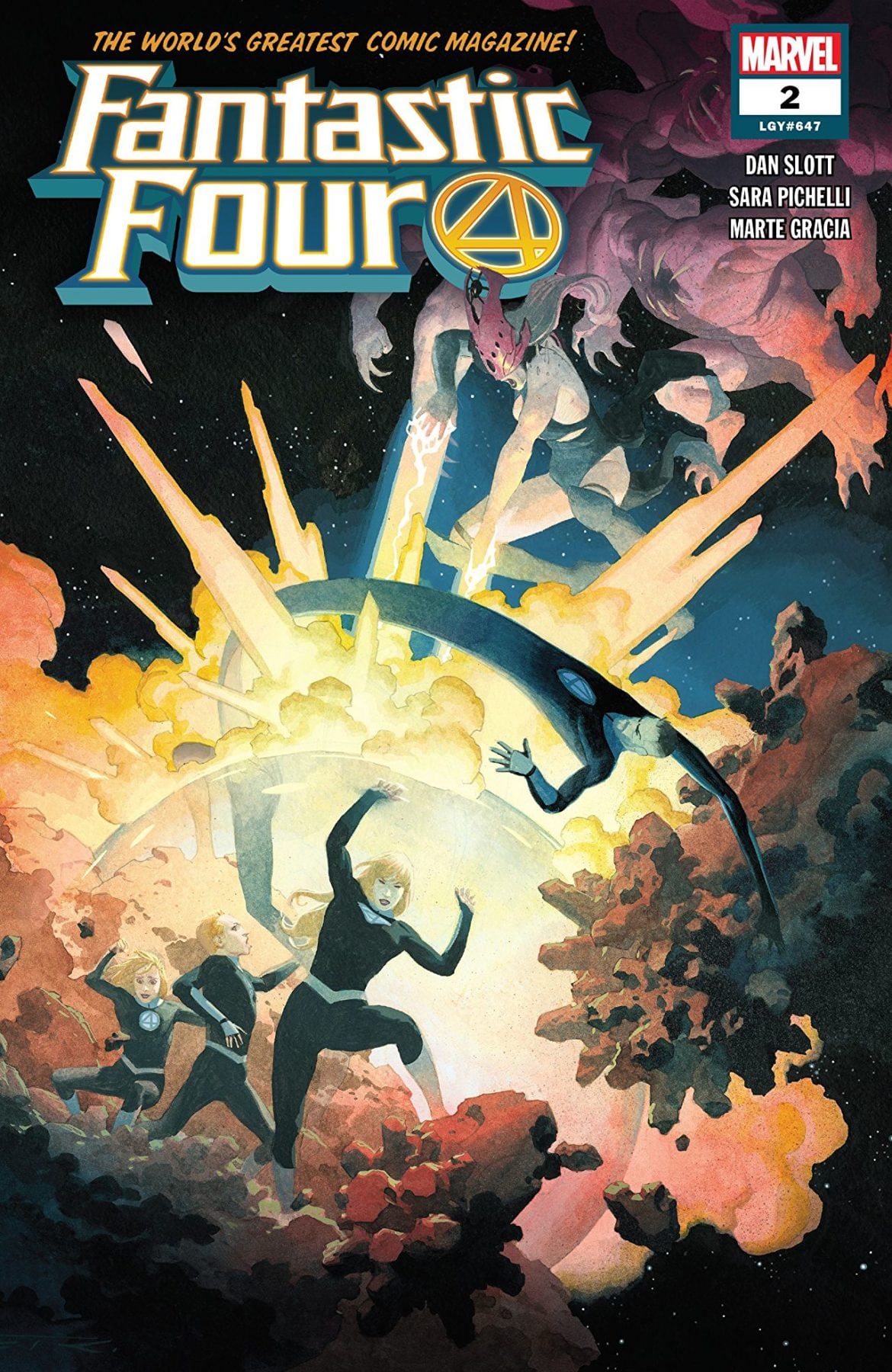
The letter itself is pretty self-explanatory. It wasn’t printed because as I now realize it’s much too long. For your edification, an open letter to Dan Slott, referencing Fantastic Four (2018) #2. What do you need to know about the book to appreciate the letter? Not too much. This is the first time we’ve seen Reed, Sue, and the kids since Secret Wars. They, along with Molecule Man and the Future Foundation have been rebuilding the multiverse one universe at a time. Franklin rebuilds the universes and then the group explores them; they’ve been at it for five years or so and time seems to have passed more quickly for them than it has on Earth. Franklin and Valeria are teenagers.

At some point, Franklin loses the ability to create universes. Evidently, all is now right with the multiverse; Franklin is done.

And the “Multiverse” has to fight back as the personification of one of the fundamental forces of nature.

Confrontation commences. It’s not pretty. Then this.

You can read the rest for yourself; here’s my letter.

Dear Dan,

Fantastic Four has been my favorite comic for almost forty years.  I’m thrilled to have Fantastic Four back on the spinner racks; the Marvel Universe doesn’t work correctly without its first family.  When I heard that you’d be helming the book, I was pleased.  You always seemed to have a good understanding of the characters; from their guest appearances in Amazing Spider-Man, to your 8-issues on The Thing and everything in between.

Issue 1 was an unadulterated pleasure.  I also really enjoyed issue 2, but there was one false note I’d like to address.

Reed is a tricky character to write; this was never more evident than in Civil War.  Tony is an engineer who thinks pragmatically.  His position in Civil War made sense.  Reed by contrast thinks like an academic working forward from first principles.  He has strong sense of right and wrong.  He should have been the first person to come over to Cap’s side, rather than the last.  Reed’s characterization in that series is wildly off the mark, it’s almost closer to Victor than it is to Reed.  Civil War 2, incidentally, showed us how necessary the Four are to the Marvel Universe.  In that series, Reed was the person we needed to refute Carol’s arguments, but Reed was unavailable.

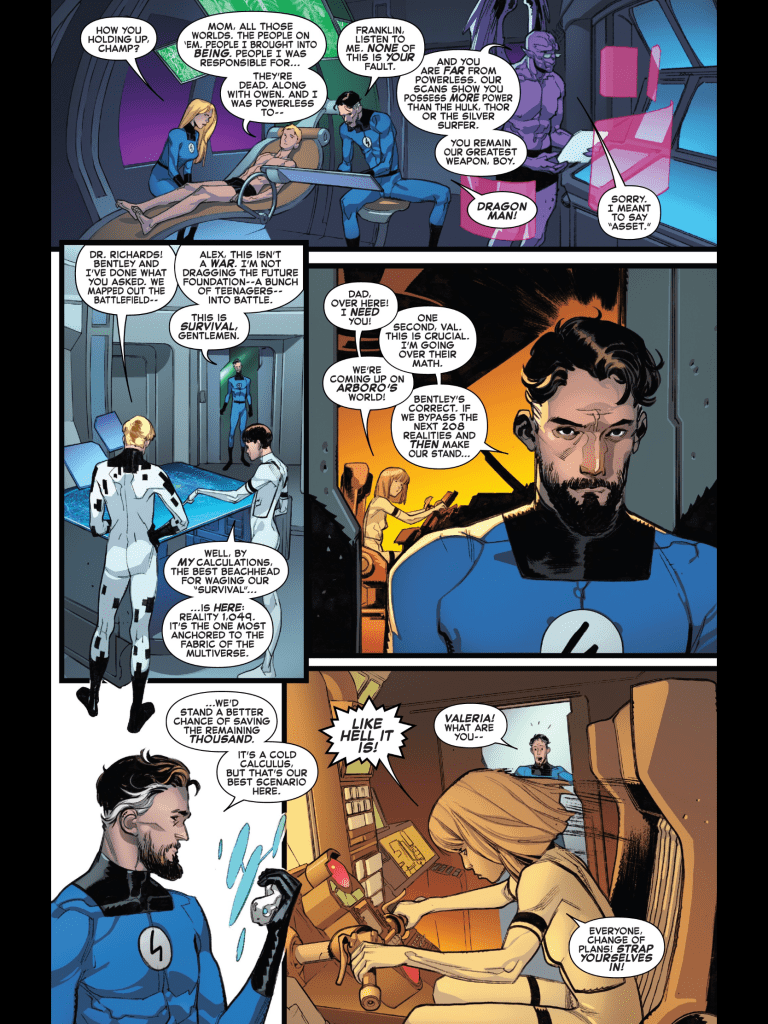
So what didn’t ring true in FF #647/2?  That Reed would bypass 208 realities teeming with life to secure a better chance of saving the rest.  Reed decides things based on principles, not pragmatics.  When Galactus lay dying, it was Reed who insisted on saving him despite the risk; Tony, the pragmatist, was overruled.  Reed is confident; he strode into the afterlife without hesitation to save Ben.  We see this confidence after the Future Foundation was routed by the Griever.  It should have been evident before then.  Reed doesn’t make tactical retreats nor does he take the easy way out.  In the Galactus Trilogy, a tactical decision might have been to try to quickly develop a way to preserve some life, while Galactus consumed the Earth’s energy.  Instead Reed confronted Galactus with the Ultimate Nullifier.  A riskier decision, but one that preserved virtually all life on Earth.

I hope this is helpful.  Aside from this, these first two issues were like a trip home.  You have to be careful writing Reed.  When you start pulling parts out of what makes him Mr. Fantastic, you could end up with the Maker and that would be a travesty.

Joseph F. Kolacinski
Horseheads, NY

Reed’s characterization has been hit-or-miss for a while; at least since Civil War. One of those posts that’s been waiting in the wings is called “Writing Reed Right,” but that’s a big undertaking. I don’t even have a guess as to when that might be finished.

Where’s a thought-projection helmet when you need one? I hope you enjoyed my reminiscences. We’re now on a twelve-month countdown to the 60th anniversary. We’ll need something pretty big for that. Any suggestions? Do you remember your first Fantastic Four comic? Let us know in the comments!

Adventures in Punditry

I like trying things I haven’t done before. A few years ago I got my one and only speeding ticket and I attended the court date. I’d never been to court before and it was interesting.

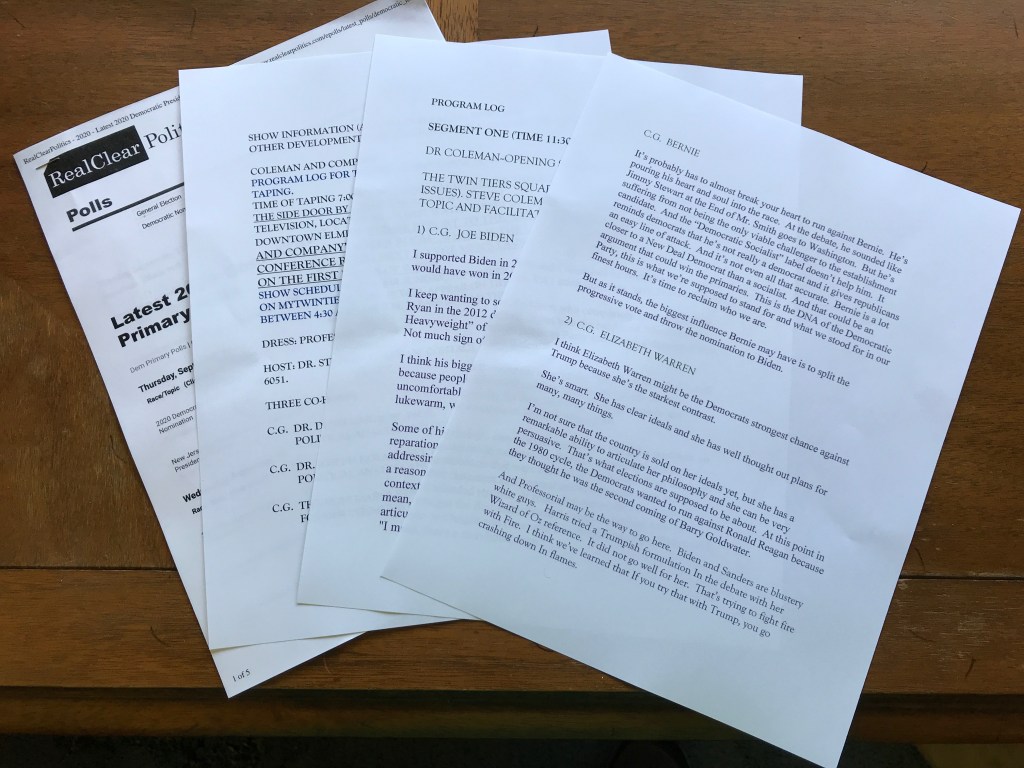
About two weeks ago, Steve Coleman, who was a Vice-President at Elmira College, invited me to be a guest on his local public affairs program. Steve’s been doing this sort of thing for years as a self-styled “Ph. D. of Politics.” Coleman and Company is now a weekly half-hour webcast that appears on Sunday evenings on MyTwinTiers.com, the website for the local WETM-18 news. Steve puts together an interesting show and it’s worth checking out.

And this isn’t just something new, this is something I’ve always wanted to try. I’m a politics junkie and I’ve been watching things like the McLaughlin Group or Face the Nation or The Rachel Maddow Show for years. I’ve done my share of groaning at the teevee and doing armchair punditry inside my own brain (“Eleanor! Pat’s just trying to wind you up! Don’t take the bait!!”). I always thought it looked like fun.

If you’re at all curious, the process was straightforward. Steve e-mailed his plan for the show to us on Sunday with an update on Tuesday so we’d know what to expect: presidential politics, impeachment, Iran, and then our own chance to sound off on something.

Over-Preparation

I was probably over-prepared. Joanne and I showed up at the studio about a half hour before we were set to tape on Thursday. We got to meet Denis Kingsley, the other guest, who is a real gentleman. Seeing the inside of the studio reminded me of my trip to the Johnson Space Center in Houston. The tour took us through Mission Control and standing in these spaces is utterly unlike what you’d expect.

We took our places and started the taping; taped, incidentally, “before a live studio audience” thanks to Joanne.

I probably should have cut Eleanor some slack. A lot of the stuff I’d thought about beforehand got left on the table because it was nowhere in my brain to be found when I needed it. I guess my biggest missed opportunity was after Denis asserted that Elizabeth Warren would be unelectable if she got the nomination. I should have pointed out that the person the Democrats really wanted to run against in 1980 was Ronald Reagan; they thought he’d be easy to beat. And no one seemed to honestly believe that Donald Trump could get the Republican nomination much less win the presidency in 2016. Some folks remained in denial until the electoral college actually voted. That, too, is why we have elections.

But this was a lovely experience. It was great fun and I really have to thank Steve for the opportunity. Unlike traffic court, I’d happily do this again.

So now I’m a bona fide “political analyst and commentator.” Coleman and Company featuring yours truly in the role of “company” is available on TwinTiers.com.

First Comics, Christmas Edition

Action 425It’s about a month on, but I thought I’d share one of my Christmas gifts with everyone. I got a copy of Action Comics #425 from my lovely wife, Joanne. It’s a beautiful copy for a 46-year-old book with an iconic Nick Cardy cover.

This book is a quasi-key for me for although it doesn’t have a historic story element or first appearance, it has an important place in my history as a collector.  Prior to this, I’d had limited exposure to comics.  I had some vague memories of the Fantastic Four, Spider-Man, and “The Marvel Super Heroes” cartoons, although I was convinced that that last was called “The Merry Marvel Marching Society” because of the closing theme (I have no recollection, what-so-ever of the opening theme btw).  I think I recall my Dad reading a Daredevil comic or two to me but, 50+ years later I’m not even sure that’s an actual memory and not some sort of mental ret-con.

Over the previous few months, I’d gotten a few comics and enjoyed them and as seriously as a 9-year-old could, I decided to become a “comic book collector,” whatever I thought that was.  I promptly marched out (as promptly as I could, anyway, given that I needed to amass 20¢) and picked up this issue.  This was my first comic as a collector.

I hadn’t reread this book for most of the intervening time, in fact, all I really recalled of it was that there was a “story about an emu.”  That’s still better than it could be, I suppose.  I can’t remember anything about my first Batman comic, although I know there must have been one since at some point in my life, I didn’t own any Batman comics, and now I own a few.

I’d made a few attempts to figure out what this “first official comic” was in the 80s to no avail.  I knew it was an Action, I thought it had an emu in it and I knew it came out sometime in 1973.  That’s surprisingly little to go on when your main resource is whatever happens to be in stock at your LCS.  Still, 45 years after I’d first picked up the issue, with some skills of google-fu and a visit to what a friend calls “that dark website,” I managed to track it down.

It’s easy to see why I’d have picked this book.  The cover is amazing.  It’s unusual in that the main hero isn’t the focus; the cover centers on some older kids reading a comic while a little red-haired kid is excited to see Superman flying by in the background.  I’m sure it spoke to me.  I can’t imagine a better cover to attract a kid who just decided to become a collector.

The interior of the book is less impressive.  There are three (count ’em! 3!) stories, which is a surprising number for a standard-sized comic.

Spoilers follow but come on… you’ve had 46 years people!

The Superman story begins in New Zealand when a hunter, Jon Halaway is attacked by a 12-foot tall flightless bird.  He kills it in self-defense.  It turns out, the bird was a Moa (Sorry, Emu fans). There were nine species of Moa in New Zealand, but all of them had been hunted to extinction by the year 1500.

img_4360

Halaway is distraught and becomes obsessed with this tragedy.  He searches and discovers the Moa had left an egg near an underground hot spring that emitted “strange fumes.” He wastes no time bringing the egg back to the States, where it becomes clear that it is sapping his life force.

img_4361

The egg hatches and the Moa develops some bizarre powers, including the ability to fly by flapping its feet.

img_4363

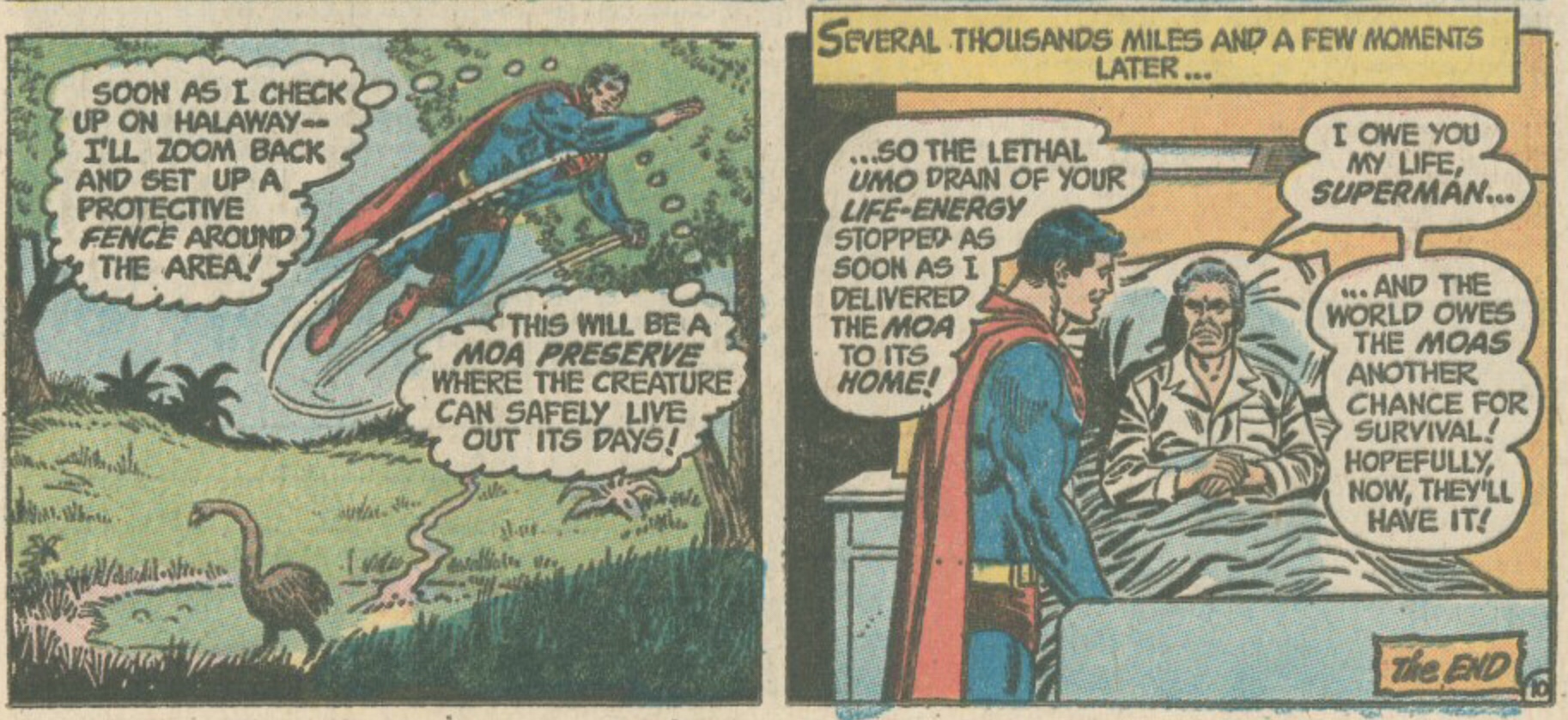
After getting telepathic messages from the Moa, Superman is able to return it to the hot spring, and Halaway recovers.

img_4364

It’s a pleasant, lightweight story, and I liked the conservational aspect.

The second story features the Atom though the title, “The 13 Men Who Run the World” is a bit of a bait and switch. A lot happens and is hung on a thin plot in a mere 6 1/2 pages. We discover that Ray’s size-control mechanism is malfunctioning and that Jean represents a biochemist who is accused of stealing gold from Fort Knox. Her client is being falsely linked to the aforementioned 13 men in the title. In quick succession, a witness who wants to come forward is murdered, Ray and Jean are kidnapped, we learn that the 13 men don’t actually exist, Ray beats the actual bad guys as the Atom and they are brought to justice.
img_4365

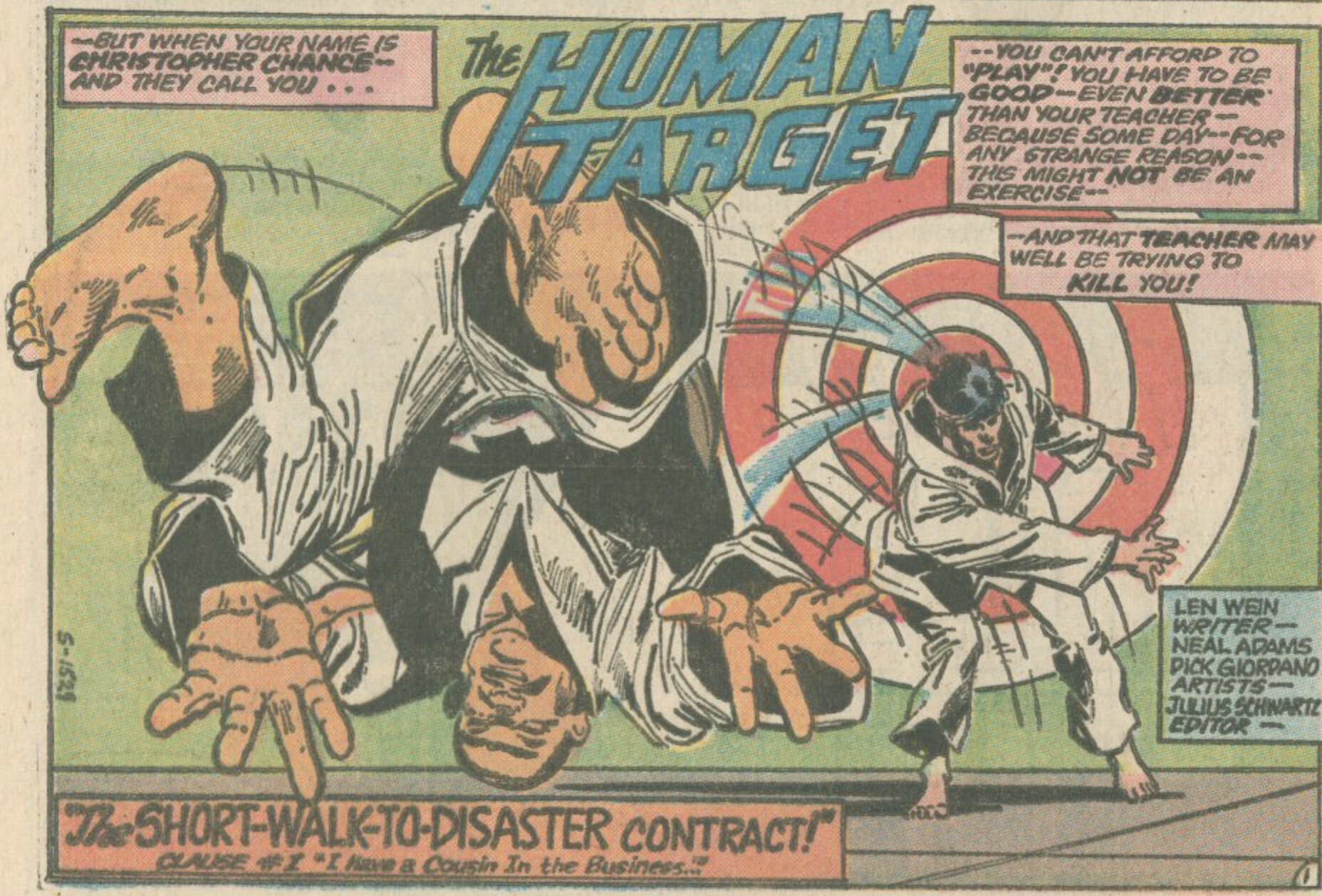
The final feature is the first installment of an early Human Target story and it stays close to the character’s formula: someone is in danger of being murdered and Christopher Chance assumes his identity to catch the killer. In this case, the potential victim is “the Great Antonio” who is scheduled to walk a tight rope across Niagara Falls.

img_4366

The ads are fun too. Did you know that a BB gun is an ideal way to convince your parents that you’re responsible enough for an actual, real gun? The ad doesn’t quite come out and say that, but I think the subtext is clear.  Evidently owning a B-B gun leads to responsible gunplay in later life.

img_4359

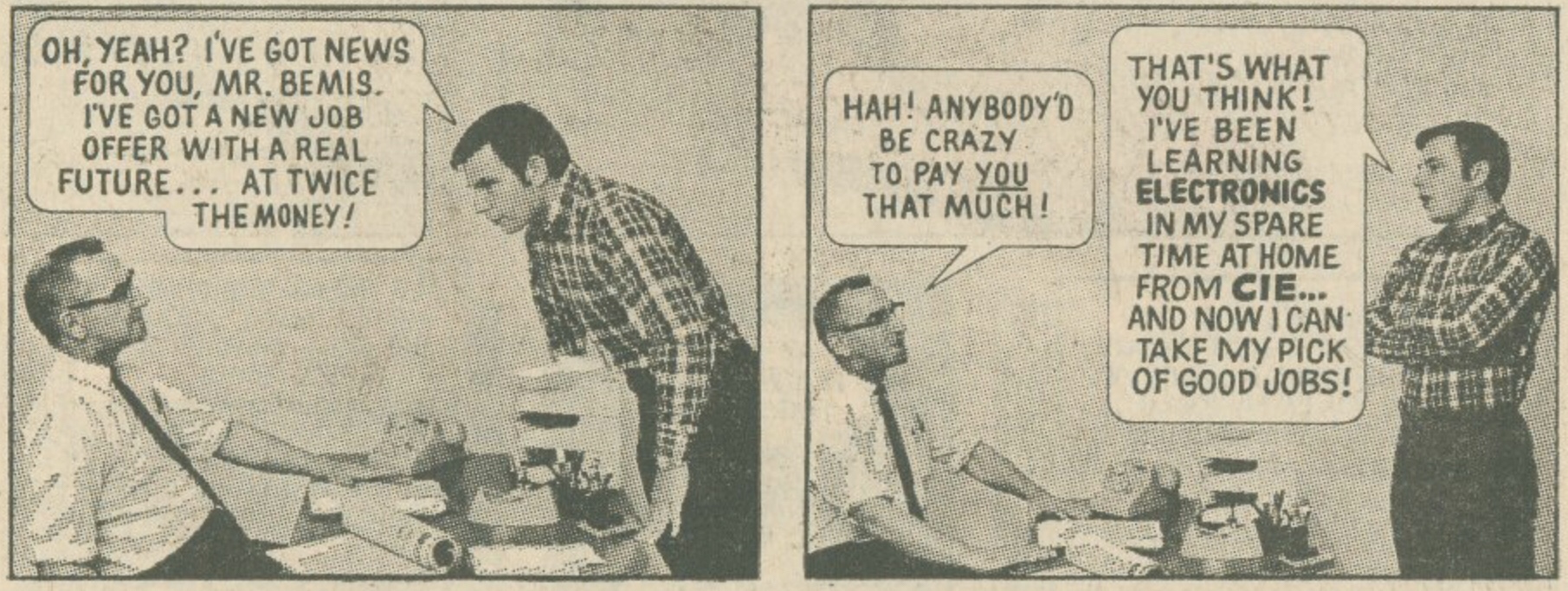
Also, you can get enough training from an outfit that advertises in comic books to get a good job in “electronics.” Mr. Bemis, by the way, is the name of Burgess Meredith’s character in the Twilight Zone episode “Time Enough at Last.”  Things do not end well for him.

img_4362

There are also 3 pages of ads for “Pirates of the Caribbean” model kits, which probably seemed excessive for the time and still seems excessive after 5 movies.  Also, also there are Sea Monkeys but not Polaris Nuclear Subs or x-ray glasses.

This book was a pleasant trip down memory lane.  It makes an interesting addition to my collection; it’s wildly different from the other books I have from the same time period.