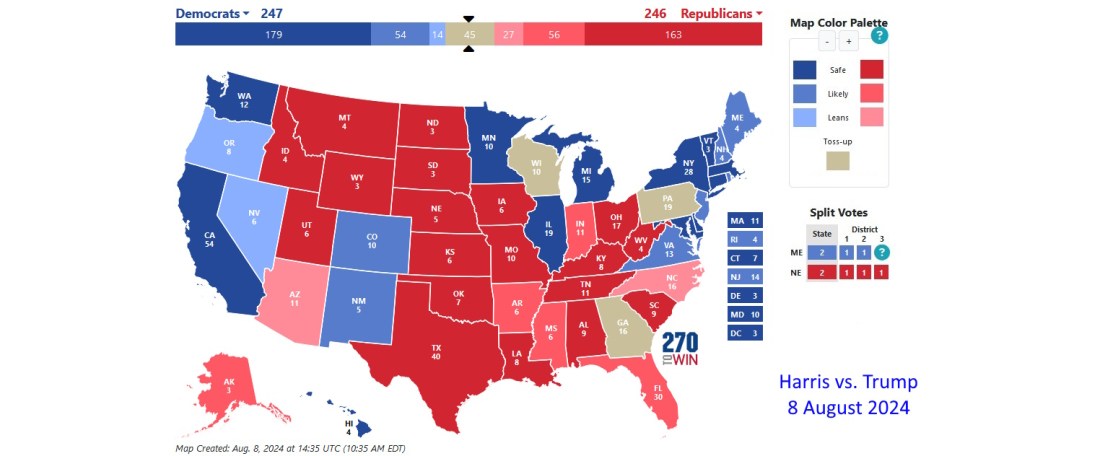
Since our last update, the Democratic Ticket has been campaigning across the country working to extend their momentum from the past two weeks. The big news there is the unveiling of Tim Walz as Harris’s running mate. They’ve been touring the swing states since the announcement and drawing large enthusiastic crowds.
JD Vance has been following them across the country trying to draw comparisons between the two campaigns. It’s been lackluster. The comparison is not helping the Republicans.
Meanwhile, Donald Trump has been mostly absent from the campaign trail; with only one sparsely attended rally in Montana and a press conference. I haven’t watched the press conference yet so I’ll reserve comments for now. The Trump Campaign holding a rally in Montana is mystifying. That’s a move you make when you’re on a clear path to victory and you can afford to spend resources on a Senate seat. His campaign has bigger issues. Was it about trying to get a rally with good attendance for a visual to counter those coming out of the Harris campaign? A positive event to get Trump back on the trail?
The narrative around the debates is mystifying as well. Trump began making up a possible debate on Fox News even before he debated President Biden. But the waffling, then canceling the debate, then insisting on the made-up Fox News debate, and finally canceling again all made Trump look frightened. Making up another debate and then insisting on three debates is a weird thing to do and is too little, too late.
The Harris/Walz tour of the swing states wraps up Saturday in Nevada.
Results:
Once again we entered the polling data into our model and ran 40,000 simulated elections. If the election were held today, it looks like Donald Trump would have about a 35% chance of winning with Vice President Harris winning about 64% of the time. The remaining 1% were Electoral College ties.
Again, I would emphasize that this is an estimate. There weren’t many state polls in the last week and using our scheme had an interesting effect: it turned out that every state ‘average’ was determined by a single poll.
This had its greatest effect in Michigan as the one poll used there is probably an outlier (Harris led by 11), which would make the probability of a Harris victory an overestimate.
Given this data, Harris is in the lead and the odds of her winning the election could be as good as 3 to 2.
Our scheme for finding our polling averages and creating the map can be found here: Methodology.
Trends:
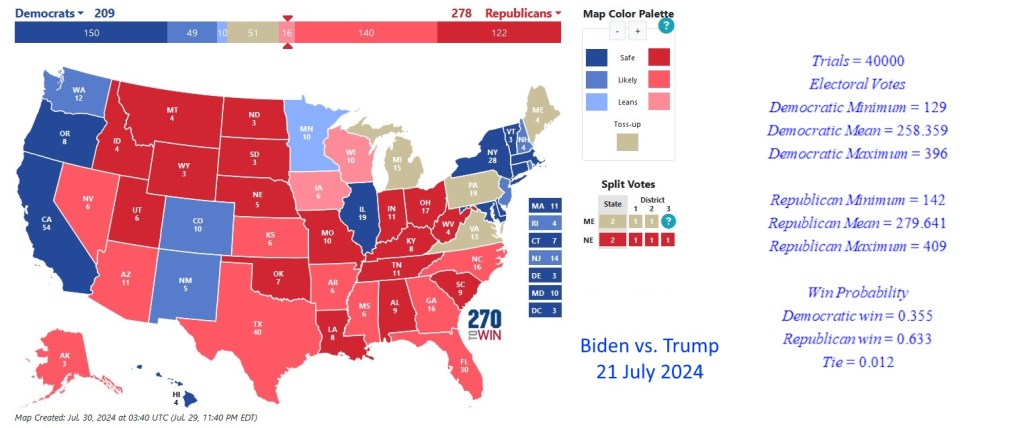
Trump was favored to win in our 21 July probability, and Harris pulled roughly even with him in our 31 July estimate. Now, for the moment, it’s safe to say that Harris has an edge. Strictly looking at the probabilities generated from the models, Harris’s probability of winning the election is roughly where Trump’s was on 21 July, between 63 and 64%. This is a complete turnaround in just under three weeks.
But that’s not the only evidence. Other predictive sites are showing similar results. Nate Silver now has Harris favored to win both the popular vote and the Electoral College. The New York Times/Siena College Poll released this morning has Harris leading Trump by 4 points in Wisconsin, Pennsylvania, and Michigan. The Cook Political Report has reclassified the race in Arizona, Georgia, and Nevada from “Lean Republican” to “Toss Up.”
The momentum remains on Harris’s side.
Last Words
It’s beginning to look like the campaign is the Democrats’ to lose. They have been able to dominate the news cycle and generate enthusiasm since the Republican Convention with President Biden’s withdrawal, followed by Harris introducing herself, the party unifying behind her, and then the announcement of Walz as Harris’s running mate. This could easily continue as the Democratic Convention will lead to hearings about Trump’s January 6th Election Interference Case which will bring us into early voting.
The Trump Campaign still seems unable to find its footing. They continue to throw whatever they can against the Democrats but nothing yet has really stuck outside of their MAGA base. With Vance drawing tiny crowds and Trump largely off the campaign trail it’s hard to see how they can turn this around. Right now it’s easy to find headlines like “Trump Campaign Bleeding Support…” or “Is Trump ‘Losing His Marbles.’“
Still, this election could go either way. Even if the probability of Trump winning the election is really at 35% (and many sites have it higher) that’s still about 10% better than his chances of winning the 2016 election. In that election, he exceeded expectations at every turn. While the Republican Party’s overconfidence in July is partly responsible for the current state of the election other overconfidence could still shake things up dramatically.
I’ve been publishing election projections for a few years now and I’ve been meaning to start publishing projections for 2024. With the big shake-up in the race, this seemed the ideal time to start.
This will actually be my second projection for this election. I did the first for my appearance on WETM’s Political Pundit Night on 9 May. At that point, Donald Trump would have had about a 66% chance of winning the election had it been held on that day.
But let’s get down to brass tacks as they say.
The State of the Race
It’s been a tumultuous few weeks after the race had been pretty stable for quite a long time. Of course, the tremors started with the first debate. You can read my analysis of that here. What’s the bottom line? President Biden gambled that a strong debate performance would shake things up and allow him to go on the offensive. That was not at all what happened.
At the debate, President Biden, coming off an exhausting travel schedule and with a cold, seemed feeble. Still, he mostly made sense. Trump, in contrast, spewed a torrent of falsehoods. His voice however sounded confident and assertive. The narrative coming out of the debate was heavily skewed toward the candidates’ presentation rather than the content of their answers. Calls began for Biden to withdraw from the ticket and that received the lion’s share of the media’s attention. Trump’s lies deserved equal attention.
The Trump campaign was uncharacteristically disciplined as the Democrats tried to regain their footing after the debate. By the time their convention rolled around the GOP thought they were riding a wave of inevitability to certain victory. This only intensified after the assassination attempt. They pandered to the fringe of their party by picking the problematic J. D. Vance as their vice-presidential candidate and some Republicans over-reached by trying to blame the assassination attempt on democratic rhetoric. None of that, amazingly, moved the needle very much.
That all changed when President Biden stepped aside and, as he put it, passed the torch onto a new generation by endorsing Vice President Harris. Over the last ten days, the Democrats have achieved a level of enthusiasm they have not reached in quite some time.
Results:
After entering the polling data into our model and running 40,000 simulated elections it appears that if the election were held today, Former President Trump would have about a 45% chance of winning. In contrast, Vice President Harris would win with a probability of 54%. The remaining results were electoral college ties.
I wouldn’t put too much faith in the units’s digit in those probabilities. Indiana, for example, landed in the “leaning Republican” category because of a single poll that was taken back in April. If it were in the “strongly Republican” category the probability of a republican victory would be somewhat but not dramatically better.
The bottom line is that this is now a competitive race with the two major candidates having about equal odds of victory.
Trends: What a Difference 10 Days Make
To get an idea of how the race is changing, let’s look at where the race was on 21 July, the day President Biden ended his candidacy.
At this point, Trump had about a 63% chance of winning the election. This was down a bit from the 8 May projection mainly because on 21 July despite the setbacks on the democratic side there were more states in the “Strongly Democratic” category and fewer that were “Strongly Republican.” This is mainly due to minor changes in my methodology for processing the polling data.
The best way to parse this is that the probability of a Trump victory fell from about 2/3 to roughly 1/2. This is a significant change in favor of Vice President Harris and at this moment the momentum is clearly on her side. This might settle down at this level in which case we would be looking at a close election. There are plenty of reasons to think that the momentum in Harris’s direction will continue for a while. Her pick for Vice President is imminent and the Democratic Convention follows quickly. The Republican Convention had little effect on the state of the race but we’ve known Donald Trump for years now. Harris though is still introducing herself and the data here indicates that voters like what they’ve seen so far. The Democratic Convention could move the needle dramatically as people get to know her and her Vice Presidential pick.
Methodology
The Polling Averages:
I took polling data from Electoral-Vote.com which avoids using partisan polls.
For the July 31st estimate: I took the mean of all the polls released after 21 July to get each state’s polling average. If a state had no polls after 21 July the most recent poll was used.
The July 21st polling averages were determined by taking the mean of the four most recent state polls or the mean of all the state polls after 1 April if there were fewer than four.
The polling averages were fed into a US Presidential Election Calculator; an earlier version of which can be found at MapleSoft Application Center.
The calculator runs a large number of simulated elections. The probability of each candidate winning is estimated by the percentage of the simulations won by each candidate.
The Map:
The colors on the map are determined by The polling estimate rather than by the probability that a candidate will win a state.
In each state, we use the polling estimate to find the conditional probability that an individual voter would choose either the Democrat or the Republican assuming they are voting for one of the major party candidates. Thus, to find, for example, the probability that a voter would choose the Democratic candidate, assuming they are voting for a major party nominee, we would calculate the following.
If a candidate is polling at 55%, the probability that he or she will win the state is actually quite a bit better than that.
For future installments, we’ll move this technical information to its own page and establish a consistent policy for creating state polling averages going forward.
Last Words
Although the Trump Campaign was smart to keep quiet as the Democrats argued over whether President Biden should withdraw from the race their response to having Harris at the top of the ticket has ranged from befuddled to panicky to weird. I didn’t expect that. It seemed to me the smart move would have been for Trump to declare victory. Something along the lines of “I’ve already beaten Joe Biden! He knew he was going to lose and he was too scared to stay in the race! I’ll beat the Democrats’ second choice just as easily.” That wouldn’t have been true but it’s a position of strength that would have been more effective than what we’re watching.
Waffling on the second debate was an unforced error. That’s a position of weakness that the Harris Campaign has been able to exploit. What would have been better? “Of course, I’ll debate Kamala. And you know what? I debated Biden and he was forced out of the race… who’s their next candidate going to be after I force her out of the race too?” This would take guts because if Harris wins that debate, and I think she will, it would be devastating. And there’s the rub. I believe that Trump is genuinely scared to debate her. Still, I’m happy to be wrong about Trump’s response to Biden’s withdrawal.
Where do we go from here? Trump and his campaign spent the Republican Convention trying to fire up their base. JD Vance was a choice intended to appeal to the right-wing fringe of the Republican Party. Vance isn’t going to bring any new voters to the Trump campaign but I suspect there are some Republicans who might feel motivated by his “childless cat-lady” comments.
With Harris at the top of the Democratic Ticket, the Trump Campaign needed to pivot and try to attract new voters. They should be walking back these comments. Instead, Vance doubled down on them.
And Donald Trump’s interview with the National Association of Black Journalists on Wednesday is more of the same. Trump was rude and belligerent. He attacked Harris for ‘changing her race’ whatever that means. We should, as a nation, collectively recoil from Trump’s remarks. Will we? This will not bring new voters to the Trump Campaign but Trump himself must think it will appeal to someone; he continued the racial attacks on Harris on Thursday. Even if we don’t recoil en masse, these remarks will repel most voters. If Trump doesn’t figure out how to run against Harris her momentum will continue and we’ll be looking at a landslide in November.
I’m two episodes into The Revolution with Steve Kornacki and it’s well-researched and fascinating. Still, as a history of one of the moments that has led to the deep dysfunction we see in today’s politics in the United States, it’s not entirely a fun listen.
On Election Day 1994 I remember proclaiming, “We will never see a Republican House of Representatives in our lifetime.” Close to 30 years later, I feel a little silly looking back on that. One of the first things Kornacki does, however, is to emphasize how staggeringly unanticipated the overthrow of the so-called “Permanent Democratic Majority” was. If nothing else, I feel a bit better.
The first episode does an excellent job of setting the stage, delineating Gingrich’s background, and describing the zeitgeist as he entered Congress, driven largely by the national tax revolt sparked by Proposition 13 in California.
And it gives a real sense of just how different Congress was in 1978. Many friendships crossed party lines and no one took offense or even notice. We hear from Ray LaHood, a former Republican Congressman who went on to serve as Transportation Secretary under President Obama, “Back in the day, there weren’t members on either side who were offended… because they knew people came to Congress to get things done and they came with the idea that the art of compromise was the way [to do that]. And not one of the 435 got their own way.” It was Gingrich who saw attacking your opponents as bad people as a viable strategy while Tip O’Neal supported the Republican leader and treated him like a team member.
It’s an interesting story. Hopefully, it will extend beyond Election Day to explore some of the changes Gingrich made during his speakership and their long-term consequences, like the shuttering of the Office of Technology Assessment.
There’s a lot to unpack about the current state of American Politics, and Gingrich is a key player in that history.
Here’s an interesting companion piece from the Al Franken Podcast:
I’ve had my head in data most of the day. There are some things I wanted to lead with, but we’re about to hit the big poll closings.
7:00
The first returns are in. Trump wins Indiana. No surprise. Everything else is too early to call. Trump looks like he’s leading in Florida, because of two, R leaning counties. So far he’s short of his 2016 totals, but it’s too early for that to mean anything.
Here’s something to start with. These are the states where the Candidates have an 80% or better chance of winning with the darker colors representing a probability of better than 90%. If Biden can merely hold these states, he wins.
Looking at what’s left here Biden has tons of paths to victory. Trump has but a few. That said, this could be very wrong.
7:18
MSNBC just called Vermont for Biden. No surprise. It looks like Biden is under-performing in Miami-Dade County. That’s not good, but maybe there’s something else that is going on there.
If you’re looking for bellwethers, if Trump wins NC or Maine 2, it’s going to be a long night. If Biden takes Florida or NC or Georgia, he probably has a clear path.
7:30
WV is too early to call. That may be a bad sign for Trump. Biden may be over-performing in a lot of Florida. In fact, (7:33) he just took the lead.
7:47
Florida doesn’t look good. It’s still early but my prediction that there’s a big shift toward Biden may be a bunch of crap.
17 states have poll closings at 8.
NYTimes has Trump with a 95% chance to win Florida.
Trump wins in Kentucky.
The New York Times has great tools and lots more results.
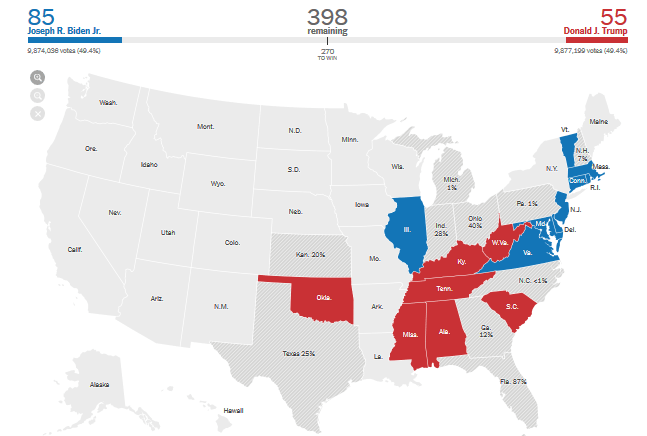
That’s 85 to 55 Biden. Things look surprisingly good in Texas though. Interesting.
McConnell wins in Kentucky. Not surprising, but disappointing.
More NYTimes. This is an awesome graphic.
8:33
Someone who supports QAnon won a House seat in Georgia. Things are going to get weird. These are the unintended consequences of gerrymandering.
8:39
Here’s a look at the Senate.
9:40
It’s going to come down to the same three states. Damn it.
12:52 PM Thursday
Well, that kind of went off the rails there; lots of things kept me from posting, sorry about that. So, where are we? Let’s start by updating the map at the top of the page
We’ve added the states that have been called. The lighter colors are states from our original map where either Trump or Biden had at least an 80% chance of winning in 538’s last projection. Nothing from that original map has changed hands. It’s still the case that if Biden holds these states, he will win the election.
Biden leads in Nevada and Arizona, which would put him at exactly 270. Trump is likely to win in Alaska and North Carolina. Georgia could go either way. Trump has a dwindling lead in Pennsylvania, but the remaining votes are likely to favor Biden.
The president, meanwhile, is doing what he claimed he would do for weeks or months. Declare victory on election night claiming to be ahead, presume that the states that went against him were rigged, and try to manufacture a victory through lawsuits.
You can’t declare victory until the votes have been counted. Part of the delay in getting the results is due to elections officials in Wisconsin, Michigan, and Pennsylvania being barred from counting early ballots before election day. They asked for relief on this, but they were rebuffed by republican state legislatures. This was part of the plan from the beginning, to give the president the illusion of leading in these states and the ability to create an atmosphere where he could claim that the election was being “stolen.” That isn’t true. What we’re seeing here is the inverse of what we saw on election night. Biden started with unrealistically large leads when the only votes that had been counted were early ones. As election night went on, we got more realistic results as the same-day votes were counted. We’re seeing the same thing in reverse now except that it’s the Biden-leading votes that are being counted last instead of the Trump-leaning ones.
Trump’s strategy here reminds me of G. W. Bush’s playbook from the 2000 recount. Turns out it’s even more offensive as a deliberate strategy than it was as an ad hoc response.
9:27 PM Thursday
The atmosphere is palpably energized. Trump’s lead in Georgia is below 2500 and the gap between the candidates is below 50,000 in Pennsylvania. It seems like we’re on the cusp of Biden pulling ahead in one of these states. Will we get a quick call after that? Don’t know.
Meanwhile, the president seems to be flailing. Claire McCaskill called the president’s speech a low point in American history. A presidential candidate calling an election into question is unprecedented. There’s a lot to unpack there; it was strange and troubling. He clearly thinks Red Ballots Matter More. But that isn’t true. All Ballots Matter.
9:40 pm
Now Georgia is within 2000 votes.
9:49 pm
Here’s another nice graphic from the NYTimes.
10:00 pm
What’s the state of the race? Trump leads in Pennsylvania and Georgia, but those leads are evaporating. Biden leads in Nevada and Arizona. The lead-in Arizona is shrinking, but the Biden campaign is confident it will hold. Trump will almost certainly win Alaska and looks safe in North Carolina.
10:28 pm
The palpable excitement had dissipated.
10:43 pm
The gap in PA is down to 26,000. According to MSNBC, It looks like Biden will overtake Trump at 4 or 5 am. I think earlier.
11:00 pm
I’m holding on for a bit to see if we get an update on Georgia. If Biden wins Georgia, that will put him up to 269 electoral votes, 1 vote away from victory. In the unlikely event that Trump wins everything else, that would be a 269-269 tie.
In that case, after the Electoral College votes, the election is decided by the House of Representatives. The democrats control the house, so you might think that would be good news for Biden. It isn’t. It’s a Trump victory. Why? The representatives don’t vote for President, the states do. Currently, the Republicans control 26 state delegations which would be enough for him to win. That’s unlikely to change after the election.
11:18
That’s enough for tonight. I’ll be back when there’s something to report.
11:22 am Friday
Good Morning! A lot has happened overnight. Biden pulled ahead in Pennsylvania and Georgia of all places. Here’s an appropriate song for this morning! I give you “Better Things” by the Kinks.
This means that Biden is leading in four of the six uncalled states with a total of 306 electoral votes. His lead in Pennsylvania is growing. Meanwhile, the latest results from Maricopa county make it unlikely that the president will be able to pull ahead in Arizona. In Nevada the latest votes being reported had Biden’s lead at about 22,000. At least one outfit has called the election for Biden.
11:00 pm
Back at it again. The last update from Pennsylvania put Biden’s lead at more than 0.5%. [Edit: It only looked that way with the rounded numbers the networks were using, this didn’t actually happen until a bit later.] That’s out of automatic recount territory. I think that will impel a call for Biden in the Pennsylvania race and then consequently the presidency.
Nothing looks especially different on the teevee at this point.
As an aside, on the news this (Friday) afternoon I saw a group of voters in Maricopa County AZ who were in line at the elections office in order to “cure” their ballots.
Evidently, in Arizona, if there’s an error on your ballot the Board of Election will contact you and allow you to come in and fix the discrepancy. This startles me and it’s an important statement about the importance of the franchise. Everyone’s vote is important and everyone’s vote should count. That’s a welcome and stark contrast to the politicians who are seeking to prevent votes from being counted, merely because they don’t think they’ll like the outcome.
8:34 am Saturday
I’ve been watching elections coverage for about an hour now. MSNBC seems to think that a call in the election is imminent. More data is on the horizon, probably at 9:00 am.
Joe Scarborough started his show by calling the 1976 Republican nomination for Gerald Ford. There’s a lot reasonable takes on Scarborough, but it seems certain that he should not do comedy.
These folks made an excellent point on the timing of the vote count. We know that the Governors of Wisconsin, Michigan, and Pennsylvania tried to allow their elections officials to start processing the early and mail-in ballots before the elections, but were stopped by the republican state legislatures. That led to a night that looked really good for the president. That was by design. Trump was planning to use the good coverage to try and force an early end to the counting and create an illusion of malfeasance. It’s an amazing disconnect on the order of the notion that we only have cases of coronavirus because we’re testing for it.
To America’s credit, by and large the president’s rhetoric was ignored and we continued to count the votes in a dignified and orderly manner. I’ve seen a number of secretaries of state being interviewed and doing news conferences and that’s dong nothing but increase my confidence in the system.
If these states had counted the mail-in ballots early, the focus on election night, the focus would have been on these states. If would have been clear from the start that Biden had a commending lead in Pennsylvania at least. The character of the coverage would have been fundamentally different and there would have nothing that even seemed suspicious.
9:10 am
From the Biden campaign. “Today seems to be the day.”
11:08 am
Another update from Maricopa County, Arizona. Trump won these votes with about 58%, cutting Biden’s lead to 20,500. If Trump does as well with the rest of the Maricopa County, that will cut Biden’s statewide lead to about 15,000. If I’m not mistaken, everything else in AZ is small.
11:30 am
That’s it! NBC is calling it for Biden!
11:35 am
Almost everyone’s on board pretty quickly. And it’s a little funny to see who the one holdout is.
11:40 am
This is a great moment. Here’s a song for today.
7:23 pm
We might be nearing the end of our Election Night Live Blog, but we’re here until after the President-Elect’s speech tonight.
It’s been genuinely moving to see all the people who are absolutely jubilant about the results of the election. It might be a function of the call being made on a Saturday morning, but I don’t remember ever seeing this kind of reaction to an election with the possible exception of 2008. The sense of relief in the crowds is palpable. The people partying talked about feeling hopeful, safer, and represented in ways that they haven’t for the last four years. In 1920 Warren Harding promised us a return to normalcy and one hundred years later we may actually have one.
And speaking of 100 years ago, it’s been a century since the passing of the 19th Amendment which didn’t give women the vote, but recognized that they should have had the franchise all along. There can be no more fitting commemoration of that anniversary than electing our first female vice-president.
Great remarks from both Harris and Biden. I liked the homages to both Obama and MLK. This is what a president is supposed to sound like and the commitment to be the President of all America is as welcome as it had been sorely missed. “Now let’s give each other a chance… this is a time to heal.”
Here’s the song (although not the version) that was playing when Biden concluded his remarks.
That last one seems pretty far off. I’m grateful to Avery Yeates, who was one of my Summer Research Students this year. We tweaked the Maple program I had been using a bit. We separated out the congressional districts in Maine and Nebraska and we ramped up the variance in the individual state elections. The old variance made sense for a weighted coin toss, where the probability is static. It didn’t reflect the variance we see in election results. We’re estimating the probabilities that a voter will vote for a candidate. These change over time, in fact, the entire point of campaigning is to shift those probabilities. I need to look at correlating the states that move together for 2024.
With that said, here’s my final prediction.
My gut tells me that there will have been a big shift in Biden’s direction over the weekend. It’s looking more and more like he is going to win and people like voting for a winner.
In addition, the news has not been good for President Trump. We’re hitting records for the number of new cases of Coronavirus each day and some of the behavior we’re seeing from a small segment of Trump supporters is downright disturbing. If there are any swing voter’s left, I think that pushes them in Biden’s direction. Of course, I could be completely wrong. I’m least confident that Texas will turn blue. They had a huge number of early voters and so, fewer people to be swayed over the weekend. On the other hand, some of the outrageous behavior seems to be motivated by the belief that Trump could lose.
If you’re curious about my track record, this contains my prediction for 2018.
I’ve been trying to find time to write about the election, but that seems more impossible by the day. On the other hand, I already have friends and family who are voting in Florida and the top-two primary system is on the ballot there. This one is time-sensitive.
Top-two simply isn’t a good idea. Our country desperately needs voting reform, but top-two isn’t voting reform, it’s doubling down on all the inherent problems of the plurality vote and making them a bit worse. Do you want real voting reform? Look for a group promoting instant run-off voting like they do in Maine, even better IMO, approval voting. The links take you to organizations doing just that.
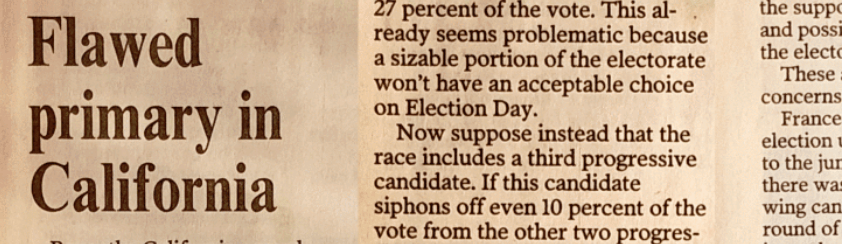
But first, do no harm. Here’s an opinion piece I wrote ten(!) years ago about the so-called “Jungle Primary.” It ran in the Star-Gazette, our local Elmira paper and the Binghamton paper and possibly one or two others across the state.
If I don’t force the issue from time to time there will be nothing new on this blog for months at a time. Most of my energy at the moment goes into preparing to teach, teaching, recuperating from teaching, grading, and tech support as we adapt again to our new online environment. Now I’m relearning stuff I had figured out back in May.
But I’d set the precedent of live blogging the debates and this one seems important enough that it’s worth a later night than usual. I probably won’t have the chance to make this one look pretty for a few days. So far I know that the debate was going to be at Notre Dame but it isn’t because COVID. Now it’s in Cleveland. Moderated by Chris Wallace of Fox News Sunday.
Leading into the debate, it seems to me that things aren’t going too well for President Trump. The NYT released his taxes over the weekend and it does not look good. That followed revelations about the President making some unfortunate comments about the military and the comments about possibly refusing to respect the results of the election are not a good look.
At this moment, the election looks like it’s Vice President Biden’s to lose. But I think he’s lost a step or two in the last few years. I think he needs to perform the way he did in the debate against Paul Ryan in 2012, but I wonder if he still has that in him. In any event, it’s a mistake to underestimate Donald Trump. He did nothing but exceed expectations in the 2016 election.
8:45
Hillary Clinton is on MSNBC giving advice. I’m having second thoughts already.
9:06
We start with SCOTUS, the elephant in the room. This is more reserved than I’m used to. Trump’s arguments here are already disingenuous.
9:08
Biden is sedate this evening, but the argument he’s making about the SCOTUS nomination is the right one.
9:11
This is an interesting exchange.
9:15
Trump is fighting with the moderator which is an interesting strategy. He rails against the individual mandate which is the thing that makes the ACA work.
9:18
Biden calls out Trump’s lies. Good line about getting lucky.
9:20
Trump is repeating things he said in 2016 that never played out. Biden: “Will you shut up man” and “This is so unpresidential.”
9:25
Trump is claiming that he saved thousands of lives and is blaming the “Fake News.”
H1N1 was a disaster??
9:33
Trump is claiming that Biden isn’t smart.
9:38
Trump seems to be especially transparent tonight. I think Biden’s hitting the right tone by just laughing at the President.
9:42
“I brought back football.” Hilarious.
9:44
Trump claims he paid millions in taxes in 2016.
Biden: “You’re the worst president this country has ever had.” My money’s still on Bush, but that made me laugh really hard.
9:50
I think the only way we could have a real debate between these two is to put them in separate rooms.
9:55
Decency. Yes. More of that, please.
9:57
Right at the racism. Nice. And the puzzled look on Biden’s face is priceless.
10:04
I need to train for these. One hour in and I’m fried.
10:11
“There has never been a president who has done more than I’ve done.” Is it because of the number of Judges? That ignores the obstruction under McConnell.
10:26
“Stand back and stand by” is easily the most chilling moment of this debate.
10:29
Biden’s been good on election security. But “We’ve caught them all?” Trump is incoherent on election security.
10:36
Trump refuses to ask his supporters to stay calm during an extended count. That’s troubling. Biden is strong here again.
Analysis:
I don’t think this will change anyone’s mind. It was a mess. Just watching it was exhausting. At best I think Trump was playing to his base which isn’t going to be enough.
I was going to say that this was a draw, but now I think the more we unpack what Trump said here the better Biden is going to look.
This was initially published yesterday as part of Prelude to Iowa. It looks like this scenario is playing out in real time so it deserves to be out on its own.
Beware of Paradoxical Results
You might think that first-past-the-post or the plurality vote is the worst voting system ever. You’d be wrong. In 2017, my student, Brandon Payne studied the Iowa Caucuses. He determined that the caucuses violate all sorts of mathematical “fairness criteria.” One example is the Condorcet criterion which states that if one candidate beats every other candidate in head-to-head match-ups, that candidate should be the overall winner. Such a candidate might not win the Iowa Caucuses.
Turns out, the viability constraint can also lead to seemingly contradictory results, which I’ll call the “viability paradox.” As a quick example, suppose that in some state, the voters have the following preferences.
Candidate A
35%
Candidate B
30%
Candidate C
12%
Candidate D
12%
Candidate E
11%
In a primary election, this would be a clear victory for candidate A.
Now let’s divide our state into five precincts of 100 voters each and let’s assign each precinct 10 delegates. We’ll conduct a caucus to allocate the delegates.
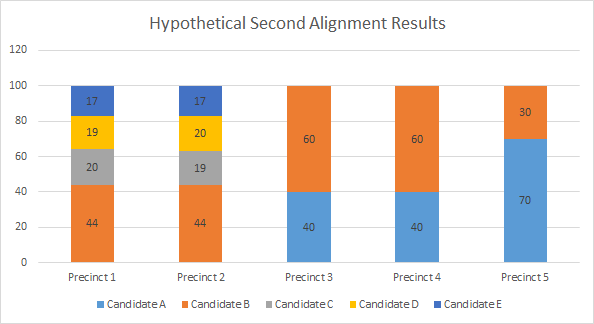
Suppose that the voters are arranged within the caucuses according to the graphic below.
Notice that there are non-viable candidate preference groups in each precinct. These voters will have to join a viable group in order to participate. They may reorganize themselves as shown below.
And so, in this case, Candidate B actually wins pretty decisively, probably 23 delegates to 15 delegates for A. Candidates C, D and E should get 4 delegates each.
There might be good reasons to decide that either candidate A or B is the rightful winner here, but one point is that there is a significant difference. Systems like this can lead to chaotic or paradoxical results. One important take away is that, right or wrong, geography can have a lot of influence on who the victor will be. Even if a candidate seems to be ahead in the polls, they can lose without any shenanigans going on, simply because how their voters are distributed across the state. Surprising results aren’t necessarily nefarious or even necessarily surprising.
You might even want to argue that results like this are a good thing because a lot of voters got to express their second choices. Here’s why you’d be wrong. It’s not systematic. In Instant Run-Off voting, for example, everybody’s second choice is counted unless their first choice is. In the caucus exactly whose second choices are counted is determined by an accident of geography. In deciding a winner between candidates A and B above, should the second choices of voters who picked candidate C in precinct 1 be less important than those in precinct 3? They shouldn’t be but in the current system they are. This is worse than a plurality vote because this could be taking us even farther away from a good collective decision.
In fact, it’s a bit worse than that. Apparently, the state weighs the delegate counts in rural counties a bit more heavily than their urban counties. If the Democrats who think we should dump the Electoral College are to have any intellectual consistency, they should reject these results and work to reform this process.
References
Payne, B., The Iowa Democratic Caucuses: A Mathematical Analysis of the “Vote,” Unpublished Manuscript.
These things happen on Tuesdays, right? Nope. Turns out it’s tonight. The democratic caucus was quite the roller coaster ride four years ago, perhaps we can hope for a more definitive result this time around. I plan to live blog the caucus and the results from my comfy couch in upstate New York. Results will be coming in shortly, which you can keep up with here: Iowa Results, Live.
How do the Caucuses Work?
Primaries are pretty straightforward; party members come out and vote for their preferred candidate, the votes are tallied and delegates are assigned based on the vote counts. There’s a certain amount to unpack there, but if you believe in the assumptions of first-past-the-post voting, primaries should make sense to you.
Caucuses on the other hand, can be kind of weird and I’m sure that most people don’t know what will happens at a caucus site in Iowa Tonight. Here’s what is scheduled to happen.
Caucus-goers will arrive at the site. Those who are not registered have the opportunity to do so, including people who want to change their party registrations and 17-year-olds who will turn 18 before Election Day in November. Only registered democrats are allowed to participate. The number of caucus-goers is established.
At 7:00 pm CST the Caucus is called to order. Representatives of campaigns may speak and caucus-goers may talk among themselves. After 30 minutes, every participant will join a “presidential preference group” or an “undecided” group. Volunteers will determine how many caucus-goers are in each group.
Each preference group’s viability is determined. If a candidate has the support of fewer than 15% of the participants at a caucus location, that group is considered non-viable. Members of that preference group will not be permitted to support that candidate without additional voters. If every candidate is viable, the caucus can proceed to step 5.
If one or more groups are non-viable, the members of those groups have four options. They can:
join a viable group,
merge with another non-viable group to form a viable group,
attempt to recruit members from a viable group to become viable or
leave the caucus. Every group must be viable before the caucus can end.
The size of each preference group is determined. Once every group is viable, the results can be officially recorded and released to the Iowa Democratic Party and the media. The caucus is declared closed.
Conventional Wisdom
This is all over the place. Nate Silver at fivethirtyeight.com last time I looked, had Biden as the favorite to win the caucus. Meanwhile the betting sites are giving the advantage to Sanders, who has led in the most recent polls. The very last, important poll will not be released. Still, it seems likely that one of these two men will wind up the victor. If I had to bet, I’d bet it will be Sanders. I still think he has enough of an enthusiasm gap on Biden to make the difference. But it’s a very different situation than it was 4 years ago. He isn’t the only challenger left standing.
If either Biden or Sanders wins both Iowa and New Hampshire, I think there’s a good chance that that person will go on to win the nomination.
Inherent in this relatively genteel tone is the belief that the candidates have time to sharpen the distinctions among them. But recent Democratic primaries indicate that they might not. In the past four contested Democratic primaries—2000, 2004, 2008, and 2016—the winner in Iowa has gone on to capture the nomination each time. The winnowing process has been swift and merciless: As I’ve calculated, in these four races combined, Democratic candidates who did not first win either Iowa or New Hampshire have won a total of just five states—and of those, three were the home or neighboring states of the candidates who won them. Not since 1992 have Democrats had a primary race in which more than two candidates won multiple states well into the process.
Ronald Brownstein in The Atlantic
The next tier of candidates seem to be betting on the race lasting long enough to make a mark. That may or may not be the case.
3:52 pm: You know what happens when you assume; I thought the Caucus was tomorrow, but as I was working on a companion piece, Prelude to Iowa I discovered that results were already coming in. So I’ll jump back and forth between the two posts. Prelude to Iowa will be published when there’s something complete enough to share.
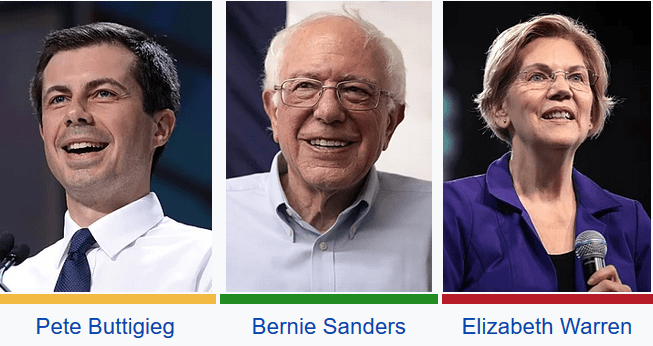
Early Lead for Sanders: We already have some results as the good folks in Ottumwa caucused earlier today. The final tally was 9 for Bernie Sanders, 6 for Elizabeth Warren and 3 for Pete Buttigeig. Klobuchar and Yang had some support in the first alignment but neither was viable. M*A*S*H fans will remember Ottumwa as the home town of Radar O’Reilly. I’m sure Walter would be proud.
6:08 pm: It sounds like Amy Klobuchar has won a satellite caucus somewhere in Florida. If there’s a surprise tonight, it will be her beating expectations, but I don’t think she’ll break into the top tier, NY Times endorsement or no.
7:00 pm:Prelude to Iowa is now live. More to come, only “How do the Caucuses Work?” is done for now.
7:53 pm: “Beware of Paradoxical Results” has been added to Prelude to Iowa. The caucuses are set to start any minute, I’m going to start paying attention to the news coverage.
8:00 pm: Turnout sounds high, possibly 15% over last year? That would be good news for Sanders.
8:03 pm: Biden group looks tiny in Iowa City. Entrance polls indicate a 4 way race, Biden, Sanders, Warren and Buttigieg.
8:16 pm: Nicole Wallace just claimed that traditionally Democrats are married to substance over elect-ability. That seems wrong. Lots of candidates look strong in Des Moines. MSNBC is promising full first and final alignment results.
8:33 pm: In Debuque, Warren and Klobuchar missed viability at least on the first alignment. Buttigeig is ahead of everybody there.
8:50 pm: Klobuchar will probably beat expectations. Based on the buzz the surprise might be bigger than I thought.
There’s a woman on the tv now making a strong case for Warren.
Record turnout on a number of different places. Oldest group is looking smaller while the youngest group is getting bigger. All good news for Sanders.
The difference between the under 30 and over 65 groups is stunning.
9:18 pm: There seems to be a lot of Amy/Pete synergy.
9:23 pm: Pete looks like he’s a lot of people’s #2. Could that be enough to push him to the top?
9:31 pm: Pete and Amy kill it in Clive, IA. Biden and Warren still viable. Bernie didn’t make viability there.
9:50 pm: There’s very little data being released. In Cedar Falls only Sanders, Warren and Buttgeig are viable. The formula for assigning delegates appears to be really complicated.
This lack of data is getting kind of tedious. I wonder if they’re worried about the different narratives the three different sets of numbers will tell.
11:20 pm: Finally something is happening. Klobuchar took the stage. This is smart. If no one else does, it will get tons of airplay.
11:30 pm: The secretary from Iowa Precinct 1-1 could not get his smart phone app to work and has been on hold to the “hotline” for over two hours.
12:19 pm: It’s a shame that Elizabeth Warren’s speech was tape delayed; it’s probably the strongest one of the night.
It doesn’t look like we’ll be getting any results tonight. That’s not a good look for the Iowa Caucus; there’s already talk about whether on not there will even be a Caucus in four years. If the nomination comes down to delegates from Iowa, we’ll all be up to our asses in conspiracy theories.
It could be doubly delayed, Biden’s lawyer sent the Iowa Democratic Party a letter wanting to see the results before they are released. That’s not a good look for the Biden campaign, although without any data what-so-ever it may tell us all we need to know about how he did tonight.
Pete: “Iowa you have shocked the nation!” That made me laugh really hard. He’s the last major candidate to speak I think, and they all did okay, but Warren still wins.


















 Comics, the Universe, and Everything