Live Blogging Election Day 2024

It’s 12:12 AM on election day and I may as well get this thing started. I’ll be adding stuff throughout the day and I’ll be live blogging the results come 7 PM on the East Coast.

My second priority is to get some sleep. That’s in a few minutes but right now I’m watching Dixville Notch New Hampshire cast the first ballots of the 2024 General election.

Is a nice start to the day, a display of pure democracy. The results are in and we have a 3 to 3 tie in Dixville Notch. I’ve been hoping this thing wouldn’t turn out to be as close as everyone seems to think. With luck this won’t be a harbinger of electoral tight ropes yet to come.

I’ll be adding a lot of stuff during the day. The featured image is an electoral map from my final probabilistic look at the election. That might be job number one when I get up. That or my final prediction.

In the meantime, you might be interested in my last probabilistic look at the election. That was a part of Dr. Steve Coleman‘s 37th political pundit night on October 24 th. That’s the video just below and I start at about 5:45 in.

More in the morning.

It’s 7:23 am! Good Morning.

I think I’ll start with my best guess on where the US Senate is going to land. First though, a quick commercial.

I’m mostly looking at the data on electoralvote.com. I’ve been following that site since 2004 and this year they are, IMO, the best source of well considered, clear minded, daily updates on the election.
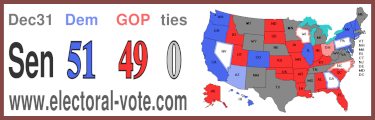
Click for www.electoral-vote.com

That link is supposed to update; you can get their current results by clicking the link.

Senate Projection

They currently have the Senate at 48 Democrats and 52 Republicans. I think it’s likely two of the four races that they rate as barely Republican will fall back to the Democratic side. That makes my prediction 50-50 with the winner of the vice presidency deciding Senate control.

There are a couple reasons for that. There are abortion referendums on the ballot in 10 states and since the Dobbs decision those have driven turnout that strongly favors the Democrats. Two of the four are well-regarded incumbents who have demonstrated their ability to win in Ohio and Montana. It also seems like Elon Musk is too inexperienced to be running GOTV efforts.

I’d like to be able to predict that Josh Hawley and Rick Scott will lose this time out but I think their states are too red for that.

Still, if there is an undetected blue wave 54 seats for the Democrats seems not impossibly insane. 

Presidential Projection

Well, now it’s 2:19 PM. The stupid day job, which I’m normally quite happy with keeps getting in the way of my geeking out on election stuff today. But after mulling it over in between all the other stuff, I’m ready to call this. At the macro level, I’m predicting Harris will win. She isn’t just leading in the probabilistic analysis that I have published today, but I think the buzz is good. She ended the campaign on a positive note and a professional one. In the meantime, there’s been even more weirdness than usual in the Trump campaign, and although that never seems to make much of a difference, I suspect this time will be a bit different.

The micro level is a bit more nuanced. I’m a bit gun shy after 2020. The Saturday before the election a Trump campaign caravan, which may have just been a bunch of his civilian supporters ran a Biden campaign bus off the road. I was pretty shaken by that and I thought when news went around, there would be a big swing in Biden‘s direction. It never materialized, so my “official” projection was way off.

My gut says that given the salience of women’s issues, the abortion issue, and the collective desire of the polling community to not underestimate Trump support this time plus a bunch of other things could have this swinging dramatically in Harris’s direction. But I’m not seeing that in the numbers. What I have seen is this particular configuration cropping up time and time again across my analysis and a bunch of other people’s analyses. Plus, even though the margins are small Harris has been consistently ahead for a week or more in the rustbelt states in Nevada.

That leads me to this projection 276 for Harris 262 for Trump. It wouldn’t surprise me if every swing state tilted in Harris’s direction or even if every swing state tilted together in one direction or the other. Based on the numbers, though this is my best guess.

2:56 PM

Here’s some interesting contacts to the Dixville notch numbers. At a first glance 3 to 3 look like looks like it portends a close election. Here are some context, though. These voters were four Republicans and two independents. all six of them voted for Nikki Haley in the Republican primary.

If the Haley voters split 50-50 between Harris and Trump, Donald Trump is toast.

7:24 PM

I got home and had dinner, and now I’m diving in. No real surprises so far except that it took 6 minutes to call Indiana for Trump. So, Kentucky and Indiana are called for Trump, and Vermont for Harris.

I’m looking forward to the live blog from electoral-vote.com.

7:28 pm.

Two minutes to closings at North Carolina, Ohio, and West Virginia.

Bernie Sanders is reelected in Vermont! Yay!

10 seconds.

I keep saying this: “Too Early to Call” is not a call. West Virginia is called for Trump. Jim Justice picked up the senate seat in WV. Also, we’ve been to the Moon.

7:45 PM

There has been a spate of bomb threats at polling locations in DeKalb County, GA. Biden won DeKalb in 2020 with 83% of the vote. Someone is scared.

7:57 PM

The polls close in sixteen states in mere minutes. It’s usually like this; there are always some red states that are called early. It will be nice to see Harris get some points on the board.

8:00 PM

Florida is called Trump. Not surprising but having grown up there it still makes me sad. So many states.

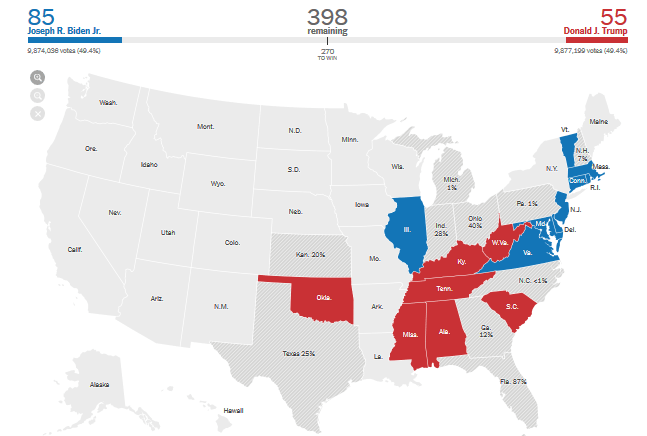
Here’s where we are from the NYTimes,
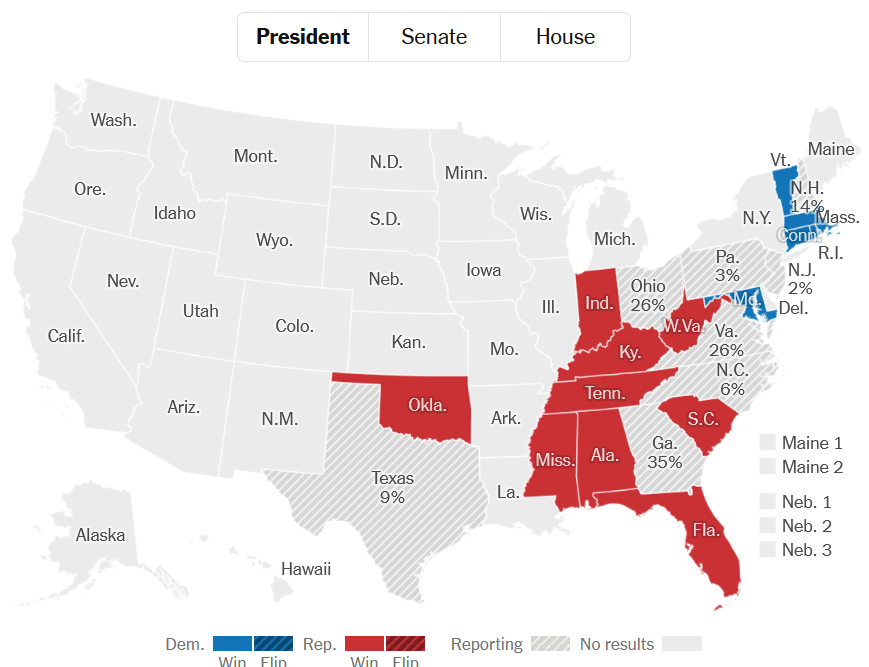
It looks like Harris is underperforming Biden in Georgia.

Harris is running up a big lead in Pennsylvania because this time, the mail ballots are being counted first. It makes me think a quote that’s attributed to LBJ, “Always count your votes last.”

Georgia and North Carolina seem to be on the ball counting the votes this time.

8:57 PM

In three minutes all but eight states will have closed their polls. We have closings from Arizona, Colorado, Iowa, Louisiana, Minnesota, Nebraska, Nevada, New Mexico, New York, Wisconsin, Wyoming.

Four or five calls for Trump, including Texas. Not even New York called for Harris. The democrats usually get off to a slow start in Electoral Votes but this is getting ridiculous.

Some of the signs of Harris underperforming and Trump overperforming in Georgia seem to be replicated in North Carolina. There are good signs in the urban areas but those could get swapped by the same-day votes.

9:24 PM

Sarah McBride is elected to Congress from Delaware. She will be the first openly transgender member of congress.

9:29 PM

New York called for Harris. Finally.

9:49 PM

A bunch of races and states that NBC had as “too early to call” have been recharacterized as “too close to call.” That is every Presidential and Senate race in Wisconsin, Michigan, and Pennsylvania.

There is reporting that there are long lines at college campuses in all the rust belt states. That’s a positive sign. There is also some good signs for Harris in suburbs in Georgia.

10:29 PM

I took some time off to finish the last Probabilistic Look at the Presidential Election. This is the disheartening part of the night.

10:38 PM

There are still people voting in Nevada who have a three hour wait. That means there will be no data out of Nevada until at least 2 AM.

11:18 PM

Moreno is projected to be the winner of the Senate Seat in Ohio. That’s a huge loss. Brown was an outstanding Senator. Still, that means that the Republicans will almost certainly control the Senate next year.

I’m hearing second hand reports from the Harris campaign. I’m afraid it sound’s like whistling through a graveyard. I want to be wrong here.

They just called Connecticut for Harris. The mere fact that that took hours is a bad sign. Kornacki is talking Trump making big gains in Virginia, New Jersey, and New York. Those are safe blue states but these are not good signs.

11:35 PM

I want some analysis about the effects of the coordinated series of bomb threats that we saw throughout the country. Polling places were cleared; there was a chilling effect on the voters affected. Could this have swung a state or two? Were the precincts targeted at random were the calls targeted at Democratic leaning locations? I have a lot of questions.

11:40 PM

North Carolina is called for Trump. I expected it but I was hoping it would turn out otherwise.

12:12 AM

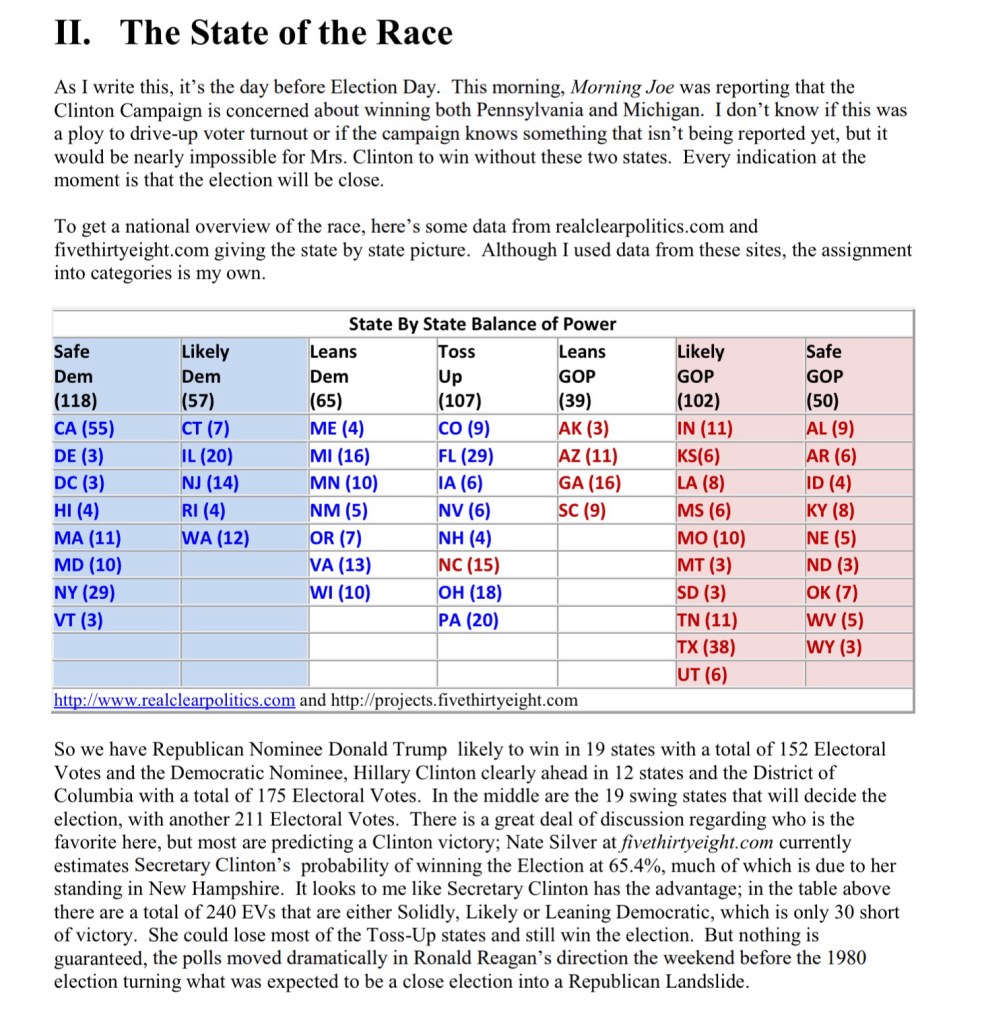
Let’s check in on the state of the race.

12:26 AM

I’m probably going to hang this up for this evening. Pennsylvania isn’t looking good (well, not just Pennsylvania). The talking heads on the teevee sound like they’re already doing an autopsy.

Has Donald Trump declared victory yet? That’s a weird amount of discipline for that gentleman.

I’ll jump back on if anything significant happens assuming I’m still awake. I may not sleep for four years.

12:35 PM

And just as I write that the call Georgia for Trump. Harris still has a path to victory but it’s frighteningly narrow. There are also a number of states that should not have been swing states that remain to be called.

They’ve called the Senate races in Nebraska (no, the other one) and Utah for Republicans Deb Fischer and John Curtis. That clinches Senate control for the Republicans.

The Harris campaign co-chair just gave a lackluster address and told Harris’s supporters to go home for the evening but that she will address the nation tomorrow. Donald Trump is leading in four of the remaining swing states.

New Mexico has finally been called for Harris and they called Virginia when I wasn’t looking.

1:00

All the polls are closed as voting wraps up in Alaska.

Live Blogging Election Night 2020

I’ve had my head in data most of the day. There are some things I wanted to lead with, but we’re about to hit the big poll closings.

7:00

The first returns are in. Trump wins Indiana. No surprise. Everything else is too early to call. Trump looks like he’s leading in Florida, because of two, R leaning counties. So far he’s short of his 2016 totals, but it’s too early for that to mean anything.

Here’s something to start with. These are the states where the Candidates have an 80% or better chance of winning with the darker colors representing a probability of better than 90%. If Biden can merely hold these states, he wins.

Looking at what’s left here Biden has tons of paths to victory. Trump has but a few. That said, this could be very wrong.

7:18

MSNBC just called Vermont for Biden. No surprise. It looks like Biden is under-performing in Miami-Dade County. That’s not good, but maybe there’s something else that is going on there.

If you’re looking for bellwethers, if Trump wins NC or Maine 2, it’s going to be a long night. If Biden takes Florida or NC or Georgia, he probably has a clear path.

7:30

WV is too early to call. That may be a bad sign for Trump. Biden may be over-performing in a lot of Florida. In fact, (7:33) he just took the lead.

7:47

Florida doesn’t look good. It’s still early but my prediction that there’s a big shift toward Biden may be a bunch of crap.

17 states have poll closings at 8.

NYTimes has Trump with a 95% chance to win Florida.

Trump wins in Kentucky.

The New York Times has great tools and lots more results.

That’s 85 to 55 Biden. Things look surprisingly good in Texas though. Interesting.

McConnell wins in Kentucky. Not surprising, but disappointing.

More NYTimes. This is an awesome graphic.

8:33

Someone who supports QAnon won a House seat in Georgia. Things are going to get weird. These are the unintended consequences of gerrymandering.

8:39

Here’s a look at the Senate.

9:40

It’s going to come down to the same three states. Damn it.

12:52 PM Thursday

Well, that kind of went off the rails there; lots of things kept me from posting, sorry about that. So, where are we? Let’s start by updating the map at the top of the page

We’ve added the states that have been called. The lighter colors are states from our original map where either Trump or Biden had at least an 80% chance of winning in 538’s last projection. Nothing from that original map has changed hands. It’s still the case that if Biden holds these states, he will win the election.

Biden leads in Nevada and Arizona, which would put him at exactly 270. Trump is likely to win in Alaska and North Carolina. Georgia could go either way. Trump has a dwindling lead in Pennsylvania, but the remaining votes are likely to favor Biden.

The president, meanwhile, is doing what he claimed he would do for weeks or months. Declare victory on election night claiming to be ahead, presume that the states that went against him were rigged, and try to manufacture a victory through lawsuits.

You can’t declare victory until the votes have been counted. Part of the delay in getting the results is due to elections officials in Wisconsin, Michigan, and Pennsylvania being barred from counting early ballots before election day. They asked for relief on this, but they were rebuffed by republican state legislatures. This was part of the plan from the beginning, to give the president the illusion of leading in these states and the ability to create an atmosphere where he could claim that the election was being “stolen.” That isn’t true. What we’re seeing here is the inverse of what we saw on election night. Biden started with unrealistically large leads when the only votes that had been counted were early ones. As election night went on, we got more realistic results as the same-day votes were counted. We’re seeing the same thing in reverse now except that it’s the Biden-leading votes that are being counted last instead of the Trump-leaning ones.

Trump’s strategy here reminds me of G. W. Bush’s playbook from the 2000 recount. Turns out it’s even more offensive as a deliberate strategy than it was as an ad hoc response.

9:27 PM Thursday

The atmosphere is palpably energized. Trump’s lead in Georgia is below 2500 and the gap between the candidates is below 50,000 in Pennsylvania. It seems like we’re on the cusp of Biden pulling ahead in one of these states. Will we get a quick call after that? Don’t know.

Meanwhile, the president seems to be flailing. Claire McCaskill called the president’s speech a low point in American history. A presidential candidate calling an election into question is unprecedented. There’s a lot to unpack there; it was strange and troubling. He clearly thinks Red Ballots Matter More. But that isn’t true. All Ballots Matter.

9:40 pm

Now Georgia is within 2000 votes.

9:49 pm

Here’s another nice graphic from the NYTimes.

10:00 pm

What’s the state of the race? Trump leads in Pennsylvania and Georgia, but those leads are evaporating. Biden leads in Nevada and Arizona. The lead-in Arizona is shrinking, but the Biden campaign is confident it will hold. Trump will almost certainly win Alaska and looks safe in North Carolina.

10:28 pm

The palpable excitement had dissipated.

10:43 pm

The gap in PA is down to 26,000. According to MSNBC, It looks like Biden will overtake Trump at 4 or 5 am. I think earlier.

11:00 pm

I’m holding on for a bit to see if we get an update on Georgia. If Biden wins Georgia, that will put him up to 269 electoral votes, 1 vote away from victory. In the unlikely event that Trump wins everything else, that would be a 269-269 tie.

In that case, after the Electoral College votes, the election is decided by the House of Representatives. The democrats control the house, so you might think that would be good news for Biden. It isn’t. It’s a Trump victory. Why? The representatives don’t vote for President, the states do. Currently, the Republicans control 26 state delegations which would be enough for him to win. That’s unlikely to change after the election.

11:18

That’s enough for tonight. I’ll be back when there’s something to report.

11:22 am Friday

Good Morning! A lot has happened overnight. Biden pulled ahead in Pennsylvania and Georgia of all places. Here’s an appropriate song for this morning! I give you “Better Things” by the Kinks.

This means that Biden is leading in four of the six uncalled states with a total of 306 electoral votes. His lead in Pennsylvania is growing. Meanwhile, the latest results from Maricopa county make it unlikely that the president will be able to pull ahead in Arizona. In Nevada the latest votes being reported had Biden’s lead at about 22,000. At least one outfit has called the election for Biden.

11:00 pm

Back at it again. The last update from Pennsylvania put Biden’s lead at more than 0.5%. [Edit: It only looked that way with the rounded numbers the networks were using, this didn’t actually happen until a bit later.] That’s out of automatic recount territory. I think that will impel a call for Biden in the Pennsylvania race and then consequently the presidency.

Nothing looks especially different on the teevee at this point.

As an aside, on the news this (Friday) afternoon I saw a group of voters in Maricopa County AZ who were in line at the elections office in order to “cure” their ballots.

What is ballot ‘curing?’

Evidently, in Arizona, if there’s an error on your ballot the Board of Election will contact you and allow you to come in and fix the discrepancy. This startles me and it’s an important statement about the importance of the franchise. Everyone’s vote is important and everyone’s vote should count. That’s a welcome and stark contrast to the politicians who are seeking to prevent votes from being counted, merely because they don’t think they’ll like the outcome.

8:34 am Saturday

I’ve been watching elections coverage for about an hour now. MSNBC seems to think that a call in the election is imminent. More data is on the horizon, probably at 9:00 am.

Joe Scarborough started his show by calling the 1976 Republican nomination for Gerald Ford. There’s a lot reasonable takes on Scarborough, but it seems certain that he should not do comedy.

These folks made an excellent point on the timing of the vote count. We know that the Governors of Wisconsin, Michigan, and Pennsylvania tried to allow their elections officials to start processing the early and mail-in ballots before the elections, but were stopped by the republican state legislatures. That led to a night that looked really good for the president. That was by design. Trump was planning to use the good coverage to try and force an early end to the counting and create an illusion of malfeasance. It’s an amazing disconnect on the order of the notion that we only have cases of coronavirus because we’re testing for it.

To America’s credit, by and large the president’s rhetoric was ignored and we continued to count the votes in a dignified and orderly manner. I’ve seen a number of secretaries of state being interviewed and doing news conferences and that’s dong nothing but increase my confidence in the system.

If these states had counted the mail-in ballots early, the focus on election night, the focus would have been on these states. If would have been clear from the start that Biden had a commending lead in Pennsylvania at least. The character of the coverage would have been fundamentally different and there would have nothing that even seemed suspicious.

9:10 am

From the Biden campaign. “Today seems to be the day.”

11:08 am

Another update from Maricopa County, Arizona. Trump won these votes with about 58%, cutting Biden’s lead to 20,500. If Trump does as well with the rest of the Maricopa County, that will cut Biden’s statewide lead to about 15,000. If I’m not mistaken, everything else in AZ is small.

11:30 am

That’s it! NBC is calling it for Biden!

11:35 am

Almost everyone’s on board pretty quickly. And it’s a little funny to see who the one holdout is.

11:40 am

This is a great moment. Here’s a song for today.

7:23 pm

We might be nearing the end of our Election Night Live Blog, but we’re here until after the President-Elect’s speech tonight.

It’s been genuinely moving to see all the people who are absolutely jubilant about the results of the election. It might be a function of the call being made on a Saturday morning, but I don’t remember ever seeing this kind of reaction to an election with the possible exception of 2008. The sense of relief in the crowds is palpable. The people partying talked about feeling hopeful, safer, and represented in ways that they haven’t for the last four years. In 1920 Warren Harding promised us a return to normalcy and one hundred years later we may actually have one.

And speaking of 100 years ago, it’s been a century since the passing of the 19th Amendment which didn’t give women the vote, but recognized that they should have had the franchise all along. There can be no more fitting commemoration of that anniversary than electing our first female vice-president.

8:28 pm

“The people have chosen empathy.” Nice.

8:58 pm

You can watch the both speeches here.

Great remarks from both Harris and Biden. I liked the homages to both Obama and MLK. This is what a president is supposed to sound like and the commitment to be the President of all America is as welcome as it had been sorely missed. “Now let’s give each other a chance… this is a time to heal.”

Here’s the song (although not the version) that was playing when Biden concluded his remarks.

Projection and Prediction

Hi, folks.

I’ve been publishing projections on Twitter and Facebook for the last few days. This is the final one, using 538’s polling averages.

That looks pretty good for Biden. If you’re curious about the methodology, check out my projections from 2016.

That last one seems pretty far off. I’m grateful to Avery Yeates, who was one of my Summer Research Students this year. We tweaked the Maple program I had been using a bit. We separated out the congressional districts in Maine and Nebraska and we ramped up the variance in the individual state elections. The old variance made sense for a weighted coin toss, where the probability is static. It didn’t reflect the variance we see in election results. We’re estimating the probabilities that a voter will vote for a candidate. These change over time, in fact, the entire point of campaigning is to shift those probabilities. I need to look at correlating the states that move together for 2024.

With that said, here’s my final prediction.

My gut tells me that there will have been a big shift in Biden’s direction over the weekend. It’s looking more and more like he is going to win and people like voting for a winner.

In addition, the news has not been good for President Trump. We’re hitting records for the number of new cases of Coronavirus each day and some of the behavior we’re seeing from a small segment of Trump supporters is downright disturbing. If there are any swing voter’s left, I think that pushes them in Biden’s direction. Of course, I could be completely wrong. I’m least confident that Texas will turn blue. They had a huge number of early voters and so, fewer people to be swayed over the weekend. On the other hand, some of the outrageous behavior seems to be motivated by the belief that Trump could lose.

If you’re curious about my track record, this contains my prediction for 2018.

Live Blogging Election Night 2018

Meanwhile, here’s what I wrote in advance of the 2016 Election, in a lab I did with my Calculus students called “It’s Election Day 2016”

I’m bitterly disappointed that I couldn’t do this lab with my students this year.

Election Day Reruns

“If you haven’t read it, it’s new to you” to paraphrase an old NBC slogan that really seemed to piss people off at the time.

I hope you’re enjoying Election Day, especially geeking out on the politics if that’s your thing.

While I finish up my last projection and final prediction, here are some old election related blog posts you might like. They’re pretty good if I do say so myself. I really wanted to update “Vote Anyway” for 2020 but sadly, time got away from me.

Enjoy!

Two Flags for Election Day

48 Star American Flag 3x5 Feet 1912-1959 Old Glory US USA for sale online |  eBay

Happy Election Day 2020! I hope every one who hasn’t is planning to vote. More on that later. Here are two flag related things about this year’s elections.

We’ve decided to fly a 48-star American Flag to mark the day of one of our most important patriotic duties. Why the 48-star flag? Well, the 48-star flag had the second-longest tenure as the nation’s official flag, from 1912 to 1959, and not once in that time did we suffer an electoral inversion where the Electoral College failed to elect the winner of the popular vote.

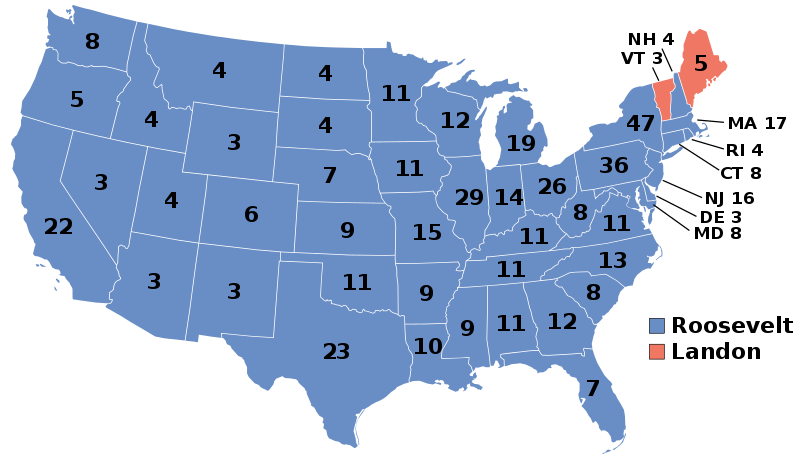
The 48-star flag was also the flag for the 1936 Election which is notable for two reasons. It’s the election where Literary Digest predicted a landslide victory for Republican Alf Landon. Don’t recall President Landon? There’s a good reason for that. The Literary Digest poll is literally a textbook example of how not to predict the winner of an election. Predicting that Landon would win 57% to 43%, they were off by a whopping 19 points! That’s the largest error ever in an important opinion poll. Don’t worry though, we’re a lot better at it now.

File:ElectoralCollege1936.svg

The other reason the 1936 election is noteworthy is that it holds the record for the largest electoral-vote landslide in American History. President Roosevelt won 527 electoral votes to Landon’s 8. That, to borrow a joke from Barbara Holland, was the start of that old saying, “As Maine goes, so goes Vermont.”

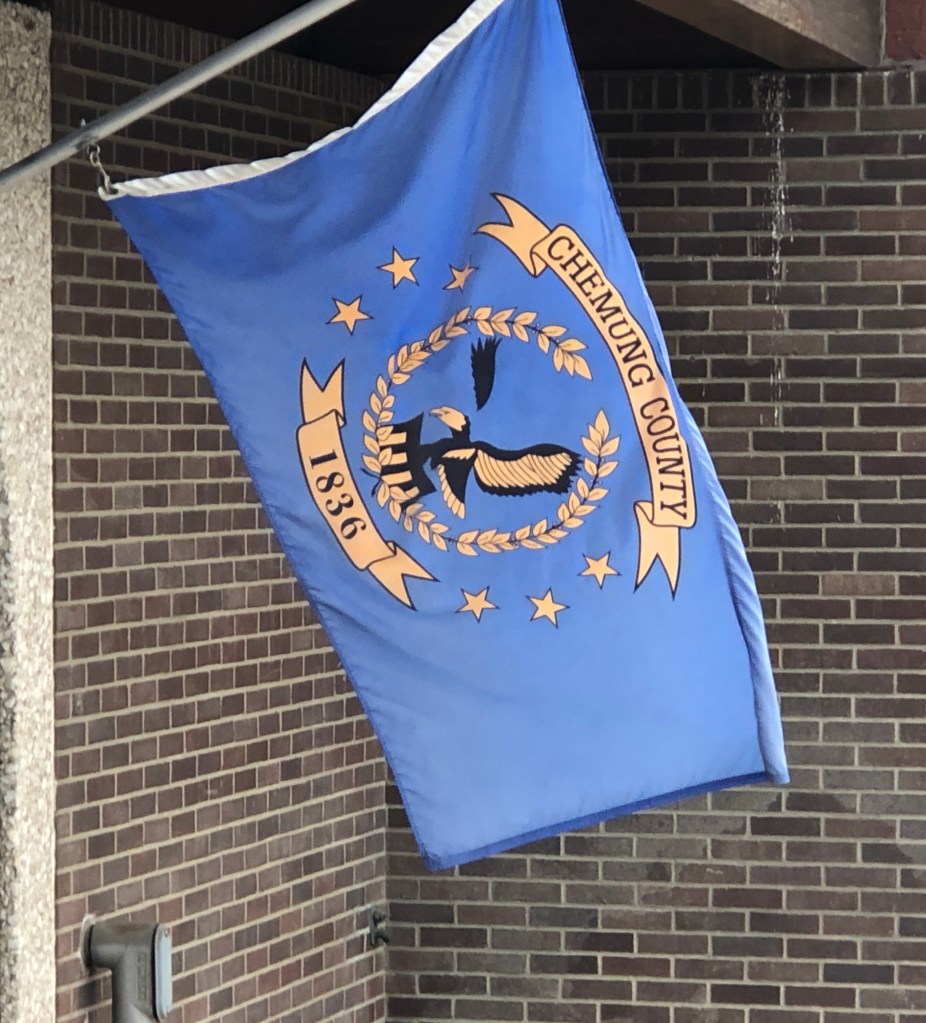
There’s another flag with a connection to Election Day this year because Joanne and I actually cast our ballots on the 24th of October, the first day of early voting. It took us just over an hour of standing in line and chatting with some friendly people to get to the voting booths. Toward the front of the line, in front of the Board of elections, I finally got a good look at a Chemung County flag. It’s the only one I’ve ever seen in the wild and it’s pretty good. It’s got an eagle and a wreath and some stars and it only uses three colors. It ticks off some of the NAVA standards. It could do without all the text and I have no clue about the symbolism but as a municipal flag, it’s above average.

Have a great day and don’t forget to vote!

What’s the Matter with Iowa

This was initially published yesterday as part of Prelude to Iowa. It looks like this scenario is playing out in real time so it deserves to be out on its own.

Beware of Paradoxical Results

You might think that first-past-the-post or the plurality vote is the worst voting system ever. You’d be wrong. In 2017, my student, Brandon Payne studied the Iowa Caucuses. He determined that the caucuses violate all sorts of mathematical “fairness criteria.” One example is the Condorcet criterion which states that if one candidate beats every other candidate in head-to-head match-ups, that candidate should be the overall winner. Such a candidate might not win the Iowa Caucuses.

Turns out, the viability constraint can also lead to seemingly contradictory results, which I’ll call the “viability paradox.” As a quick example, suppose that in some state, the voters have the following preferences.

Candidate A35%
Candidate B30%
Candidate C12%
Candidate D12%
Candidate E11%

In a primary election, this would be a clear victory for candidate A.

Now let’s divide our state into five precincts of 100 voters each and let’s assign each precinct 10 delegates. We’ll conduct a caucus to allocate the delegates.

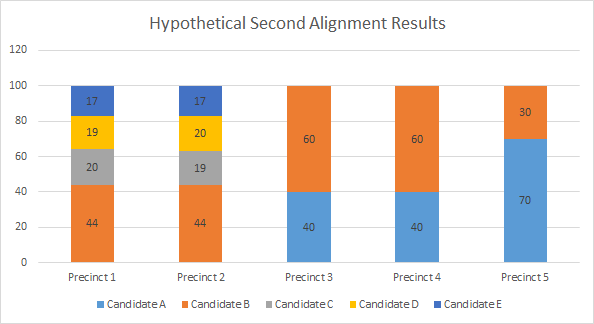
Suppose that the voters are arranged within the caucuses according to the graphic below.

This image has an empty alt attribute; its file name is image.png

Notice that there are non-viable candidate preference groups in each precinct. These voters will have to join a viable group in order to participate. They may reorganize themselves as shown below.

This image has an empty alt attribute; its file name is image-1.png

And so, in this case, Candidate B actually wins pretty decisively, probably 23 delegates to 15 delegates for A. Candidates C, D and E should get 4 delegates each.

There might be good reasons to decide that either candidate A or B is the rightful winner here, but one point is that there is a significant difference. Systems like this can lead to chaotic or paradoxical results. One important take away is that, right or wrong, geography can have a lot of influence on who the victor will be. Even if a candidate seems to be ahead in the polls, they can lose without any shenanigans going on, simply because how their voters are distributed across the state. Surprising results aren’t necessarily nefarious or even necessarily surprising.

You might even want to argue that results like this are a good thing because a lot of voters got to express their second choices. Here’s why you’d be wrong. It’s not systematic. In Instant Run-Off voting, for example, everybody’s second choice is counted unless their first choice is. In the caucus exactly whose second choices are counted is determined by an accident of geography. In deciding a winner between candidates A and B above, should the second choices of voters who picked candidate C in precinct 1 be less important than those in precinct 3? They shouldn’t be but in the current system they are. This is worse than a plurality vote because this could be taking us even farther away from a good collective decision.

In fact, it’s a bit worse than that. Apparently, the state weighs the delegate counts in rural counties a bit more heavily than their urban counties. If the Democrats who think we should dump the Electoral College are to have any intellectual consistency, they should reject these results and work to reform this process.

References

  • Payne, B., The Iowa Democratic Caucuses: A Mathematical Analysis of the “Vote,” Unpublished Manuscript.

How would presidential elections change if electoral votes were allocated by congressional district ?

First published on Quora.

This is the system currently used in Maine and Nebraska. In Maine and Nebraska, the statewide winner gets the two electoral votes (EVs) corresponding to the senators. Then the remaining votes are determined by the winner of each congressional district.

The Electoral College already has a “small state bias” that skews for the time being in favor of the Republicans since the smaller states tend to be more Republican than the country as a whole. I haven’t checked the numbers, but California has the same population as something like the smallest 20 states combined. That’s two EVs for the statewide win in California compared to forty for the statewide wins in these other states. It’s this bias that is responsible for the two “electoral inversions” we had in 2000 and 2016. That is to say, the two elections where the winner of the Electoral College did not match the winner of the popular vote.

Choosing the remaining EVs by congressional district would further skew things in the Republican direction. This is due to the extreme partisan gerrymander that took place after the 2010 election. To put this into perspective, the Democrats won the “national congressional vote” (NCV) in 2018 by something around 7 percentage points. This will give them a majority of between 14 and 19 seats when the remaining races are determined. By contrast, the Republicans won the 2014 NCV by 5.4 percent in 2014. That gave them a majority of 30 seats. Worse, in 2012 the Democrats won the NCV by 1.2% but the Republicans maintained a majority in the House of 16 seats.

So, at least until the congressional districts are redrawn in the wake of the 2020 Census, the current small-state bias that favors Republicans would be exacerbated. I don’t know if it would be impossible for a Democrat to win the presidency under such a system, but it would certainly be more difficult and there would be many instances where this system would elect the Republican even if the American people preferred the Democrat.

Still, it’s easy to imagine a worse system. During the run-up to the 2012 election, I recall Nebraska debating a return to a winner-take-all system so that President Obama could not win an EV from Nebraska like he did in 2008. At about the same time the Republican-controlled Pennsylvania legislature debated switching to allocating EVs by congressional district to help Governor Romney. Imagine such a system implemented nationwide, with all the red states using winner-take-all and all the blue states allocating electoral votes by congressional district or vice-versa. Such a system would virtually guarantee one-party control of the presidency.

References (all accessed 19 November 2018):

House Election Results: Democrats Take Control

RealClearPolitics – Election Other – 2014 Generic Congressional Vote

RealClearPolitics – Election Other – 2012 Generic Congressional Vote

114th United States Congress – Wikipedia

113th United States Congress – Ballotpedia