Our latest episode, In which we wrap up Asimov’s Foundation with a discussion of “The Merchant Princes.” and get ready to start Foundation and Empire is now available. We’ll also have another Apple TV+ minute for you and another installment of Asimov Trivia! Is this true? It certainly sounds true!
Our second episode, entitled “Podcast must obey the orders given it by human beings except where such orders would conflict with the First Episode” is posted, available wherever fine podcasts blossom or will be when Anchor gets around to up loading it for us. Of course, we are now begging the question… what will the fourth episode be called?
We start discussing the first novel, Foundation, in earnest and get all the way through the first two stories, “The Psychohistorians,” and “The Encyclopedists.” We also try our hand at doing a new segment, “Asimov Trivia.” You can join us on the link below.
I’m experiencing reverse deja vu. I just finished reading “The Mayors,” the third ‘chapter’ of Asimov’s Foundation and the only part of the trilogy that I’ve revisited since 8th grade or so. It was terrific, perhaps especially because I remembered so little of it; it was almost, except for a few flashes of vague recollection, like reading it fresh. But that’s not the reverse deja vu part.
The last time I read this particular story, coincidently enough, was 7 years ago on 1 May 2014. How do I know? Well, back then I was preparing to discuss the story in class and iBooks saved and dated my highlighting and my notes. As I’m reading, I’m having a lot of what I think are original thoughts, like “Oh, this reminds me of this other story…” or “I bet this is John W. Campbell’s influence right here.” Most of them though were sitting there waiting for me. Seven-Years-Ago-Joseph had thought of it first; that guy seems pretty smart. And that’s the reverse deja vu part, having thoughts that I believed were new only to find I’d had them before.
But I’ve buried the lede here. Why am I rereading Foundation? Well, Apple TV is working on an original teevee series based on the original Foundation Trilogy and one presumes the sequels and the prequels. I’m looking forward to it and the rereading is part of gearing up for the teevee series.
And so is starting Stars End – A Foundation Podcast, which I’ve done with Dan <@MrEarlG> and Jon <@jblumenfeld100>. We’ll be talking about the books and about Asimov and the Apple TV series. It’s been a lot of fun so far and our first episode (A Podcast must not harm a human being or, through inaction, allow a human being to come to harm) was released on Monday.
Please give it a listen; it’s on Anchor, and Spotify, and PocketCasts, and RadioPublic. It seems to be a long process, but soon, you’ll be able to find it wherever fine podcasts are sold. Or given away. Or however that works, I haven’t exactly figured it out yet.
You can also follow the podcast on Twitter at <@StarsEndPodcast> or you can find all our episodes and learn more about the podcast and us at the podcast’s webpage <https://starsendpodcast.wordpress.com/>.
Image Credits:
The featured image is a picture of the Galactic Center in the Public Domain and found on Wikimedia Commons. Author: NASA/JPL-Caltech/ESA/CXC/STScI
It’s 2 January 2021, Isaac Asimov’s 101st birthday and in the U . S. today has become, unofficially at least, “National Science Fiction Day.” To mark the day, I present an answer I wrote for Quora in 2019. Enjoy!
Who is the better writer, Arthur C. Clarke or Isaac Asimov?
Clarke and Asimov are two of my favorite authors and I have to admit I’m a bit conflicted. Upfront I should tell you that Clarke is my all-time favorite writer but when I put something I’ve written for my students into “I Write Like” the answer I hope to get back is “Isaac Asimov.”
So I think it breaks down like this.
In my opinion, Clarke is the better Science Fiction author.
Art from the paperback edition of Rendezvous with Rama
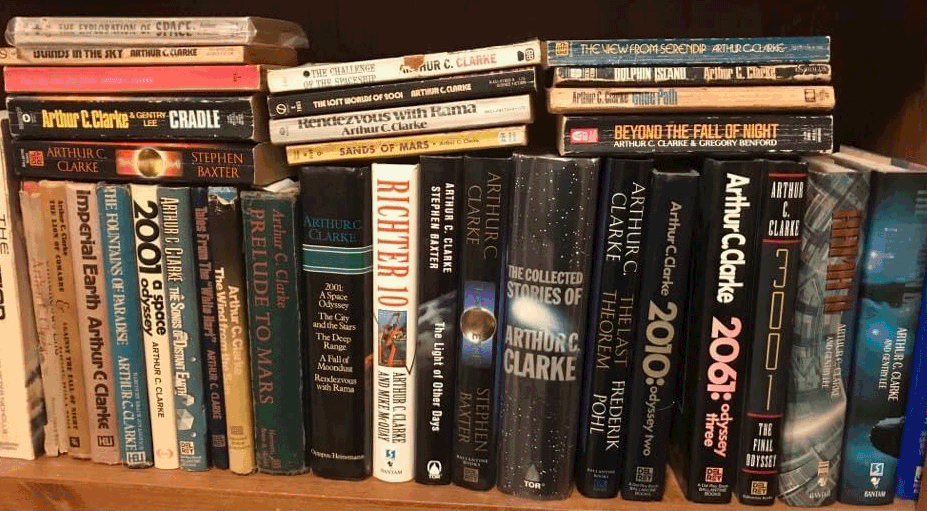
When you’re looking for a sense of awe, Clarke delivers. You get big ideas well executed. Childhood’s End and 2001: A Space Odyssey make you believe that Humankind’s potential is truly limitless. Rendezvous with Rama (not so much the sequels) presents you with the awesome undertaking it must be to cross interstellar distances in a universe that doesn’t allow faster than light travel. It then metaphorically smacks you with our place in the cosmos; it turns out that the vessel wasn’t even aimed at Earth, it was merely using our sun to refuel. That Rama encountered humans was an accident; a cosmic coincidence and nothing more. Fountains of Paradise is one of the quintessential hard science fiction novels, carefully laying out the technological advances we’d need to make to build a space elevator and then turning that fantastic notion into a believable engineering project. In the Star Clarke convincingly puts you inside the mind of a Jesuit priest who is questioning his faith. There are lighter-weight works that are less impressive, but the best of Clarke is unassailable.
Cover art for the novelization of “Nightfall.”
Asimov, too, has written some great Science Fiction but it’s simply not as great. Asimov’s most famous work, the Foundation Trilogy is based around the idea of “psychohistory” which is like statistical inference without the limitations, feed enough data into the model and the theory can predict upcoming events with amazing accuracy. It’s a fascinating idea, but the execution is a little stiff. I, Robot, as great as it is, boils down to a series of logic puzzles using the three laws of robotics. The Robot Novels are good detective stories. The Galactic Empire novels are good space opera. The thing I was most impressed with in Asimov’s SF output was the Gods Themselves because it gave us believable aliens who were truly alien and not just the recognizable humans from imaginary planets with the literary equivalent of an interesting forehead prosthetic. The last time I read the Gods Themselves the aliens seemed a little less alien and a little less believable. Although lots of Asimov’s fiction is great, very little of it is transcendent, thus advantage Clarke.
It’s worth noting that if your metric for evaluating great science fiction is whether you’re compelled to read it under the covers with a flashlight so your mom won’t catch you staying up all night, the answer is Robert Heinlein.
Returning to the topic at hand: I think Asimov is the better writer of non-fiction.
With non-fiction, clarity is king, and both Asimov and Clarke excel at writing about highly technical subjects in straightforward understandable prose. But Clarke’s non-fiction hews closely to his science fiction. Speculations about the realities of space flight is a common topic. Clarke also wrote several books about undersea exploration after he developed an interest in scuba diving. Much of what remains is about the future of technology and the limits of speculation. All excellent but also all themes that are explored in-depth in his science fiction.
Possibly as a result of being so astonishingly prolific, Asimov’s work covers an astonishing variety of topics. Within the sciences, he wrote books on Astronomy, Chemistry, Physics, Biology, Mathematics, Ecology, and probably more that don’t spring to mind. There’s also Asimov’s Guide to Shakespeare, Asimov’s Guide to the Bible, Asimov’s Chronology of the World and Isaac Asimov’s Treasury of Humor to barely scratch the surface.
But the thing that gives the edge to Asimov for me is the column on “science fact” that he wrote for the Magazine of Fantasy and Science Fiction. These are both delightful and informative; the column ran for 399 issues and more than 33 years.
Collections of Asimov’s essays from the Magazine of Fantasy and Science Fiction
Asimov had a way of starting an essay with an anecdote that would draw the readers in and get them interested in the topics and then lead them into the main part of the essay. Well written, substantive, and most importantly engaging, these were perfectly targeted at the audience while not compromising the subject matter with oversimplification. Advantage: Asimov.
And then there’s the Clarke-Asimov Treaty, which is spelled out in the dedication to Report on Planet Three. It reads, “In accordance with the terms of the Clarke/Asimov treaty, the second-best science writer dedicates this book to the second-best science-fiction writer.” That sums it up pretty well.
And there you have it. Happy National Science Fiction Day!





 Comics, the Universe, and Everything
