

Happy Independence Day! It’s been a while since I’ve been able to post; I’m still surprisingly in the middle of what I’ll call “the academic year that would not end.” There’s still one big project underway that will hopefully be wrapped up soon. Still, I wanted to get back to this, and the quarter-millennial seems too significant to pass up.
I’ve seen this big anniversary called a lot of different things, and I’ve been intrigued by this kind of nomenclature ever since I read Isaac Asimov’s “The Tercentenary Incident.” It was reinforced when I arrived at Elmira College just in time for its sesquicentennial. “Sesqui-,” it turns out, means “one and a half” if that wasn’t obvious. But who knew? More recently, I had some fun back when we had the second “Hari Awards for Foundational Excellence” on the Stars End Podcast. I had to coin the term “semi-semi-septennial” for something that might recur every eighteen months.
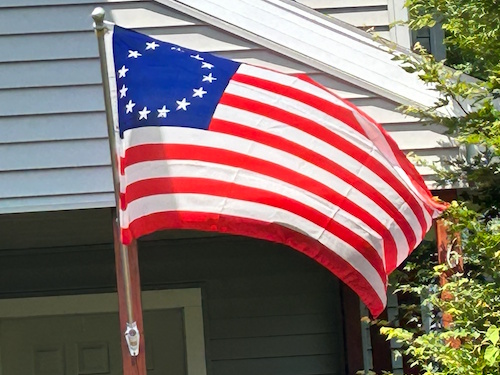
We’ve been flying flags to honor the celebration for about a week now. The first was the Betsy Ross flag, which was also the first flag we flew after I purchased a flagpole and began leaning into my interest in vexillology.
It seems kind of appropriate that this flag has its share of controversies. This is one of my favorite American flags, but I’m hesitant to fly it; it’s become popular among groups with whom, let’s say, I have philosophical disagreements. That’s fine, though. It’s their right to fly it, but it belongs to everybody. I’m not willing to cede its use to the folks across the aisle. The second controversy hits a bit of a theme here: the story about Betsy Ross designing the flag with General Washington doesn’t seem to have existed before 1876 except in her family’s lore.
So, here we are at the 250th anniversary of the start of the American Experiment. I like to call it the quarter-millennial because it evokes the possibility that this might last a full thousand years. That might cause some anxiety for anyone who could be tuning into the news right now. The formal term is semiquincentennial, which is a bit of a mouthful. I’ve heard “sesquicentennial,” which means 150 years, on some podcast or other. That’s wrong, clearly. There’s no official prefix for “two and one half,” but apparently some folks are using “sester-,” so sestersentennial. “Some” is doing a lot of work there. Have some fun with it; make up your own! How about semisemimillennial, or the decasilver anniversary? You could try “semipenticentenary” (like tercentenary), but that’s getting pretty fancy.
Our second flag may never have been realized as a flag; it’s simply the 1976 Bicentennial logo printed on a flag. It’s easy to imagine this as a proper flag: remove the text, make the logo larger, and give the background some color. It’s visually striking and more distinctive than the official America 250 logo, which you can see in the featured image above.
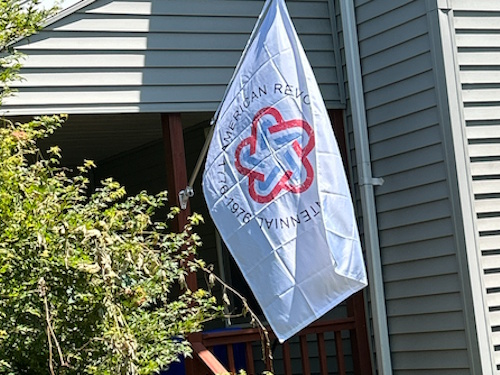

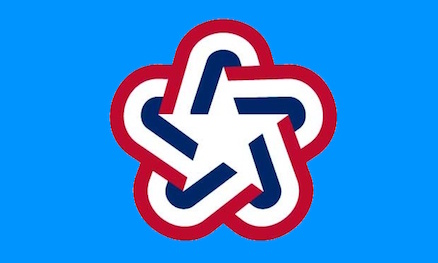
The Bicentennial logo was everywhere, and it was immediately recognizable. Below, you can see the logo on the Vehicle Assembly Building at Kennedy Space Center. No text was needed. Everyone knew that image.

Having lived through the Bicentennial, I’m disappointed in the 250th. This celebration, whether America 250 or Freedom 250, seems to merely be a few events in particular cities near the actual date of the anniversary. The Bicentennial seemed to be a years-long collection of events that involved the entire country. Schoolhouse Rock sang about American history and government for the entire year. I have strong memories of meeting the Freedom Train when it arrived in town and touring it, and of seeing the movie 1776 on a field trip to a theater on Clematis Street in West Palm Beach. Well, some of the movie. The teachers pulled us out of the theater halfway through because there were “too many GDs.” I’m still mad about that; it took me years to see the rest of the movie, which, by the way, is great.
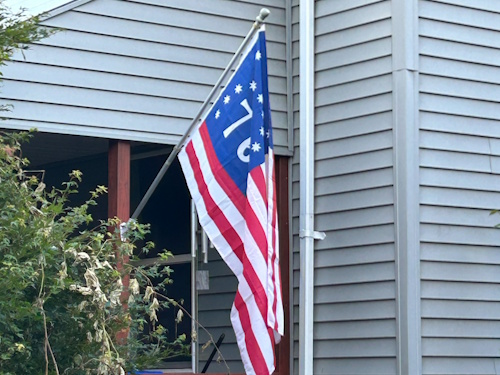
Our third flag was the Bennington Flag, which we wrote about back in 2019. Like the Betsy Ross flag, its origins are shrouded in family lore rather than contemporary records. Legend holds that it was carried at the Battle of Bennington, then spirited off the field by Nathaniel Fillmore, who passed it down through generations of his family, including a certain US President. When the Smithsonian examined it, they found it was made of cotton and sewn with cotton thread, neither of which would have been readily available in 1777. They dated it to around 1820. So, like the Betsy Ross story, the flag we know and love probably didn’t exist when it was supposed to have made history. Still, it endures, with its distinctive arch of stars and the “76” in the canton, even if only for aesthetic reasons. If you’d like to read our original post, you can find it below.

We flew the Serapis flag on 3 July, and it’s another one we’ve written about before. Where the origins of the Betsy Ross and Bennington flags were obscured by history, the genesis of the Serapis flag is known, and it was downright accidental. After John Paul Jones captured the HMS Serapis, his own ship’s colors had been destroyed in the battle, and continuing with no flag flying marked him as a pirate. A new flag was hastily created based on a sketchy, or perhaps garbled, description from Benjamin Franklin. The result was an unusual flag with red, white, and blue stripes and eight-pointed stars in the canton. It was enough for Jones to prove he was sailing under recognized American authority, and unlike many other flags, it has a documented pedigree. Here’s our original post, if you’d like more detail.
Our final flag was reserved for the Fourth; it’s a variant of the Betsy Ross flag with “1776-2026” embraced within the circle of stars. We’ll fly this one for a while.
I like this as our marker of the quarter-millennial. The circle of thirteen stars explicitly calls back to the Betsy Ross flag and the date in the canton reminds us of the Bennington flag. The consistent design of the flag since its inception evokes every version and embraces our history back to the earliest days of the Republic. That embrace makes an unspoken argument about what this semiquincentennial should have been.

Unless I’m specifically writing about politics, I try to avoid it in blog posts. I need to make an exception here, for what are flags but markers of our political divisions? There’s another flag that’s available to mark the occasion; it’s another Betsy Ross variant, but with “250” within the circle. That flag is associated with Freedom 250, which was created to supplant the congressionally established America 250. America 250 was bipartisan and attempted to be inclusive. As near as I can tell, Freedom 250 seems to have an agenda and is frequently, ostentatiously partisan. I explicitly chose a flag that flies outside of that controversy, which I won’t detail here.
So, here we are, fifty years after the Bicentennial’s unifying spirit, with a celebration that has felt chaotic and disjointed. But like the Betsy Ross flag, America and its symbols belong to all of us. If we’re truly celebrating 250 years of the American Experiment, that celebration should include every American, transcend partisanship, and embrace a patriotism that grows from the self-evident truths laid out by the Founders and salutes our progress toward an egalitarian society.
That is worth celebrating.
References:
- Latin prefix for Two and a half, Stack Exchange<atwo-and-a-half-times?, accessed 4 July 2026</atwo-and-a-half-times?
- Heritage, Horizon and Festiva<atwo-and-a-half-times?l</atwo-and-a-half-times?, logohistories.com <atwo-and-a-half-times?accessed 8 July 2026</atwo-and-a-half-times?
Picture Credits:
- Featured Image: The America 250 logo.
- Images 3 to 5: The bicentennial logo was created by Bruce Blackburn for the American Revolution Bicentennial Administration(ARBA).
- The Vehicle Assembly Building: From NASA.org, cleaned up by Lumo (from Proton).


