A Probabilistic Look at The Presidential Election: 04 September 2024

Stubbornly Stable.

Yeah, it’s taken me a while to get this one out, again. Sorry. It’s been tricky settling back into the academic year.

Starting this week I will download polling data on Fridays and, with luck, will have a post for you on Saturday. Look for our next update on or around the 14th.

That thing about a week being an eternity in politics has never seemed more true. Donald Trump’s visit to Arlington National Cemetery was a bit more than a week ago, but that’s still within the data collection for this update. It’s been a crazy week or so.

The State of the Race

One thing that surprised me was Nate Silver’s announcement on Thursday that according to his model, Donald Trump had about a 60% chance of winning the election. Silver is doing something fundamentally different than I’m doing here. He’s trying to bring fundamentals and other factors into his probabilities while I’m just looking at poll numbers.

I just do not see it. And whereas good poll numbers are based in fact, I worry that trying to factor in other fundamentals doesn’t. A lot of it, I believe, is guesswork at best and wishful thinking (or existential terror) at worst.

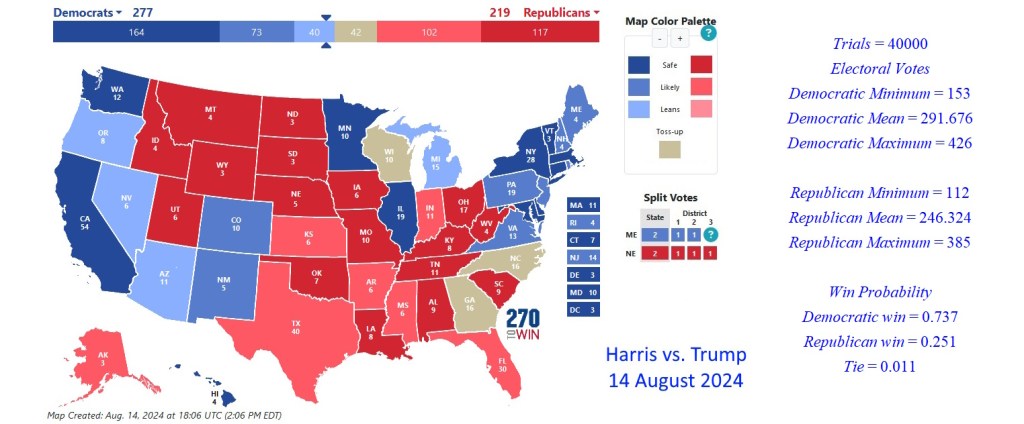
Let’s look at what happened over the past few days over at electoral-vote.com. On Thursday Pennsylvania shifted from barely Democratic to toss-up. Friday’s map had Pennsylvania back at barely Democratic, while Georgia moved from barely Democratic to toss-up and North Carolina moved from barely Republican to toss-up. Yesterday, Texas moved from leans Republican to barely Republican. That sounds like a big deal until you dig into the data. In this case, the margin shrank from five points to four. It is, to paraphrase the Bard, much ado about very little. The website 270 to Win moved Texas and Florida from red to toss-up on Friday. Here’s their “Polls Only” Map.

If this is correct there’s a lot of open ground where either side can grow. Are Trump’s chances of victory improving? That’s harder to say.

Results:

I was pondering a change in methodology last week. I’m only making one change. I’m now reaching back 15 days to gather my polls rather than 10. Some of the polls on Electoral-Vote.com collect data for a month. Since the date on EV’s polls is the midpoint of the data collection, those would never get included with any window shorter than 15 days.

This will also keep more polls in the data set and reduce the chance that one extreme or outlier poll will skew the data.

As usual, we entered the polling data into our model and ran 40,000 simulated elections. Here’s what we get.
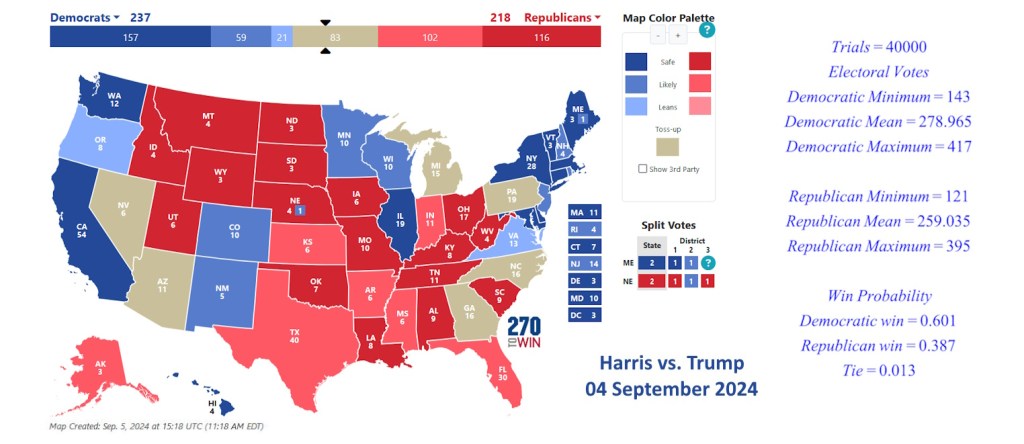
More states are showing as “Toss Up” than our recent updates, but light red, light blue, and taupe are very close together; this is not a dramatic change.

The results of the simulations tell us that the probability of Harris winning if the election were held today sits at 60% while Trump’s likelihood of victory is about 39%. One percent of the simulations ate ties.

This is where our results have been for a while, Harris still has a slight lead and the odds of her winning remain at about 3 to 2. But wait.

Trends:

I shifted methods so I’m not going to list the week-to-week changes. In the Electoral-Vote.com data, there’s some slight tightening in the race as evidenced by the larger number of toss-up states. Since I collected this data there was Nate Silver’s election probability, Trump’s pulled ahead on at least one betting site and Trump led the latest NYTimes/Siena College poll. Contrarily Harris is ahead in the FiveThirtyEight analysis with a 54% chance of victory.

We might be looking at a 50/50 race in out next update, but from our vantage point, the race as a whole seems stubbornly stable. In our model Harris’s advantage is driven by how many more electoral votes remain in the “Strongly Democratic” column vs. it’s “Strongly Republican” counterpart. Want to move our numbers? Get us a fresh poll in Indiana or Oregon depending on which side you’d like to help.

Last Words

I looked at something a little different this week and it’s interesting. While most of our analysis seems centered on the close races, let’s look at the ends of the red/blue spectrum. I ran a set of 1000 simulations and looked at the biggest landslides. The best result for the Republicans was a victory of 353 EVs to 185. The biggest win for the Democrats was 398 to 140. The maps for these might look something like this.

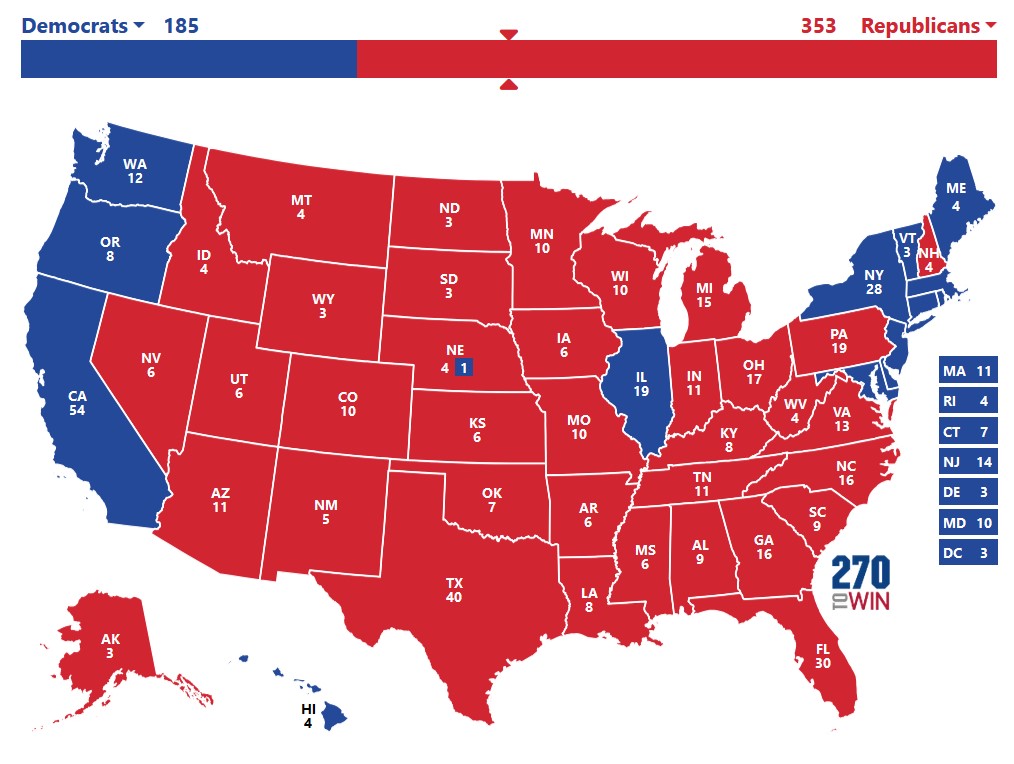
Neither of these are are going to happen; we won’t get close to either without a systematic polling error. Still, these look a lot more reasonable in the light of 270-to-Win’s polls only map; if you assume all the Toss Ups fall in one direction you get a Democratic victory of 390 to 148 or a Republican victory of 328 to 210. Stay tuned.

A Probabilistic Look at The Presidential Election: 28 August 2024

No DNC Bump & Dancing Inside the Margins

Quicker than usual; I have to be ready to Teach on Monday. There are actually two sets of results here. I’ll explain.

Results for 28 August 2024:

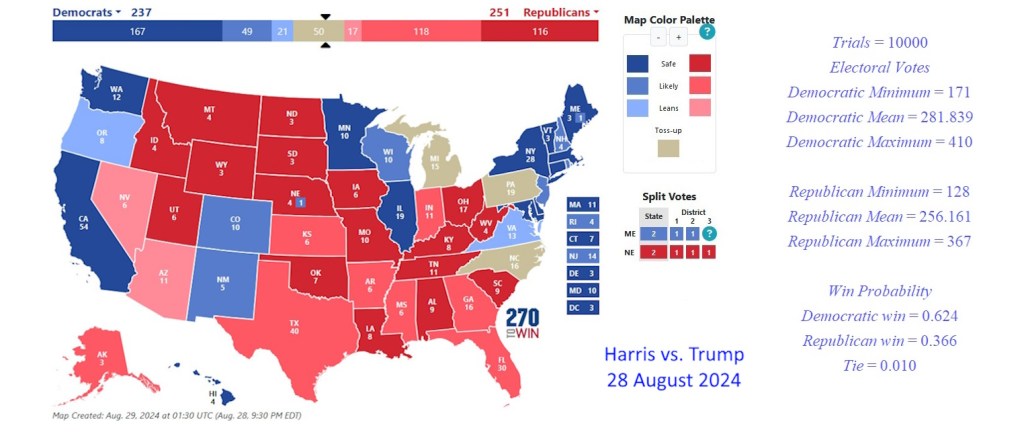
The projected electoral map between Harris and Trump based on the 28 August data.

As usual, we collected data on Wednesday. We’re in virtually the same place as we were last week. Here Harris wins about 62% of the simulations and Trump takes about 37%. The likelihood of a tie is still at about 1%. Let’s look at the state shifts.

StateChange
ArizonaBarely Democratic to Barely Republican
Maine ALLeaning Democratic to Strongly Democratic
Maine 2ndBarely Republican to Leaning Democratic
North CarolinaBarely Democratic to Toss Up
WisconsinToss Up to Leaning Democratic

There is more dancing of the results that live inside the margin of error. The Maine shifts are the most significant here and that’s why the probability barely moved even though Trump pulled ahead with the electoral count. The light blue, light red, and tan states all have probabilities at or near 50/50; those will bounce back and forth in the simulations but the dark blue and the dark red? Those stay on one side for the majority of the trials. If something moves into one of those categories we’re likely to see it.

So, we’re holding steady with the odds of a Harris victory sitting at 3 to 2; there’s no real evidence of a bump from the Democratic convention. Globally the numbers still seem to be trending in Harris’s direction.

Results for 29 August 2024:

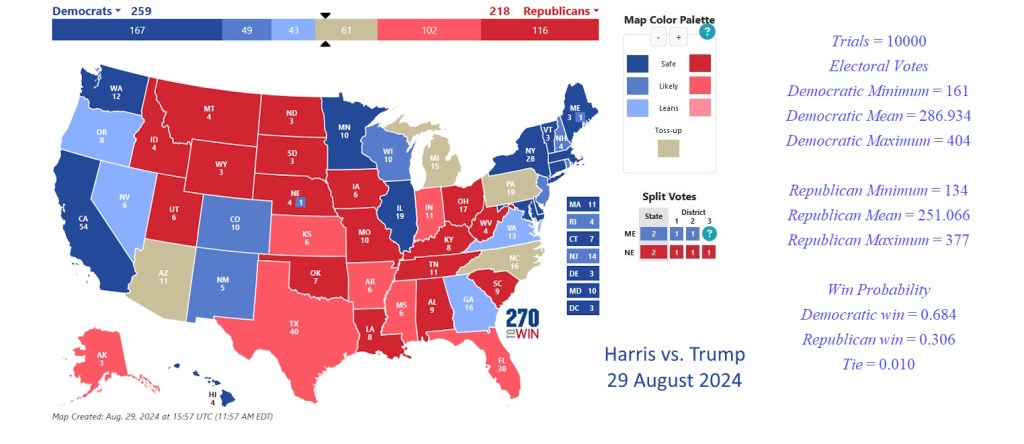
Several polls that showed a movement towards Harris in the swing states arrived on 29 August. Here are the results from that next day. I won’t give these results their own write-up because I played with the parameters; there are no apples-to-apples comparisons.

Last Words

These results are making me think about my methodology; I’d like to tamp down the variance and I’m not sure the colors are giving the best indication of the state of the race. Still, I don’t want to switch things up too many times.

So, I’m pondering. I may just let the status quo ride and make changes for 2028. If I make more alterations I’ll use them until Election Day. My plan is to have everything sorted by Wednesday.

Stars End S5E16

We encounter the back cover of the Good Doctor’s first actual book as we wrap up The Pebble in the Sky with chapters 14 through 22.

Cover of the Bantam Paperback edition of Pebble in the Sky (1957)

“Podcast Along With Me The Best is Yet to Be.”

If you’ve been around for a while you probably remember our discussions of the “Great Man Theory of History” vs the “Bottom-Up” paradigm. In other words, do remarkable individuals with unique characteristics write history or is it driven by powerful historical forces that generate great leaders when they are needed? It’s a false dichotomy, but a useful one. In the Foundation Universe the bottom-up theory must dominate otherwise psychohistory could not work the way it does.

But Joseph Schwartz is just the right Jewish tailor with a special kind of trick memory who is accidentally thrust to an exact moment in Earth’s future. Once there he is brought to the only scientist on Earth doing a particular type of brain research. He then survives a dangerous experiment that gives him an unlikely set of psychic powers which he uses to save the lives of nearly every human in the galaxy.

Put those numbers into your Prime Radiant and crunch them!

This probably delayed the creation of psychohistory by hundreds of years. “I just don’t understand it, Hari, the math says everyone in the galaxy should be dead right now.”

You’ll want to hear this! Let’s GO!

For some additional content, check out Of Pebbles and Pulps exclusively at StarsEndPodcast.com!

A Probabilistic Look at The Presidential Election: 21 August 2024

This is what the stock market calls a “correction.” Harris Still Favored

I’m watching night 3 of the Democratic National Convention and Oprah just exited the stage. It was electric; the crowd was as energized as it has been all through the convention. Today we’re looking at a set of data that was collected almost entirely before the convention.

The State of the Race

The slowdown in the campaigning is over and the DNC seems to be sucking up all the air in the election. Well, maybe it’s just sucking up all of my attention. (Boy, that was just a hell of a response for Mayor Pete.) The excitement in the Arena is palpable and infectious. There was little to no bounce coming out of the RNC. I don’t think the same will be true of the DNC.

Trump and Vance are on the campaign trail, and Trump seems more active than last week, but I don’t know if it’s enough. More on that after the analysis.

Results:

A minor change in the methodology; with this update, I’ve separated out the congressional districts in Maine and Nebraska. Those are modeled separately and this will make the projections a bit more accurate. Since Electoral-Vote.com doesn’t have that data I’ll be taking it from Projects.FiveThirtyEight.com. Plus the first and third districts in Nebraska needed a smidgen of algebra because I only had separate polling on District 2. Aside from that, as always, an explanation of how the map was created and our scheme for finding our polling averages can be found here: Methodology.

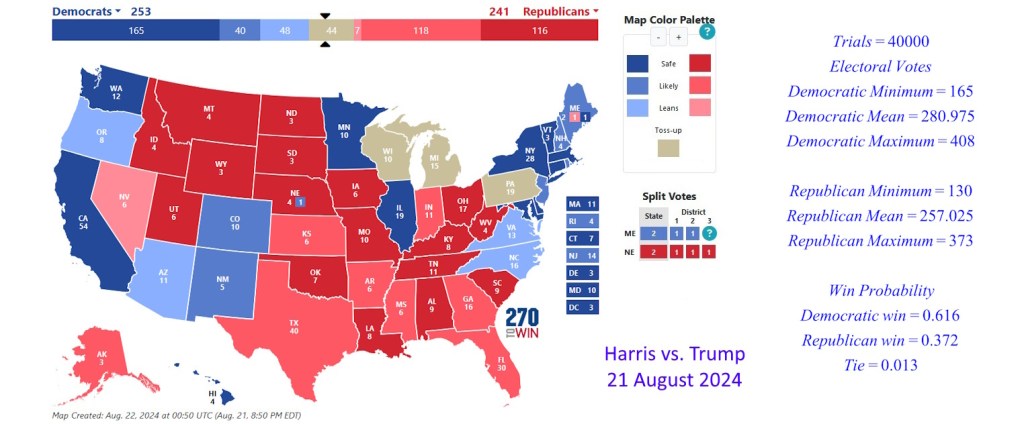
You probably know how this goes by now. We entered the polling data into our model and ran 40,000 simulated elections. If the election were held today, Vice President Harris would have roughly a 62% chance of winning while Donald Trump would win about 37% of the time. The likelihood of an Electoral College tie is still approximately 1%.

This is a “polls only” approximation and so it’s sensitive to changes in polling numbers. That leads to some volatility. For example, let’s look at Virginia which moved from “Leaning Democratic” to “Barely Democratic.” Here’s what that looks like in their data.

From electoral-vote.com: a graph of presidential polling in Virginia.

That is not a dramatic change, we’re looking mostly at the result normal of statistical variation.

Given this data, Harris still leads and the odds of her winning the election are about 3 to 2.

Trends:

The averages have shifted back in Trump’s direction and it’s put the odds for Harris and Trump back to where they were two weeks ago. Here are the changes from last week.

StateChange
GeorgiaToss Up to Leaning Democratic
MichiganBarely Democratic to Toss Up
NevadaBarely Democratic to Barely Republican
North CarolinaToss Up to Barely Democratic
PennsylvaniaLeaning Democratic to Toss Up
VirginiaLeaning Democratic to Barely Democratic

As I mentioned above most of these look like what happens with results within the margin of error. The possible exception there is Georgia where the new poll looks a lot different from the previous one. My best guess is that this is merely a more accurate description of the state of the race than a rightward shift but it could be either. More polling will determine that. It turns out that one consequence of my choice of using a ten-day window for poll numbers is some volatility as we’re frequently replacing a single poll with a different single poll. I hope we get more state polls as election day draws closer; that will tamp down the variation.

The odds of a Harris winning sitting at 3 to 2 seems more reasonable than the 3 to 1 we found last week.

Last Words

I’m now writing on Thursday Morning. The end of Night 3 at the DNC was nearly flawless. Walz gave a powerful “pep talk” that received what might have been the best crowd response of the day. It was also steeped in Americana. A high school football coach who loves his family, helps his neighbors, and helped win a state championship surely has appeal to voters all across the political spectrum. And watching his family was heart-warming. Trying to reconcile that with a “soulless communist who will destroy America” just does not compute.

Neil Young’s “Keep on Rocking in the Free World” is a perfect song to end the evening.

As I mentioned, I haven’t seen much coverage of the Republican campaign. I’ve seen a tiny rally featuring Vance, part of a small, weird, appearance by Trump in Howell, Michigan, and an AI-generated image implying that Taylor Swift is endorsing Trump. In addition, a Trump staffer released a now-deleted video of Trump backed by Beyoncé’s song “Freedom,” Trump had claimed that he is better looking than Kamala Harris and that there’s no way Harris’s acceptance speech will get better ratings than his speech to the RNC. Trump’s interest in crowd sizes remains an ongoing theme. Maybe I’ve seen more than I thought.

Let’s take those one at a time.

  • The Vance rally just seems like more of the same.
  • In his appearance in Howell, Michigan Trump seemed lethargic. If any other candidate had made that speech Trump would have been all over them for being “low energy.” Also, “Kamala crime wave?” Seriously?
  • I’m pretty sure the Taylor Swift thing was a misstep.
  • I’m certain using Beyoncé’s “Freedom” was a misstep. There’s already a cease and desist order. A lawsuit will probably follow.
  • “I’m better looking than Kamala Harris” is just sad.
  • And bragging about the ratings of his acceptance speech is just dumb. There will be objective evidence tomorrow and my money here is on the new kid. If Trump’s right this is a non-story. If he’s wrong it’s an embarrassment. There’s no upside.
  • Trump’s obsession with crowd sizes is getting funny. The best example of that is probably Walz and Harris appearing remotely to the DNC after the roll call vote from the very same venue that hosted the RNC. Both venues were packed and there was no footage of anyone leaving early. If nothing else this was some world-class trolling.

Trump had a pretty effective line of attack against President Biden, but it’s now been a month since the president dropped out. The Trump Campaign still does not have a coherent strategy to run against Harris. Falsely calling her a communist or blaming her for a nonexistent crime wave might play to his base but it won’t play with independents and it won’t bring any new voters to his cause. We’ve seen it all before.

Stars End S5E15

Here’s your chance to join the discussion about Pebble in the Sky, Chapters 7 through 13! Also, we’ll open up the “Stars End Mailbag” and talk about Star Trek: Discovery!

Cover of Pebble in the Sky, paperback ed. , circa 1992

“There is Only One Reason Why a Synapsifier Can Possibly Be Used – To Improve a Podcast”

A lot of us who are past the point where we would be culled by the 60 take supplements to, theoretically, help improve our memory. Just the other day I couldn’t remember the title of the Star Trek episode “Return to Tomorrow.” That was no fun. I think most of us would like to be at least a little smarter and maybe some of what would come from a device like the synapsifier could be helpful.

I’ll pass on the parts about being lost in the department store, wandering about the automat, or being driven mad by the thoughts of strangers though. Those don’t sound fun either. “Lost in the Supermarket” by the Clash might sum up all of these potential side effects.

It would though, improve a podcast, to a point. Remembering what we want to say would help quite a bit. And having perfect recall would save a lot of note-taking. But telepathic communications would ruin things even with state-of-the-art recording equipment unless an hour of silence would be an improvement.

In the meantime, we’ll muddle through and bring you the best podcast possible with regular human brains and imperfect memory! Let’s GO!

A Probabilistic Look at The Presidential Election: 14 August 2024

Harris’s Momentum Continues

Let’s GO!

The State of the Race

The campaign seems to have slowed down somewhat while the Democrats gear up for their convention. Vice President Harris and President Biden will appear together today (8/15) in Maryland while Governor Walz is on his own tour of the Northeast. JD Vance is in Pennsylvania today while yet another controversial quote has surfaced.

Donald Trump has been a bit more active than he had been. This week we’ve seen his interview with Elon Musk on X and a last-minute rally in North Carolina which was supposed to be focused on the economy. The economic content was sparse while Trump frequently veered off-topic and attacked his opponents.

Results:

An explanation of how the map was created and our scheme for finding our polling averages and can be found here: Methodology.

As usual, we entered the polling data into our model and ran 40,000 simulated elections. If the election were held today, it appears Vice President Harris would have about a 74% chance of winning while Donald Trump would win about 25% of the time. The likelyhood of an Electoral College tie is roughly 1%.

Remember that this is an estimate and it is only based on the current polling numbers. As we’ve seen these can change dramatically over three weeks; and we’re nearly three months from the election.

Given this data, Harris leads and the odds of her winning could be as high as 3 to 1.

Trends:

The race continues to move in Harris’s direction. This is evident if we look at the movements of the state polls between last week and this. There’s one exception to the trend;

Michigan changed from Strongly Democratic to Barely Democratic. This was expected; the polling average last week was based on a single poll that was a clear outlier. That poll, which had Harris up by ten fell out of the average was replaced by two more typical results.

The other shifts tell a consistent story.

  • Texas: Strongly Republican to Leans Republican
  • North Carolina: Barely Republican to Toss Up
  • Arizona: Barely Republican to Barely Democratic
  • Pennsylvania: Toss Up to Leans Democratic

These all show movement toward Harris. In addition, within the last week, Harris is now leading:

  • in national popular vote polls and polling averages,
  • in states with a total of more than 270 electoral votes,
  • on forecasting sites like 538 and The Cook Political Report, and
  • on betting sites like Polymarket.

The comparative attendance and enthusiasm at Democratic vs. Republican Rallies also speak in Harris’s favor.

The momentum remains on Harris’s side.

Last Words

The Harris campaign has consolidated its lead over the last week. It’s no surprise; just over three weeks ago most voters believed that the presumptive nominees of both major political parties were too old to effectively serve as president. The voters wanted a new candidate in the race. With President Biden’s decision to withdraw his candidacy, they got one. The political landscape shifted and the Democrats are capitalizing on that by running an effective, aggressive, and positive campaign. Likely, they will further strengthen their position throughout their convention. But conventional wisdom would then suggest that things will shift back toward being competitive as the campaign begins in earnest and Harris and Walz have to add some specifics to their policy proposals.

But maybe not.

Donald Trump spent months attacking President Biden and implying he should withdraw from the race. He should have been prepared when it happened. But he wasn’t.

At the RNC, with the possibility of Biden’s withdrawal growing more likely, Trump could have picked a running mate that could bring more voters into their base. But he didn’t.

In the aftermath of an assassination attempt, Trump could have changed tactics, eschewed political violence, and become a candidate aiming to unite the nation. But he couldn’t.

Trump could have gone on the campaign trail to court voters and make the case for the Republican ticket every day since 21 July. But he wouldn’t.

Instead, he picked a running mate who appealed to the extreme edge of his base and who is alienating voters, childless cat ladies, and post-menopausal females.

And he didn’t turn away from political violence. When he mentioned Paul Pelosi at the RNC he pantomimed a hammer. “Bam, bam, bam!”

And there’s nothing new in his rhetoric. He hasn’t even bothered to change his talking points. the “Worst President in American History,” became the “Worst Vice President” and “Lyin’ Joe Biden” has turned into “Lyin’ Kamala Harris.” Simplistic.

And the lies are all the same no matter what Trump wants to tell us. The 2020 Election wasn’t stolen. Trump didn’t have the biggest inaugural crowd ever. He wasn’t the best President for African Americans since Abraham Lincoln. We are actually better off than we were four years ago. The list goes on.

This election could still go either way, but it’s getting close to the point where it will take something as dramatic as a major party candidate withdrawing from the election for that to happen. But it’s getting late to try that; ballots are closing.

If Donald Trump doesn’t get back on the campaign trail and give the country something more than the same old grievances, the same old falsehoods, and the same old show this election could be a rout. We’re tired of it.

Adventures in Punditry

Exploring the Question: Has American Politics Gone Insane? | Political Pundit Night

It’s funny how your sense of time changes as you get older. In my head, this whole “going on the internet and saying stuff” thing is pretty new, but I’ve actually been at it for a while. My first gig on Coleman and Company was, unbelievably, about five years ago, and Stars End: A Foundation Podcast is over three years old!

The Coleman and Company Header

There’s a bit of a gap. That first gig on Coleman and Company was in September 2019, just as the 2020 Election was heating up. I was unable to Join Dr. Coleman and his Company again until March 2023, about three-and-a-half years later. When Steve asked me to pitch in again and told me the topic was “Has American Politics Gone Insane,” I couldn’t say “no.” The new status quo is a very different format than my first appearance, with many more voices; looking at the Zoom screen I felt like I was on Hollywood Squares. It was also two hours long instead of thirty minutes. This allowed us to explore the question with more depth.

You can watch the first hour right here.

The first hour of Dr. Coleman’s Political Pundit Night: Has American Politics Gone Insane. 23 March 2023

My favorite bit might have been in Steve Sprague’s opening statement (and I’m paraphrasing here) where he opined that perhaps American politics aren’t clinically insane, but it sure seems like a bunch of people have rabies and a bunch of other people are in a cult. My short answer to the question was “Of course it has,” but ultimately I am more interested in the cure than the mere diagnosis.

If you’re interested in finding my bits, I’m at about 22 minutes and 49 minutes in hour one.

Here’s the second hour.

The second hour of Dr. Coleman’s Political Pundit Night: Has American Politics Gone Insane. 23 March 2023

In hour two, about six minutes in, Steve asks “Has journalism let the American people down?” An interesting discussion ensues. This is all the more relevant as we saw in the recent Biden/Trump debate that some national news organizations are not fact-checking the candidates in real-time. The conversation winds through the weaponizing of journalism, court cases against major cable news outlets, and the War on Woke. It continued into the balkanization of the American public into political camps. We wrap the hour up on some fundamental structural issues like how we vote and gerrymandering. I pop up at 20:30, 25:15, 44:20, 55:05, 55:55, and 57:55 but all of those need some context.

This was a great group of people to have this conversation with! I’m honored to have been included and even happier to have become a regular contributor. The next Political Pundit Night is at 7:00 pm EDT on 15 August 2024 and can be found on <MyTwinTiers.com/coleman-and-company>.

The images and videos above are the property of WETM-TV and <MyTwinTiers.com>.

Stars End S5E14

Pebble In The Sky First Edition Cover

We begin our conversation about Pebble in the Sky with Chapters 1 through 6.

“Between One Podcast and the Next.”

Isaac Asimov is famously prolific; if you know one thing about the Great and Glorious Az it might be that he wrote more than 500 books. Asimov-Reviews.net puts the number at 514 counting the Good Doctor’s dissertation. Asimov.Fandom.com puts the number at a much more modest 506.

The Back Cover of Opus 100. Asimov’s First 100 books.

Why is this relevant? Well, Pebble in the Sky is Asimov Book #001; it’s the first thing he wrote that got stuck between its own two covers (unless you count his dissertation, which he did not). It’s also only his first novel even though he had already been writing professionally for eleven years. Most of I, Robot and the Foundation Trilogy were in the rearview mirror; those quickly became books 002, 004, 006, and 009. Pebble in the Sky is also a lot of fun!

Don’t miss it as we delve into this significant moment in Asenion history! Let’s GO!

A Probabilistic Look at The Presidential Election: 8 August 2024

Harris Takes Lead

Hello again!

The State of the Race

Since our last update, the Democratic Ticket has been campaigning across the country working to extend their momentum from the past two weeks. The big news there is the unveiling of Tim Walz as Harris’s running mate. They’ve been touring the swing states since the announcement and drawing large enthusiastic crowds.

JD Vance has been following them across the country trying to draw comparisons between the two campaigns. It’s been lackluster. The comparison is not helping the Republicans.

Meanwhile, Donald Trump has been mostly absent from the campaign trail; with only one sparsely attended rally in Montana and a press conference. I haven’t watched the press conference yet so I’ll reserve comments for now. The Trump Campaign holding a rally in Montana is mystifying. That’s a move you make when you’re on a clear path to victory and you can afford to spend resources on a Senate seat. His campaign has bigger issues. Was it about trying to get a rally with good attendance for a visual to counter those coming out of the Harris campaign? A positive event to get Trump back on the trail?

The narrative around the debates is mystifying as well. Trump began making up a possible debate on Fox News even before he debated President Biden. But the waffling, then canceling the debate, then insisting on the made-up Fox News debate, and finally canceling again all made Trump look frightened. Making up another debate and then insisting on three debates is a weird thing to do and is too little, too late.

The Harris/Walz tour of the swing states wraps up Saturday in Nevada.

Results:

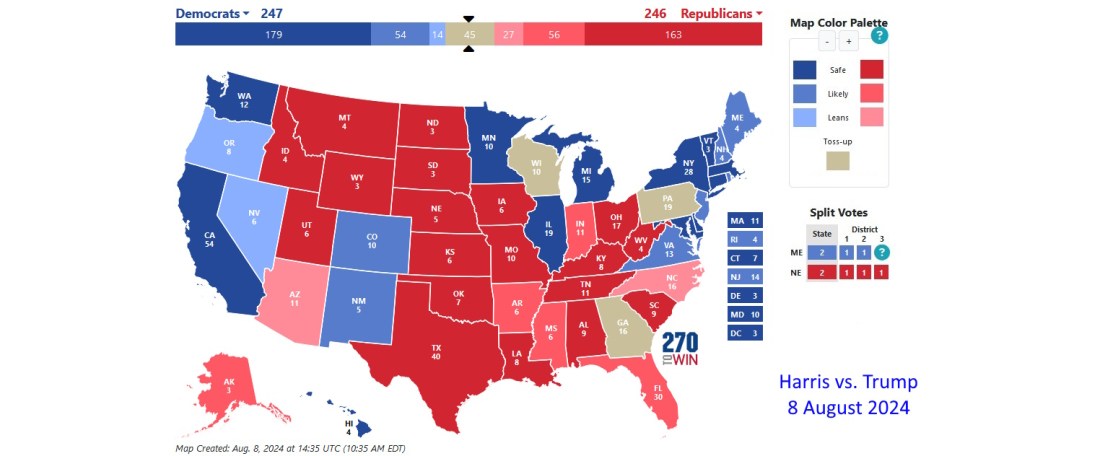
Once again we entered the polling data into our model and ran 40,000 simulated elections. If the election were held today, it looks like Donald Trump would have about a 35% chance of winning with Vice President Harris winning about 64% of the time. The remaining 1% were Electoral College ties.

Again, I would emphasize that this is an estimate. There weren’t many state polls in the last week and using our scheme had an interesting effect: it turned out that every state ‘average’ was determined by a single poll.

This had its greatest effect in Michigan as the one poll used there is probably an outlier (Harris led by 11), which would make the probability of a Harris victory an overestimate.

Given this data, Harris is in the lead and the odds of her winning the election could be as good as 3 to 2.

Our scheme for finding our polling averages and creating the map can be found here: Methodology.

Trends:

Trump was favored to win in our 21 July probability, and Harris pulled roughly even with him in our 31 July estimate. Now, for the moment, it’s safe to say that Harris has an edge. Strictly looking at the probabilities generated from the models, Harris’s probability of winning the election is roughly where Trump’s was on 21 July, between 63 and 64%. This is a complete turnaround in just under three weeks.

But that’s not the only evidence. Other predictive sites are showing similar results. Nate Silver now has Harris favored to win both the popular vote and the Electoral College. The New York Times/Siena College Poll released this morning has Harris leading Trump by 4 points in Wisconsin, Pennsylvania, and Michigan. The Cook Political Report has reclassified the race in Arizona, Georgia, and Nevada from “Lean Republican” to “Toss Up.”

The momentum remains on Harris’s side.

Last Words

It’s beginning to look like the campaign is the Democrats’ to lose. They have been able to dominate the news cycle and generate enthusiasm since the Republican Convention with President Biden’s withdrawal, followed by Harris introducing herself, the party unifying behind her, and then the announcement of Walz as Harris’s running mate. This could easily continue as the Democratic Convention will lead to hearings about Trump’s January 6th Election Interference Case which will bring us into early voting.

The Trump Campaign still seems unable to find its footing. They continue to throw whatever they can against the Democrats but nothing yet has really stuck outside of their MAGA base. With Vance drawing tiny crowds and Trump largely off the campaign trail it’s hard to see how they can turn this around. Right now it’s easy to find headlines like “Trump Campaign Bleeding Support…” or “Is Trump ‘Losing His Marbles.’

Still, this election could go either way. Even if the probability of Trump winning the election is really at 35% (and many sites have it higher) that’s still about 10% better than his chances of winning the 2016 election. In that election, he exceeded expectations at every turn. While the Republican Party’s overconfidence in July is partly responsible for the current state of the election other overconfidence could still shake things up dramatically.

Stars End S5E13

In which we talk about “Cal” and “The Fun They Had” with special guest Rachel from the Menuscript Podcast.

“The Podcasts They Had”

“Cal” has been called “the last great Asimov short story” and it looks like it’s his very last robot story. Cal is a robot who learns how to write fiction and develops into an odd sort of Asimov avatar throughout the story.

“The Fun They Had,” is one of the Great and Glorious Az’s most reprinted works featuring a student thinking back to how great school must have been back in the long, long ago of the 20th century.

We’re joined by special guest Rachel Schwartzbard who has just started her own podcast, the Menuscript, which is excellent. She’ll talk about it in this episode. You don’t want to miss that; afterward, you’ll want to check out her podcast!

The stories and Rachel’s podcast can be found right here.

Let’s GO!

Image Credits:

  • Featured Image: The Featured Image was “Designed by Freepik” at <www.freepik.com>.
This image advertises the the post also appeared on StarsEndPodcast.com.
StarsEndPodcast.com