There have been two new episodes since I shared Stars End episode 2 here. Is a podcast the last refuge of the Incompetent like the title to Episode 4 claims! Find out! Time to get caught up! Please like, review and share!
Episode 3: As foretold! Mayors! Bridles! Saddles! Oddly, no actual horses! And the ultimate answer to the ultimate cliffhanger! Also show news, we react to the trailer for the Apple TV+ series and and more Asimov trivia!
Episode 4: We talk about “The Traders,” part four of Foundation. This story first appeared, with surprisingly little fanfare in the October 1944 issue of Astounding under the title “The Wedge.”
In addition we have our second Apple Plus Minute and another edition of Asimov Trivia with a new contestant and a new quiz master!
This is a reblog from mytwintiers.com, that wasn’t obvious enough. Sadly, here the sky was a uniform shade of grey so nothing to see. But there are still live feeds to check out!
Skywatchers will be treated to a “ring of fire” solar eclipse on Thursday, but their location will determine how much of it they get to see.
I’m a big Star Trek Fan and so, I enjoy having stuff that looks like it might be used in the show if the show were real life.
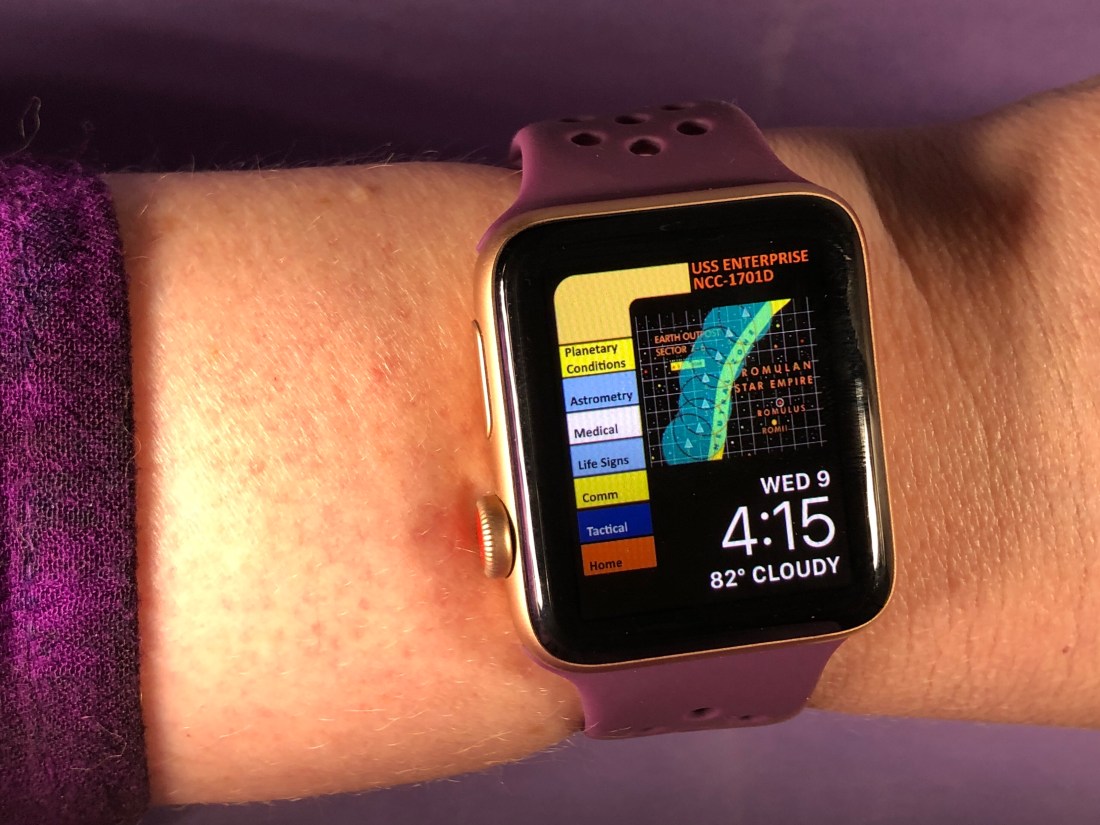
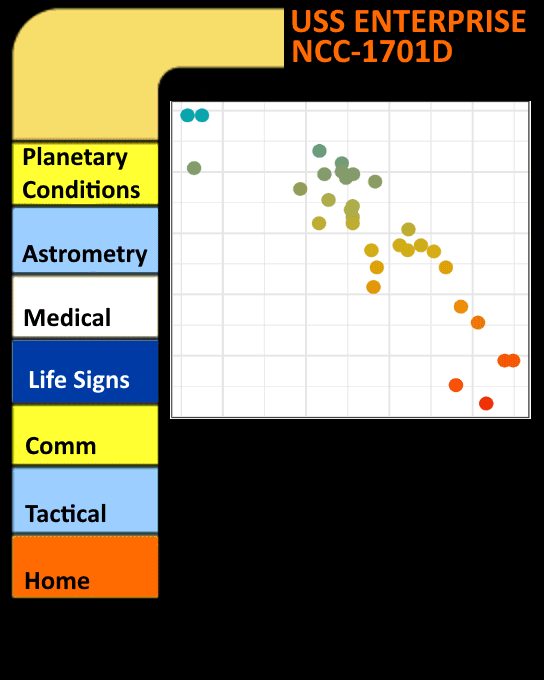
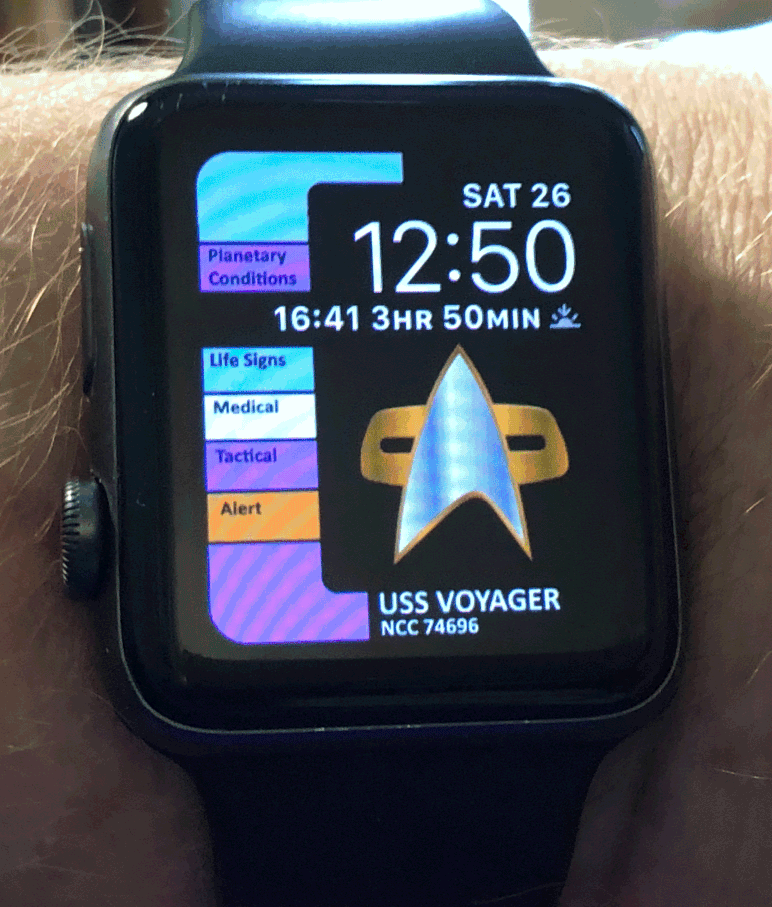
Over the holidays I was inspired to create a couple of Apple watch faces that make my watch look as if it runs on the “Library Computer Access/Retrieval System” (or LCARS). That’s the operating system used in all the Star Trek shows set in the 24th century from Next Generation to Lower Decks. I created two, which you can see here.
But here’s the thing: These are made using the Apple Watch’s Photo Face. These are static images that look like they have buttons, but the “buttons” aren’t functional. The only things that are active are the complications that are active from the Apple watch itself.
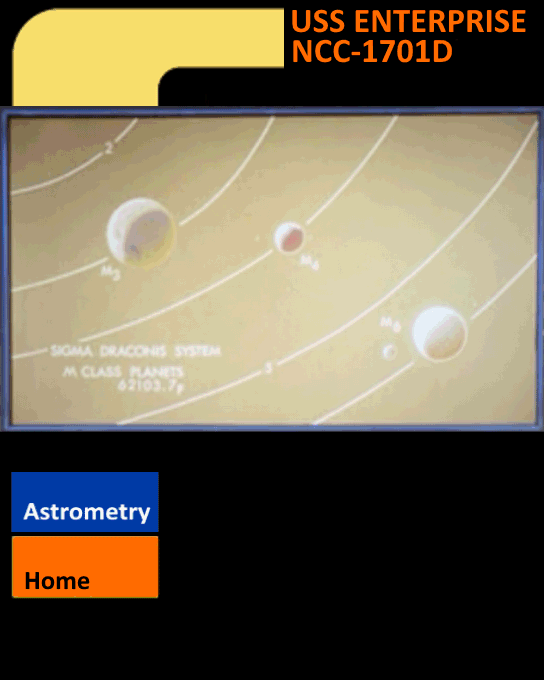
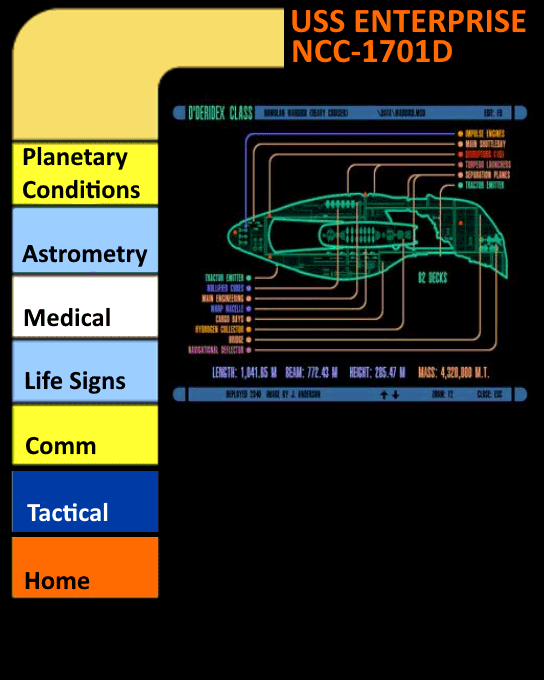
This isn’t ideal. So what’s the next best thing? How about a watch face that seems interactive? We can get closer. If we load a number of images to the Photo Face the Apple Watch will display a different one every time you raise your wrist and, if you want to pretend it’s actually interactive, you can tap the watch face and it will switch to another image. You can’t control which image you get next, but you can make-believe. Here’s a collection of images you can use.
This collection includes:
A home page with the UFP Logo, three astrometrics faces, two each of planetary conditions, tactical, and medical faces, one face that appears to scan for life signs and a face that looks as though a communications system is active.
So, if you want a watch face that looks like it might be used on a federation vessel, feel free to use the collections above!
To install, save all of the images above to your iPhone.
Then:
Select all the images you want to use from your gallery.
Scroll down and select “Create Watch Face.”
Select the “Photos” face.
Set the position of the time, “Bottom” for all of these, and choose the complications you want above and below the time.
And select “ADD.”
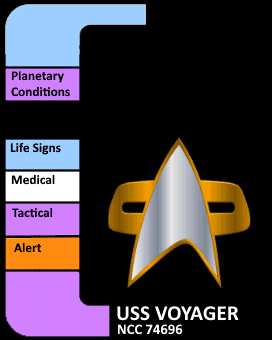
You should be all set. Comments and suggestions are welcome; and if you’d like a Voyager face let me know in the comments. If you use the watch face please leave a picture in the comments!
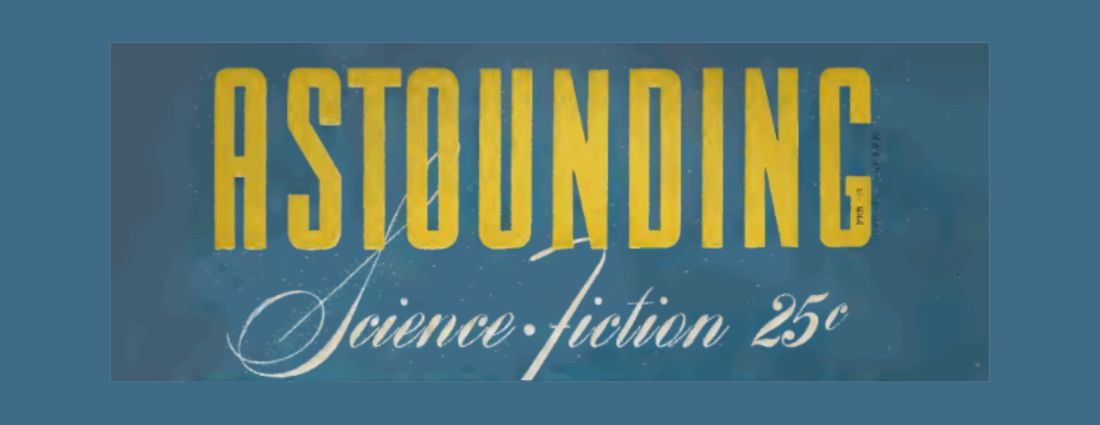
We hope you’re enjoying our podcast so far and if you are, you’re probably as anxious to see the resolution of the cliffhanger that ended our second episode as we are! Do you think what has to be done to keep Terminus safe from Anachreon was obvious? We didn’t particularly think so despite 20-year-old Isaac’s assurances to the contrary. “The Enyclopedeaists” appeared as “Foundation” in Astounding Science Fiction for May, 1942. Here are the coming attractions from that issue.
It’s clear that John W. Campbell expected that riddle to bring people back to Astounding for the June issue. He didn’t stop there though, “Bridle and Saddle” was featured on the cover as well.
Of course, we now know “Bridle and Saddle” as “The Mayors,” the title it was given in Foundation.
We’ll also bring you up to date on what we know about the show so far and we’ll…
Our second episode, entitled “Podcast must obey the orders given it by human beings except where such orders would conflict with the First Episode” is posted, available wherever fine podcasts blossom or will be when Anchor gets around to up loading it for us. Of course, we are now begging the question… what will the fourth episode be called?
We start discussing the first novel, Foundation, in earnest and get all the way through the first two stories, “The Psychohistorians,” and “The Encyclopedists.” We also try our hand at doing a new segment, “Asimov Trivia.” You can join us on the link below.
I’m experiencing reverse deja vu. I just finished reading “The Mayors,” the third ‘chapter’ of Asimov’s Foundation and the only part of the trilogy that I’ve revisited since 8th grade or so. It was terrific, perhaps especially because I remembered so little of it; it was almost, except for a few flashes of vague recollection, like reading it fresh. But that’s not the reverse deja vu part.
The last time I read this particular story, coincidently enough, was 7 years ago on 1 May 2014. How do I know? Well, back then I was preparing to discuss the story in class and iBooks saved and dated my highlighting and my notes. As I’m reading, I’m having a lot of what I think are original thoughts, like “Oh, this reminds me of this other story…” or “I bet this is John W. Campbell’s influence right here.” Most of them though were sitting there waiting for me. Seven-Years-Ago-Joseph had thought of it first; that guy seems pretty smart. And that’s the reverse deja vu part, having thoughts that I believed were new only to find I’d had them before.
But I’ve buried the lede here. Why am I rereading Foundation? Well, Apple TV is working on an original teevee series based on the original Foundation Trilogy and one presumes the sequels and the prequels. I’m looking forward to it and the rereading is part of gearing up for the teevee series.
And so is starting Stars End – A Foundation Podcast, which I’ve done with Dan <@MrEarlG> and Jon <@jblumenfeld100>. We’ll be talking about the books and about Asimov and the Apple TV series. It’s been a lot of fun so far and our first episode (A Podcast must not harm a human being or, through inaction, allow a human being to come to harm) was released on Monday.
Please give it a listen; it’s on Anchor, and Spotify, and PocketCasts, and RadioPublic. It seems to be a long process, but soon, you’ll be able to find it wherever fine podcasts are sold. Or given away. Or however that works, I haven’t exactly figured it out yet.
You can also follow the podcast on Twitter at <@StarsEndPodcast> or you can find all our episodes and learn more about the podcast and us at the podcast’s webpage <https://starsendpodcast.wordpress.com/>.
Image Credits:
The featured image is a picture of the Galactic Center in the Public Domain and found on Wikimedia Commons. Author: NASA/JPL-Caltech/ESA/CXC/STScI
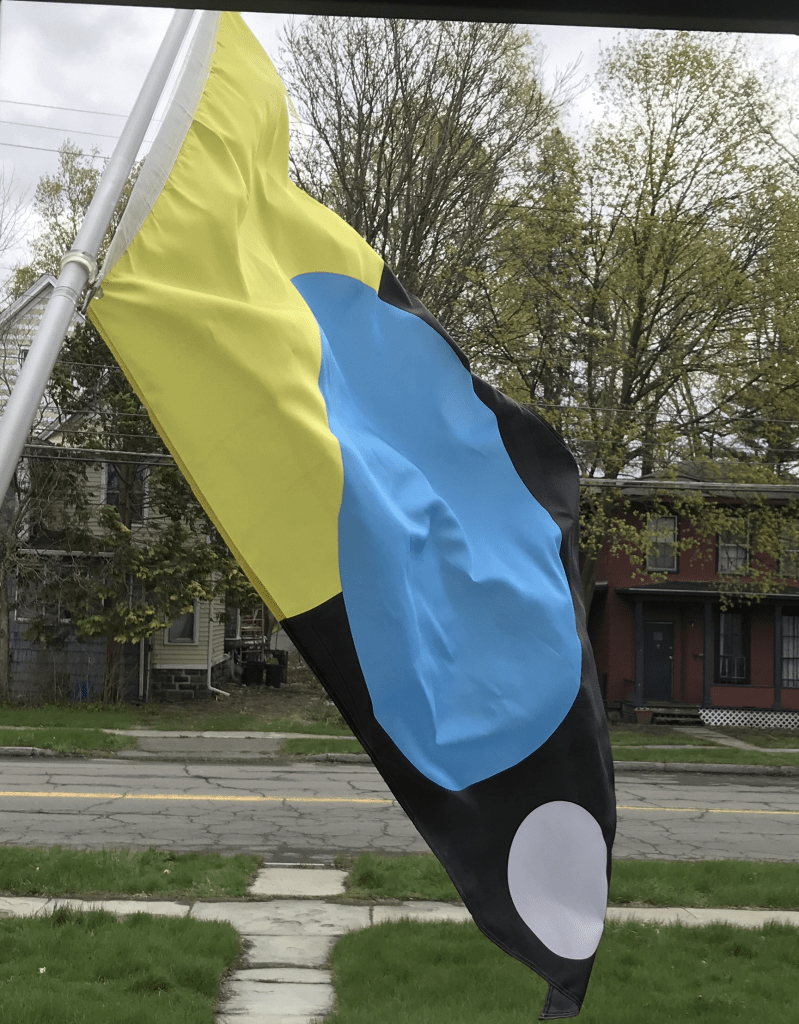
Good morning everyone, and Happy Earth Day! Today, for Earth Day, we’ve finally gotten a copy of “the Flag of Earth” that was designed by James W. Cadel in 1970. I’ve been wanting one of these for a while. It’s a beautiful flag with clear symbolism, showing a simple representation of the Earth, Moon and the Sun. As it is stated on the Flag of Earth Website, “The Earth and its most important celestial neighbors – the Sun and Moon – are overlaid on a backdrop of the darkness of space.”
The origins of Cadel’s flag trace back to the Apollo 11 moon landing and a movement to plant, not the American Flag on the Moon, but one that represented all of humanity. The United Nations flag was proposed as an alternative, but that, it was pointed out, does not represent all of Earth, but merely a particular organization. This was “one giant leap for Mankind” but that sentiment was marred by an ostentatious display of nationalism. Surely if politics can end at the water’s edge, then nationalism can end at the edge of the atmosphere.
The following year Cadel designed this flag, hoping it would be used on future space missions in the spirit of the message that the Apollo 11 astronauts left on the Moon, “We came in peace for all Mankind.”
NASA never warmed to that idea, but the Flag of Earth became popular in astronomical circles and was flown at observatories and SETI (Search for Extraterrestrial Intelligence) installations worldwide. It was lowered to half-staff to mark the passing of Carl Sagan. The North American AstroPhysical Observatory, which runs the ARGUS Array, is now entrusted with the Flag of Earth’s legacy and its website. You can find a lot more information there and you can also purchase merchandise, the proceedes of which support the Observatory’s projects including the Search for Extraterrestrial Intelligence.
One unrelated note: we had been flying the 1901 Maine flag prior to today although I did not have time to post about it at the time. It worked nicely for the holiday season and it did, in fact, fly for a part of 2020, Maine’s bicentennial year. While we were flying the 1901 flag, there was a welcome proposal to restore it as the official state flag that sadly failed. It would have been a big improvement. More on that when we continue our series on state flags.
It’s 2 January 2021, Isaac Asimov’s 101st birthday and in the U . S. today has become, unofficially at least, “National Science Fiction Day.” To mark the day, I present an answer I wrote for Quora in 2019. Enjoy!
Who is the better writer, Arthur C. Clarke or Isaac Asimov?
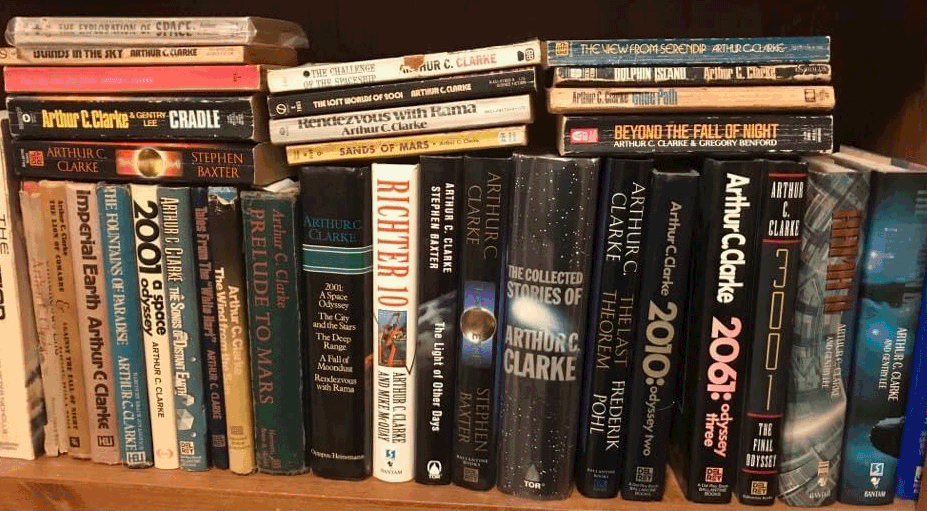
Clarke and Asimov are two of my favorite authors and I have to admit I’m a bit conflicted. Upfront I should tell you that Clarke is my all-time favorite writer but when I put something I’ve written for my students into “I Write Like” the answer I hope to get back is “Isaac Asimov.”
So I think it breaks down like this.
In my opinion, Clarke is the better Science Fiction author.
Art from the paperback edition of Rendezvous with Rama
When you’re looking for a sense of awe, Clarke delivers. You get big ideas well executed. Childhood’s End and 2001: A Space Odyssey make you believe that Humankind’s potential is truly limitless. Rendezvous with Rama (not so much the sequels) presents you with the awesome undertaking it must be to cross interstellar distances in a universe that doesn’t allow faster than light travel. It then metaphorically smacks you with our place in the cosmos; it turns out that the vessel wasn’t even aimed at Earth, it was merely using our sun to refuel. That Rama encountered humans was an accident; a cosmic coincidence and nothing more. Fountains of Paradise is one of the quintessential hard science fiction novels, carefully laying out the technological advances we’d need to make to build a space elevator and then turning that fantastic notion into a believable engineering project. In the Star Clarke convincingly puts you inside the mind of a Jesuit priest who is questioning his faith. There are lighter-weight works that are less impressive, but the best of Clarke is unassailable.
Cover art for the novelization of “Nightfall.”
Asimov, too, has written some great Science Fiction but it’s simply not as great. Asimov’s most famous work, the Foundation Trilogy is based around the idea of “psychohistory” which is like statistical inference without the limitations, feed enough data into the model and the theory can predict upcoming events with amazing accuracy. It’s a fascinating idea, but the execution is a little stiff. I, Robot, as great as it is, boils down to a series of logic puzzles using the three laws of robotics. The Robot Novels are good detective stories. The Galactic Empire novels are good space opera. The thing I was most impressed with in Asimov’s SF output was the Gods Themselves because it gave us believable aliens who were truly alien and not just the recognizable humans from imaginary planets with the literary equivalent of an interesting forehead prosthetic. The last time I read the Gods Themselves the aliens seemed a little less alien and a little less believable. Although lots of Asimov’s fiction is great, very little of it is transcendent, thus advantage Clarke.
It’s worth noting that if your metric for evaluating great science fiction is whether you’re compelled to read it under the covers with a flashlight so your mom won’t catch you staying up all night, the answer is Robert Heinlein.
Returning to the topic at hand: I think Asimov is the better writer of non-fiction.
With non-fiction, clarity is king, and both Asimov and Clarke excel at writing about highly technical subjects in straightforward understandable prose. But Clarke’s non-fiction hews closely to his science fiction. Speculations about the realities of space flight is a common topic. Clarke also wrote several books about undersea exploration after he developed an interest in scuba diving. Much of what remains is about the future of technology and the limits of speculation. All excellent but also all themes that are explored in-depth in his science fiction.
Possibly as a result of being so astonishingly prolific, Asimov’s work covers an astonishing variety of topics. Within the sciences, he wrote books on Astronomy, Chemistry, Physics, Biology, Mathematics, Ecology, and probably more that don’t spring to mind. There’s also Asimov’s Guide to Shakespeare, Asimov’s Guide to the Bible, Asimov’s Chronology of the World and Isaac Asimov’s Treasury of Humor to barely scratch the surface.
But the thing that gives the edge to Asimov for me is the column on “science fact” that he wrote for the Magazine of Fantasy and Science Fiction. These are both delightful and informative; the column ran for 399 issues and more than 33 years.
Collections of Asimov’s essays from the Magazine of Fantasy and Science Fiction
Asimov had a way of starting an essay with an anecdote that would draw the readers in and get them interested in the topics and then lead them into the main part of the essay. Well written, substantive, and most importantly engaging, these were perfectly targeted at the audience while not compromising the subject matter with oversimplification. Advantage: Asimov.
And then there’s the Clarke-Asimov Treaty, which is spelled out in the dedication to Report on Planet Three. It reads, “In accordance with the terms of the Clarke/Asimov treaty, the second-best science writer dedicates this book to the second-best science-fiction writer.” That sums it up pretty well.
And there you have it. Happy National Science Fiction Day!
Happy New Year! Almost. As a fun project, over the last week or so, I created a couple of watch faces for my Apple watch. These make the watch look as if it runs on the “Library Computer Access/Retrieval System” (or LCARS) from the Star Trek shows set in the 24th century. It makes sense to share these on the day the landmark 800th episode of the franchise is released.
I was inspired by seeing a smart watch on Twitter Christmas Day with an LCARS face and of course, Apple doesn’t offer one. This is the next best thing, making use of the watch face that displays photos. The “buttons” aren’t functional. The only things that are active are the complications that are active from the Apple watch itself.
So, it you’re like me and you’ve been wanting a watch face that looks like it might be used on a federation vessel, feel free to use one of these and enjoy!
To install, save one of the following two files to your iPhone.
Then:
Select the image from your gallery.
Scroll down and select “Create Watch Face.”
Select the “Photos” face.
Set the position of the time, “Top” or “Bottom” and choose the complications you want above and below the time.
And select “ADD.”
You should be all set. Happy New Year! Comments and suggestions are welcome; if you use the watch face please leave a picture in the comments!
If you like this, you’ll also like the New and Improved version!
I’ve had my head in data most of the day. There are some things I wanted to lead with, but we’re about to hit the big poll closings.
7:00
The first returns are in. Trump wins Indiana. No surprise. Everything else is too early to call. Trump looks like he’s leading in Florida, because of two, R leaning counties. So far he’s short of his 2016 totals, but it’s too early for that to mean anything.
Here’s something to start with. These are the states where the Candidates have an 80% or better chance of winning with the darker colors representing a probability of better than 90%. If Biden can merely hold these states, he wins.
Looking at what’s left here Biden has tons of paths to victory. Trump has but a few. That said, this could be very wrong.
7:18
MSNBC just called Vermont for Biden. No surprise. It looks like Biden is under-performing in Miami-Dade County. That’s not good, but maybe there’s something else that is going on there.
If you’re looking for bellwethers, if Trump wins NC or Maine 2, it’s going to be a long night. If Biden takes Florida or NC or Georgia, he probably has a clear path.
7:30
WV is too early to call. That may be a bad sign for Trump. Biden may be over-performing in a lot of Florida. In fact, (7:33) he just took the lead.
7:47
Florida doesn’t look good. It’s still early but my prediction that there’s a big shift toward Biden may be a bunch of crap.
17 states have poll closings at 8.
NYTimes has Trump with a 95% chance to win Florida.
Trump wins in Kentucky.
The New York Times has great tools and lots more results.
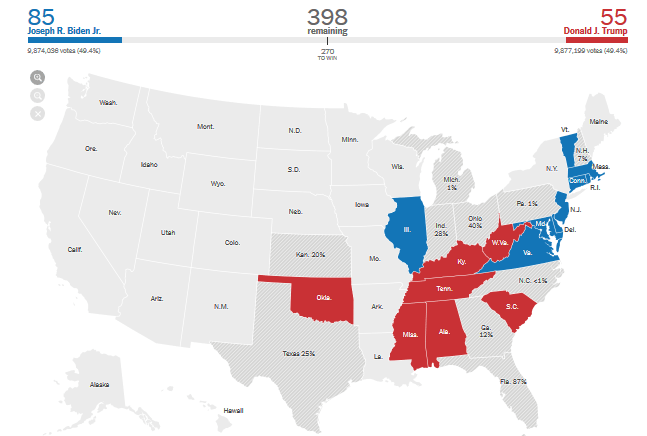
That’s 85 to 55 Biden. Things look surprisingly good in Texas though. Interesting.
McConnell wins in Kentucky. Not surprising, but disappointing.
More NYTimes. This is an awesome graphic.
8:33
Someone who supports QAnon won a House seat in Georgia. Things are going to get weird. These are the unintended consequences of gerrymandering.
8:39
Here’s a look at the Senate.
9:40
It’s going to come down to the same three states. Damn it.
12:52 PM Thursday
Well, that kind of went off the rails there; lots of things kept me from posting, sorry about that. So, where are we? Let’s start by updating the map at the top of the page
We’ve added the states that have been called. The lighter colors are states from our original map where either Trump or Biden had at least an 80% chance of winning in 538’s last projection. Nothing from that original map has changed hands. It’s still the case that if Biden holds these states, he will win the election.
Biden leads in Nevada and Arizona, which would put him at exactly 270. Trump is likely to win in Alaska and North Carolina. Georgia could go either way. Trump has a dwindling lead in Pennsylvania, but the remaining votes are likely to favor Biden.
The president, meanwhile, is doing what he claimed he would do for weeks or months. Declare victory on election night claiming to be ahead, presume that the states that went against him were rigged, and try to manufacture a victory through lawsuits.
You can’t declare victory until the votes have been counted. Part of the delay in getting the results is due to elections officials in Wisconsin, Michigan, and Pennsylvania being barred from counting early ballots before election day. They asked for relief on this, but they were rebuffed by republican state legislatures. This was part of the plan from the beginning, to give the president the illusion of leading in these states and the ability to create an atmosphere where he could claim that the election was being “stolen.” That isn’t true. What we’re seeing here is the inverse of what we saw on election night. Biden started with unrealistically large leads when the only votes that had been counted were early ones. As election night went on, we got more realistic results as the same-day votes were counted. We’re seeing the same thing in reverse now except that it’s the Biden-leading votes that are being counted last instead of the Trump-leaning ones.
Trump’s strategy here reminds me of G. W. Bush’s playbook from the 2000 recount. Turns out it’s even more offensive as a deliberate strategy than it was as an ad hoc response.
9:27 PM Thursday
The atmosphere is palpably energized. Trump’s lead in Georgia is below 2500 and the gap between the candidates is below 50,000 in Pennsylvania. It seems like we’re on the cusp of Biden pulling ahead in one of these states. Will we get a quick call after that? Don’t know.
Meanwhile, the president seems to be flailing. Claire McCaskill called the president’s speech a low point in American history. A presidential candidate calling an election into question is unprecedented. There’s a lot to unpack there; it was strange and troubling. He clearly thinks Red Ballots Matter More. But that isn’t true. All Ballots Matter.
9:40 pm
Now Georgia is within 2000 votes.
9:49 pm
Here’s another nice graphic from the NYTimes.
10:00 pm
What’s the state of the race? Trump leads in Pennsylvania and Georgia, but those leads are evaporating. Biden leads in Nevada and Arizona. The lead-in Arizona is shrinking, but the Biden campaign is confident it will hold. Trump will almost certainly win Alaska and looks safe in North Carolina.
10:28 pm
The palpable excitement had dissipated.
10:43 pm
The gap in PA is down to 26,000. According to MSNBC, It looks like Biden will overtake Trump at 4 or 5 am. I think earlier.
11:00 pm
I’m holding on for a bit to see if we get an update on Georgia. If Biden wins Georgia, that will put him up to 269 electoral votes, 1 vote away from victory. In the unlikely event that Trump wins everything else, that would be a 269-269 tie.
In that case, after the Electoral College votes, the election is decided by the House of Representatives. The democrats control the house, so you might think that would be good news for Biden. It isn’t. It’s a Trump victory. Why? The representatives don’t vote for President, the states do. Currently, the Republicans control 26 state delegations which would be enough for him to win. That’s unlikely to change after the election.
11:18
That’s enough for tonight. I’ll be back when there’s something to report.
11:22 am Friday
Good Morning! A lot has happened overnight. Biden pulled ahead in Pennsylvania and Georgia of all places. Here’s an appropriate song for this morning! I give you “Better Things” by the Kinks.
This means that Biden is leading in four of the six uncalled states with a total of 306 electoral votes. His lead in Pennsylvania is growing. Meanwhile, the latest results from Maricopa county make it unlikely that the president will be able to pull ahead in Arizona. In Nevada the latest votes being reported had Biden’s lead at about 22,000. At least one outfit has called the election for Biden.
11:00 pm
Back at it again. The last update from Pennsylvania put Biden’s lead at more than 0.5%. [Edit: It only looked that way with the rounded numbers the networks were using, this didn’t actually happen until a bit later.] That’s out of automatic recount territory. I think that will impel a call for Biden in the Pennsylvania race and then consequently the presidency.
Nothing looks especially different on the teevee at this point.
As an aside, on the news this (Friday) afternoon I saw a group of voters in Maricopa County AZ who were in line at the elections office in order to “cure” their ballots.
Evidently, in Arizona, if there’s an error on your ballot the Board of Election will contact you and allow you to come in and fix the discrepancy. This startles me and it’s an important statement about the importance of the franchise. Everyone’s vote is important and everyone’s vote should count. That’s a welcome and stark contrast to the politicians who are seeking to prevent votes from being counted, merely because they don’t think they’ll like the outcome.
8:34 am Saturday
I’ve been watching elections coverage for about an hour now. MSNBC seems to think that a call in the election is imminent. More data is on the horizon, probably at 9:00 am.
Joe Scarborough started his show by calling the 1976 Republican nomination for Gerald Ford. There’s a lot reasonable takes on Scarborough, but it seems certain that he should not do comedy.
These folks made an excellent point on the timing of the vote count. We know that the Governors of Wisconsin, Michigan, and Pennsylvania tried to allow their elections officials to start processing the early and mail-in ballots before the elections, but were stopped by the republican state legislatures. That led to a night that looked really good for the president. That was by design. Trump was planning to use the good coverage to try and force an early end to the counting and create an illusion of malfeasance. It’s an amazing disconnect on the order of the notion that we only have cases of coronavirus because we’re testing for it.
To America’s credit, by and large the president’s rhetoric was ignored and we continued to count the votes in a dignified and orderly manner. I’ve seen a number of secretaries of state being interviewed and doing news conferences and that’s dong nothing but increase my confidence in the system.
If these states had counted the mail-in ballots early, the focus on election night, the focus would have been on these states. If would have been clear from the start that Biden had a commending lead in Pennsylvania at least. The character of the coverage would have been fundamentally different and there would have nothing that even seemed suspicious.
9:10 am
From the Biden campaign. “Today seems to be the day.”
11:08 am
Another update from Maricopa County, Arizona. Trump won these votes with about 58%, cutting Biden’s lead to 20,500. If Trump does as well with the rest of the Maricopa County, that will cut Biden’s statewide lead to about 15,000. If I’m not mistaken, everything else in AZ is small.
11:30 am
That’s it! NBC is calling it for Biden!
11:35 am
Almost everyone’s on board pretty quickly. And it’s a little funny to see who the one holdout is.
11:40 am
This is a great moment. Here’s a song for today.
7:23 pm
We might be nearing the end of our Election Night Live Blog, but we’re here until after the President-Elect’s speech tonight.
It’s been genuinely moving to see all the people who are absolutely jubilant about the results of the election. It might be a function of the call being made on a Saturday morning, but I don’t remember ever seeing this kind of reaction to an election with the possible exception of 2008. The sense of relief in the crowds is palpable. The people partying talked about feeling hopeful, safer, and represented in ways that they haven’t for the last four years. In 1920 Warren Harding promised us a return to normalcy and one hundred years later we may actually have one.
And speaking of 100 years ago, it’s been a century since the passing of the 19th Amendment which didn’t give women the vote, but recognized that they should have had the franchise all along. There can be no more fitting commemoration of that anniversary than electing our first female vice-president.
Great remarks from both Harris and Biden. I liked the homages to both Obama and MLK. This is what a president is supposed to sound like and the commitment to be the President of all America is as welcome as it had been sorely missed. “Now let’s give each other a chance… this is a time to heal.”
Here’s the song (although not the version) that was playing when Biden concluded his remarks.






















 Comics, the Universe, and Everything
