Stars End S3E36

“Never Hoard Your Silver Podcast”

Sometimes we bury the lede in the title so let’s rectify that straightaway: featuring special guest Melinda Snodgrass!

We’ve never been shy about our obligatory Star Trek references. As we’ve undertaken our long, strange trip through Asimov’s Robot Novels and some related short stories, those references skewed sharply in the direction of The Measure of a Man, which is in my opinion “the moment when The Next Generation earned the right to call itself Star Trek.” It’s great TV and great SF and a monument to themes and ideas that Asimov championed throughout his career.

So for this episode, we going to treat you to an episode-long Star Trek reference as we’re joined by the author of The Measure of a Man, the aforementioned Melinda Snodgrass!

Please excuse us, we’re all a bit starstruck.

In addition to writing the quintessential Data episode for TNG, Melinda Is a ⁠lifelong Science Fiction fan⁠ who has written many novels including the Circuit series, co-created the Wild Cards series of books, and has extensive screenwriting credits including L. A. Law, Sliders, and The Outer Limits. Within the realm of Star Trek, Melinda has written Tears of the Singers, a TOS novel, and five episodes of TNG, which also include a second excellent Data-Centric episode, The Ensigns of Command.

She was the Story Editor on Next Generation while the show transformed from a program struggling to find its voice into the science fiction juggernaut we all know and love.

As Jon puts it, this episode “slaps!” You do not want to miss this one! Let’s go!

Images used under the fair use doctrine.
Stars End S3E35

“Who Really Cares What a Podcast Looks Like Or Is Built Of Or How It Was Formed”

We finally know that season 2 of Apple TV+’s Foundation will begin on 14 July. Rather than tackling another novel, we’re wrapping up season 3 of Stars End with short stories and guests.

In our next episode, we’re both pleased and proud to announce that we’ll be interviewing Melinda Snodgrass, author of the first truly great episode of Star Trek: The Next Generation, and the source of many of our Star-Trek-related digressions, “The Measure of a Man.”

But in the meantime, for this episode, we’re reading The Great and Glorious Az’s “The Bicentennial Man,” (TBM) which is based in part on a suggestion from famed science fiction editor Judy-Lynn del Rey. To quote the good doctor, “Of all the robot stories I ever wrote, ‘The Bicentennial Man’ is my favorite and, I think, the best.” In The Complete Robot, he pairs it with our last episode’s subject, “…That Thou Art Mindful of Him” (TTAMoH) in a section entitled “Two Climaxes” where he envisions the ultimate fate of the three laws and the science of robotics.

Of the two, TBM has the less auspicious genesis. You’ll recall that TTAMoH was commissioned for an anthology entitled Final Stage which charged the authors with taking their themes to their ultimate conclusion. TBM was commissioned for an anthology entitled “The Bicentennial Man” where the stories could be anything at all so long as it was suggested by the phrase, “The Bicentennial Man.” That, to a large degree, was the way things worked in the US in 1976.

But there was an earlier suggestion from del Rey about “…a robot who has to choose between buying its own liberty and improving its own body.” After reading TBM, Judy-Lynn wanted the story, and when the original anthology fell through, Judy-Lynn got the story. It appeared in a different anthology, one that she edited, Stellar Science Fiction #2 published in February 1976.

So, don’t miss our discussion of “The Bicentennial Man, ” the Good Doctor’s favorite Robot Story, and his third favorite story overall, surpassed only by “The Last Question” and “The Ugly Little Boy.”

Let’s go!

Stars End S3E34

“That Thou Art Mindful of the Podcast”

Asimov’s story “…That Thou Art Mindful of Him” has an interesting pedigree. It was initially commissioned for an original collection entitled, Final Stage: The Ultimate Science Fiction Anthology edited by Edward L. Ferman and Barry N. Malzberg. The intent of the anthology is compelling. Here’s how the editors described the premise.


The assumption was that science fiction — that branch of literature, half beast, half-civilized —sits upon perhaps, a dozen classic themes, which, in various combinations, permutations, and convolutions, underline most of the work in the field. Like the ten to twenty basic chess attacks and defenses, these themes can lead to winning combinations of great beauty or, in less talented hands, to disastrous and obvious clichés.

Some of science fiction’s most astounding writers were each given one of these classic themes and charged with crafting that theme’s ultimate story. The assignment of “Robots and Androids” could only have gone to the good doctor. Each contributor was also tasked with writing an afterword on the theme and their story.

Thus, “…That Thou Art Mindful of Him” was born. Ed Malzberg was also editor of The Magazine of Fantasy and Science Fiction at the time. According to Peter King writing on Amazon.com, Malzberg, upon receiving the manuscript, was compelled to include it in his magazine first. It appeared in the ⁠April 1974 issue⁠. In his afterword to the story, The Great and Glorious Az proclaimed “…having followed matters through to the logical conclusion, I have possibly destroyed the Three Laws, and it made it impossible for me to ever write another positronic robot story.”

But then, of course, he qualified it, maybe not. And he said something similar after writing the Bicentennial Man two years later (that’s for next week). He qualified that as well, “But then again,” he wrote, “I might. I’m not always predictable.” Two novels and a bunch more short stories later, the good doctor might have been more predictable than he thought.

Anyway, we talk about it. Please tune in and join the fun! Let’s go!

Afterword to “…For Thou Art Mindful of Him.”

by Isaac Asimov, Final Stage: The Ultimate Science Fiction Anthology, Penguin Books, 1974

The first story I wrote in which the Three Laws of Robotics were explicitly stated, was “Runaround,” which appeared in the March 1942 issue of Astounding Science Fiction. The laws were implicit, however, in stories, I had written earlier — the earliest being “Robbie,” which appeared under the title of “Strange Playfellow” in the September 1940 issue of Super Science Stories. So I have been playing around with those Three Laws for more than a generation.

With all due modesty, (which means “very little modesty” in this case), the Three Laws were revolutionary in science, fiction development. That’s not to say that there were no sympathetic robots in the field before Robbie. There was Lester Del Rey’s “Helen O’Loy” in the December 1938 Astounding Science Fiction, for instance. The Three Laws, however, and the stories I used to explore them, represented the first honest attempt at a rationalization of robots as machines, and not as symbols of man’s overweening pride leading to his destruction, à la Frankenstein. The field did me the honor of excepting the Three Laws, and though no one but myself can use them explicitly, many writers simply assume their existence and know that the reader will assume it too.

This does not mean that I wasn’t aware from the start, that there were serious ambiguities in the Three Laws. It was out of these ambiguities, indeed, that I wove my stories. In The Naked Sun, the ambiguities could even lead to robot-induced murder.

And, of course, the deepest ambiguity and the one that had the potential for giving the greatest trouble was the question of what was meant by the phrase “human being“ in the Three Laws. John Campbell and I used to discuss the matter in the far-distant good old days of the Golden Age, and neither of us ever came to a satisfactory conclusion. It did seem likely, though, that if I were allowed to dig deeply into the question of “What is man that thou art mindful of him?” as addressed to the robot, I might upset the Three Laws altogether, — and at that I always balked.

But John is now dead, and I am in my late youth, and the Three Laws have given me good, loyal, and profitable service for thirty-four years, and maybe that’s enough. So when asked to write “the ultimate story” in robotics — or as near as I could come to one — I sighed and took up the matter of that Biblical quotation (Psalms 8:4).

I think you will agree with me that, having followed matters through to the logical conclusion, I have possibly destroyed the Three Laws, and it made it impossible for me to ever write another positronic robot story.

Well, don’t bet on it, you rotten kids.

Stars End S3E33

“Use the Podcast But Not to Justify Needless Harm to Individuals”

We interrupt our regular program!

Dateline: Capitol District, Trantor

This just in: AppleTV+ has announced the premiere date for Foundation, Season 2: 14 July 2023.

That means that we, at Stars End will be wrapping up Season 3 of the podcast and strapping in for Season 4!

Release Date! Trailer! New Episodes! We’ll talk about it! You’ll listen! It’s a psychohistorical necessity!

You can watch the trailer along with us on the episode right here.

Meanwhile still in season 3, we reach the climax of not merely Robots and Empire but The Great and Glorius Az’s Robot novels collectively! Do we finally get a satisfying ending? You’ll have to listen to find out! And just how philosophical do we get this time? We’re not saying! So tune in and join us already! We promise that no co-host melted down in the recording of this podcast! Probably.

This could very well be where the climax of the novel happens!

And speaking of meltdowns, the ultimate confrontation between Daneel and Giskard on the one hand Amadiro and Mandamus on the other play out against the backdrop of Three Mile Island. In Asimov’s future, this sounds like a vast deserted wilderness and maybe it is 3000 years hence. Not so today. Three Mile Island itself is pretty small, barely big enough for a nuclear power plant or two. Fun fact: TMA-2, the reactor that suffered a partial meltdown and was shut down in 1979 is currently in a state called “Post defueling monitored storage.” It will be officially decommissioned in 2052.

We now return you to your regularly scheduled program. If this has been an actual emergency you would have been instructed where to tune in your area for Foundation and official Asimovalia.

Stars End S3E32

This image has an empty alt attribute; its file name is image.png

“The Very Word Podcast is Taboo in Polite Society”

We hit some big, philosophical issues in this episode.

As a mathematician, it seems odd that I’m frequently the one to point out that some things can’t be quantified. We’re reaching the limits of quantifiability with the Three Laws of Robotics, just as we did with Psychohistory. How do you quantify harm? Take the First Law, for example. Even within a single human, there’s psychological harm or physical harm, at least if you’re Giskard. How do you compare the two? It’s not even possible to measure the two things with the same unit. What’s bigger: 17 furlongs or 200 degrees on the Rankine scale? And there’s also social harm, financial harm, legal harm… the list goes on.

This image has an empty alt attribute; its file name is image-1.png
This image has an empty alt attribute; its file name is image-2.png
How is this not a copy of The Naked Sun?

It’s even trickier if the question is about the amount of harm between two humans. And what about the Zeroth Law? Quantifying harm between groups of humans? Species of humans? Collections of sapient beings that might be humans? That way, it seems, lies madness. What’s bigger: royal blue or next Tuesday? The only possible path to an answer is the ability to predict the consequences of any action. That brings us back to Psychohistory. It’s a vicious circle.

We get into it as Daneel continues to evolve into a Zeroth Law robot in chapters 15, 16, and 17 of Robots and Empire. Meanwhile, we revisit the caves of steel, experience the pomp and circumstance surrounding Gladia’s visit to Earth, meet a government functionary, and witness an assassination attempt! Plus: a space maneuver worthy of Captain Kirk himself! You’ll enjoy this one!

We also ask: do college professors think? We never quite get to the bottom of that one, either.

Let’s go!

Stars End S3E31

“Ceterum Censeo Delenda Est Podcast”

Joanne and I stayed in a hotel one night last week and I was delighted to discover a pancake robot while enjoying the continental breakfast.

I know that sounds pretty damn cool, but it was disappointing. Do you have a mental picture of a pancake robot? Whatever it is, I’d wager it isn’t a box. This one looks like a ⁠box⁠.

Today the feeling is more akin to bewilderment. I searched for a picture of the pancake robot and got a truly absurd number of hits. There are lots of pictures and cartoons that look like that mental picture from before. Another that ⁠looks like a 3-D printer making love to a hot plate⁠. Also, an annoyingly catchy song that even has its own video. I did not see any of that coming. Well, mostly.

But let’s get back to Daneel and Giskard, the more traditional science fictional robots who never seem to make pancakes even though they could.

In this episode, we continue our odyssey through the excellent Robots and Empire and talk about Part 4: Aurora, or, if you prefer Chapters 11 through 14, The Old Leader, The Plan and the Daughter, The Telepathic Robot, and The Duel.

Together we’ll see how Amadiro and Mandamus’ plan to destroy Earth starts to come together, Vasilia’s machinations to regain possession of Giskard, and watch in real-time as Daneel evolves into the first-ever 4-laws robot, saving Giskard from Vasilia and in turn, Giskard saving Daneel from destruction! It’s great and you’ll want to join us!

Also, there is some Latin. There may even be pancakes.

Stars End S3E30

“Keep Your Mind on the Podcast and Do Not Let the Trailing Off of a Single Thread Affect You.”

Join us as we continue our journey through Isaac Asimov’s masterpiece Robots and Empire, as we delve into chapters 7 through 10. 

In this episode, we take a closer look at “The Overseer,” “The Settler World,” “The Speech,” and “After the Speech,” as Asimov continues to link his major works into a future-historical tapestry.

We see how The First Law of Robotics can be undermined as foreshadowed in The Naked Sun.

We witness Gladia becoming the true successor to Elijah Baley’s legacy as she learns public speaking, articulates a political vision filled with peace and harmony, and changes the course of the rest of her life all in the space of a lazy afternoon.

And we watch as Elijah Baley lays the groundwork (dare I say “Foundation?”) for the Zeroth Law of Robotics from his deathbed.

And of course, Daneel and Giskard go on about the whole thing.

Please join us for our discussion about Robots and Empire, and where it’s taking the universe Asimov built.  Let’s go!

My Voyager Rewatch: S4E26

My #StarTrekVoyager rewatch S4E26 “Hope and Fear”

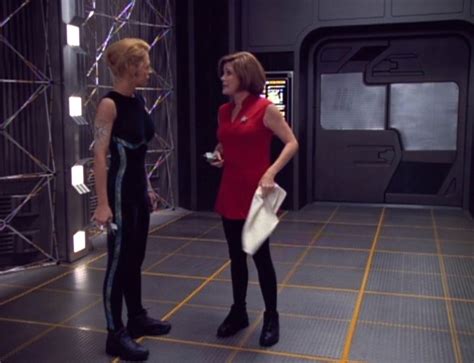
It’s the final episode of season four. Curiously, it isn’t a two-part bridge into season five. That’s unusual. But let’s go! The teaser pits Janeway and Seven in a game on the holodeck and they discuss intuition. A strong start that ends on an ominous note.

They’re still deciphering that message from “Hunters,” so this is a sequel to a weak episode.

But hey! That’s Ray Wise under the dopey bald cap. “Arturis” as he’s called has an unrealistic knack for languages and the message is decrypted via dues ex alien. Will it be interesting?

“You’re much more attractive than the average drone.” Ugh! Still, we get the message… mostly. It contains coordinates that are only 10 light-years away. It’s suspicious that Arturis decoded the message so easily and that the location in a months-old message is close to their current location.

Nevertheless, they race toward the plot complication, which appears to be a Starfleet vessel. Too good to be true. Do we trust Arturis? That doesn’t look like a Starfleet design. “I’m surprised you’re not more encouraged by this discovery,” he says. He’s up to something.

Credit to the writers, Janeway at least isn’t buying it. Will they do the Dumb Thing? Probably.

The Dauntless NX01-A. I remember the name. It’s a trap.

Using intertwined log entries is new and effective. It’s a nice device but the conflict between Seven and Janeway only works if Seven believes the ship would get them back to Earth. She doesn’t.

The shoe finally drops. Janeway’s war crimes have come home to roost. Helping the Borg defeat Species 8472 got Arturis’s race borgified and he wants revenge, kidnapping Janeway and Seven to get them assimilated. Another strong scene with Seven and Janeway and Seven gets a hilarious line. Obviously, it doesn’t work.

A middling episode, but it satisfyingly brings the season full circle, bookending the war crimes, Janeway’s relationship with Seven, and other reflections like Seven rejecting a return to the collective. Some things DO have consequences. That’s a nice change of pace.

Rating: 3 out of 5.

#StarTrek

Images used under the fair use doctrine.

My Voyager Rewatch: S4E25

My #StarTrekVoyager rewatch S4E25 “One”

Awesome! I’ve been looking forward to this one. No pun intended. The Doctor teaching Seven social skills is a dubious proposition at best; this part’s all a bit clumsy.

You know, I vaguely remember this one from 24 years ago. The crew is allergic to a nebula and must cross it in stasis.

“Sub nucleonic radiation” is devastating to organic tissue, but Seven will be okay… because she’s not organic? Still, the Borg drone who had trouble adjusting to brief solitude being utterly isolated is a good setup. The Doctor being in command is also dubious. Or maybe it’s comedy?

The deck full of “coffins” is aptly eerie. Foreshadowing? Cut to Seven on Day 10. Tom sleepwalks. Found unconscious, he should be dead. Tensions are rising, so the EMH prescribes a trip to the holodeck. It’s interesting how Seven uses the trip to the holodeck but the Doctor wants compliance, not creativity.

The plot complication is a welcome distraction. It turns out to be a false alarm. An interesting consequence of the organic matter integrated into the computer systems. Still, it should have been easily foreseen. The Doctor has been knocked offline outside of the sick bay before.

We don’t need to change the rules to manufacture drama. Still, the tension gets ramped up nicely as Seven is increasingly isolated. A chance encounter brings a pilot with sexual-predator vibes onto the ship. Is he a hallucination? Seven is definitely hallucinating now and the ambiance is positively Hitchcockian.

This part is outstanding especially as it culminates with the Doctor going offline. In retrospect, the slow build here worked exceptionally well and the climax is intense. It’s also nice that the episode had consequences; Seven has grown and we don’t merely revert to the status quo. A solid episode and most of my qualms I can dismiss as early hallucinations or forgive for being necessary to set the plot in motion. The pay-off at the end, for example, made the awkward bit in the teaser worthwhile.

This episode will be fun to ponder and revisit. What was real and what wasn’t? I’m not entirely sure.

Rating: 3.5 out of 5.

#StarTrek

Images used under the fair use doctrine.
My Voyager Rewatch: S4E24

My #StarTrekVoyager rewatch S4E24 “Demon”

It’s nice to see Vorik! And is Roxanne Dawson pregnant? Memory Alpha says “yes.” That explains the uniform and the camera angles.

Voyager needs a gas station. Sounds like a barn burner! Paris: “even at 1/4 impulse we’ll be out of gas within a week.” Traveling at sub-light speeds is stupid! It would take years to travel between solar systems.

On the one hand, it’s not a recycled TNG plot. On the other, it’s already pretty dumb. Griefing Neelix is fun, but he can’t bring a book to temporary quarters? Why? Does Neelix move his lips when he reads? Or insist on reading passages out loud? And let’s shut down the good scanners while we look for fuel. Dumb. At least Seven tells them that’s stupid.

The gas station is on a Demon-class planet. Very unpleasant. At least the Demon isn’t literal.

Hey! Directed by Potsie Webber again!

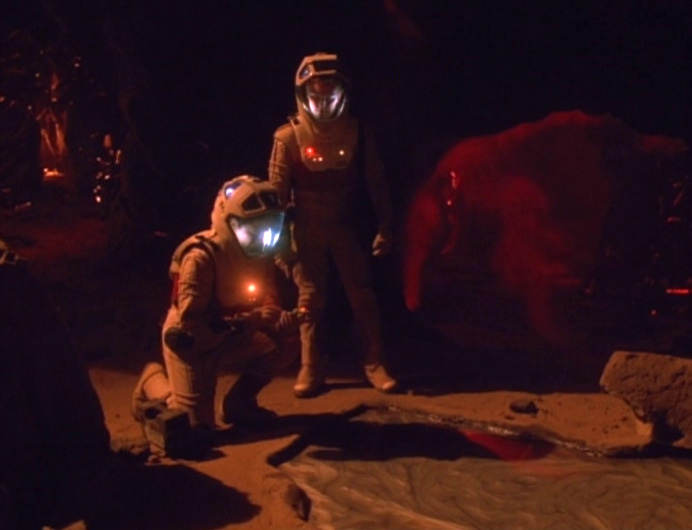
Harry wants to know why he shouldn’t take the initiative. Because you’re an ensign. He and Tom are still not funny. Using EV Suits in an environment too toxic for the ship is dumb. Splitting up is dumb. Drastic temperature changes on Harry’s suit having no obvious effects is dumb. I’ll stop. But wait! The computer says the suit has a problem, saving the FX budget! It’s too dangerous to orbit the planet, so now we land. Ugh!

The B story, Neelix sleeping in sickbay, is even worse but is mercifully short. Also, the visuals of the shuttle do not match the conditions on the planet. Tom and Harry can now breathe without suits and are oddly out of character. I bet the ship will be poisonous to them now.

Yup. The blatantly predictable thing happens. The concept of bio-forming vs. terraforming is interesting at least. But that’s not what happened. The planet 3-D printed a new Harry and Tom. The originals should be dead but inexplicably they’re not. Still dumb. The planet wants to 3-D print everybody.

None of the characters have figured that out yet. Janeway says “sentience” when she means “sapience.” We casually, off-screen, copy everyone, sidestepping the Tuvix-sized ethical issues. I must never have seen this one when it first ran 24 years ago because I’d still be irritated.

But I don’t blame Potsie.

Rating: 0.5 out of 5.

#StarTrek

Images used under the fair use doctrine.