Adventures in Punditry

I like trying things I haven’t done before. A few years ago I got my one and only speeding ticket and I attended the court date. I’d never been to court before and it was interesting.

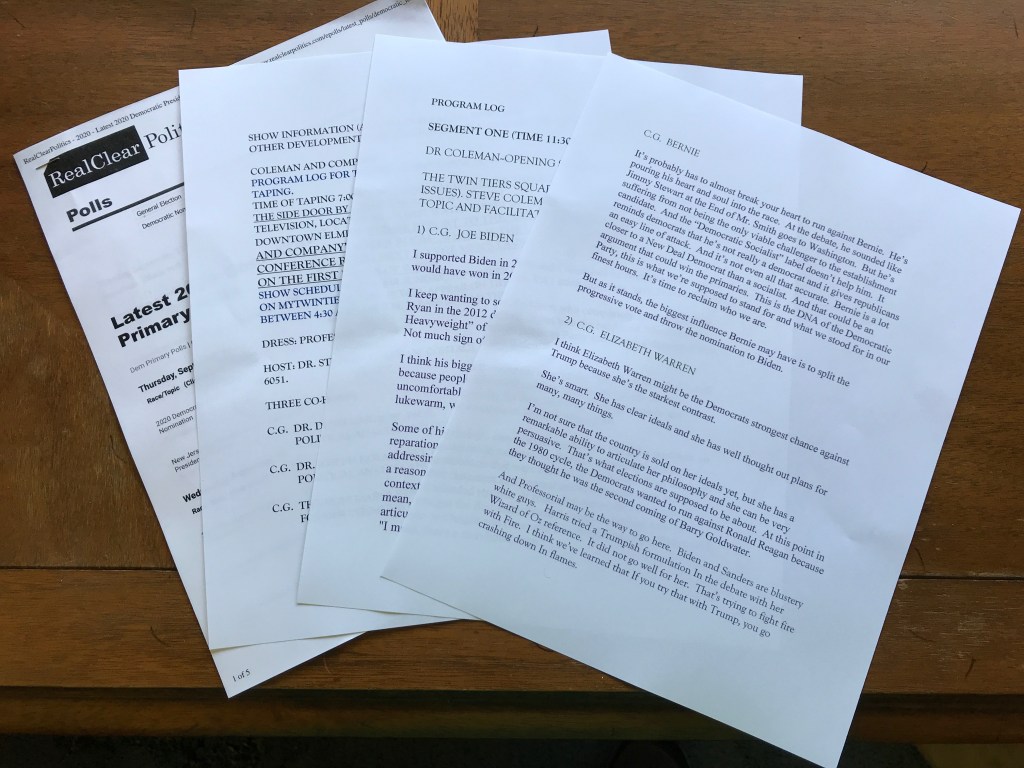
About two weeks ago, Steve Coleman, who was a Vice-President at Elmira College, invited me to be a guest on his local public affairs program. Steve’s been doing this sort of thing for years as a self-styled “Ph. D. of Politics.” Coleman and Company is now a weekly half-hour webcast that appears on Sunday evenings on MyTwinTiers.com, the website for the local WETM-18 news. Steve puts together an interesting show and it’s worth checking out.

And this isn’t just something new, this is something I’ve always wanted to try. I’m a politics junkie and I’ve been watching things like the McLaughlin Group or Face the Nation or The Rachel Maddow Show for years. I’ve done my share of groaning at the teevee and doing armchair punditry inside my own brain (“Eleanor! Pat’s just trying to wind you up! Don’t take the bait!!”). I always thought it looked like fun.

If you’re at all curious, the process was straightforward. Steve e-mailed his plan for the show to us on Sunday with an update on Tuesday so we’d know what to expect: presidential politics, impeachment, Iran, and then our own chance to sound off on something.

Over-Preparation

I was probably over-prepared. Joanne and I showed up at the studio about a half hour before we were set to tape on Thursday. We got to meet Denis Kingsley, the other guest, who is a real gentleman. Seeing the inside of the studio reminded me of my trip to the Johnson Space Center in Houston. The tour took us through Mission Control and standing in these spaces is utterly unlike what you’d expect.

We took our places and started the taping; taped, incidentally, “before a live studio audience” thanks to Joanne.

I probably should have cut Eleanor some slack. A lot of the stuff I’d thought about beforehand got left on the table because it was nowhere in my brain to be found when I needed it. I guess my biggest missed opportunity was after Denis asserted that Elizabeth Warren would be unelectable if she got the nomination. I should have pointed out that the person the Democrats really wanted to run against in 1980 was Ronald Reagan; they thought he’d be easy to beat. And no one seemed to honestly believe that Donald Trump could get the Republican nomination much less win the presidency in 2016. Some folks remained in denial until the electoral college actually voted. That, too, is why we have elections.

But this was a lovely experience. It was great fun and I really have to thank Steve for the opportunity. Unlike traffic court, I’d happily do this again.

So now I’m a bona fide “political analyst and commentator.” Coleman and Company featuring yours truly in the role of “company” is available on TwinTiers.com.

The First 2020 Democratic Debate Night 2

Well, here we go again; although today, I’m setting up some of this in advance and trying to get the hang of this live blogging thing. If the format is consistent with last night, the moderators for the first round will be Savannah Guthrie from the Today Show, Lester Holt, anchor of The NBC Nightly News and Telemundo anchor José Díaz-Balart.

https://www.rollingstone.com/politics/politics-news/democratic-primary-debates-2019-817339/

Tonight’s lineup includes the following candidates: Former Vice-President Joe Biden, Vermont Senator Bernie Sanders, California Senator Kamala Harris, Mayor of South Bend Indiana Pete Buttigieg, New York Senator Kirsten Gillibrand, Colorado Senator Michael Bennet, Best Selling Author Marianne Williamson, Representative Eric Swalwell, Entrepreneur Andrew Yang, and Former Colorado Governor John Hickenlooper. The qualifying candidates were randomly assigned to the two nights. Only one of the five leading candidates appeared last night, namely Elizabeth Warren. Biden, Sanders, Harris, and Buttigieg are all in tonight’s debate. It may be as cordial as last night’s gathering, but I’d expect to see more fireworks. We’ll see.

I’ll be back at 9:00 this evening.

8:58 pm. I’m back and here we go.

Lambchop (Chris Hayes) says Trump is president, so anyone could be president. All bets are off.

The first question is for Sanders: will taxes go up for the Middle Class in a Sanders Administration? Sanders: People will be paying less for health care, we have to eliminate student debt. More in taxes and less in health care.

For Biden: you said nothing will fundamentally change. Biden: The middle Class built America. We have to return dignity to the middle class. We need to eliminate the Trump Tax Cuts.

Harris: Where were the questions about paying for proposals when we passed the Trump Tax cuts? It sounds like she’s proposing universal basic income for poorer Americans. That’s news I think.

Hickenlooper: I’ve done big progressive things.

Will nominating a socialist re-elect Trump? Sanders: I’m 10 points ahead of Trump and we need to expose him for the fraud he is.

Gillibrand: We want healthy capitalism, not corrupted capitalism.

Bennett: Against Medicare for all. Add a public option to the ACA.

Buttigieg: I believe in free college for needy Americans but not for the children of millionaires. We need it to be affordable not to go to college.

Swalwell jumped in out of turn.

Yang: A value-added tax could pay for Universal Basic Income.

Swalwell: We must be a nation where technology creates more jobs than it destroys. That’s a direct shot at Biden. Pass the torch.

Biden: We need to invest more in education. Free community college. Freeze student debt interest for people making less than $25,000.

Saunders: We need someone willing to take on Wall Street etc.

Harris got a lot of applause for some pretty basic stuff.

Gillibrand: We need to transition to single-payer.

Buttigieg: I would start with “Medicare for all who want it.” It will outcompete the Corporate sector. Medicare kept our family out of Bankruptcy.

Biden: The fastest way to universal health care is by building on the ACA.

Sanders: Every other major country has figured out Universal Health care. We can too. The insurance companies are focused on profits. He dodged the question here.

Williamson: We won’t beat Trump just with plans. We don’t have health care in America, we have sickness care.

Bennet: The ACA is the quickest way to universal care. A public option would be Medicare for all for those who have it.

Sanders: Medicare is the most popular medical system.

Harris and Swalwell are talking over each other.

9:31 pm

Would your health care plan cover undocumented people? Every hand up.

Buttigieg: The country is healthier when everyone is healthier. Then he segued to immigration.

Biden: Jail insurance executives who lied about opioids.

Lots more talking over each other and more digs at other candidates tonight. These guys may see the stakes being higher. Does it help Warren that she was able to float above the crowd last night?

Harris: On day one I will reinstate DACA and their parents. Will release children from cages. She has a boisterous group of supporters in the audience. Trump’s policies are contrary to American values.

More digs at Trump tonight I think.

Hickenlooper likens Trump’s family separation policy to kidnapping. ICE has to see their mission differently.

Williamson uses the term child abuse. These are crimes. Trump is attacking a basic American principle.

Gillibrand: Trump is tearing apart who we are. Lots of specifics on immigration. Don’t transfer funds to for profit prisons.

Buttigieg: The GOP cloaked itself in Christianity we must call out hypocrisy. Big applause.

Biden: the Obama administration lessened the number of refugees; Trump got rid of the policy. Deport illegal immigrants who have committed crimes. Keep refugees safe until they can get a hearing.

Saunders: Day 1, reverse every damn executive order Trump has made in this region.

Swalwell: Immigrants can contribute to America.

Harris: I was tracking deportation as AG of CA and disagreed with the Obama administration.

How would you stand up to China? Bennet: Mobilize nations to oppose their trade policy. Raging against the wall.

Yang: Russia has been laughing their asses off for the last two years. The tariffs are not productive.

Buttigieg: China is using technology to perfect authoritarianism. It’s a big threat we must address.

After the commercial break, we have MSNBC’s Rachel Maddow and Meet the Press’s Chuck Todd as moderators. Meanwhile, there’s a Charles Manson movie coming.

10:00 pm, Part 2:

The first question to Mayor Pete: We took many steps to prevent the police shooting in South Bend. We must make it work. Everyone should feel the same way when approached by a police officer.

Williamson: We need slavery reparations.

Harris: This issue still isn’t being discussed honestly. It was hurtful when Biden said favorable things about segregationists. This cannot just be a philosophical discussion among democrats.

Biden: I did not praise racists. I was a public defender. As VP we worked with these issues in a major way. I ran because of civil rights and those must include the LGBT community. I didn’t oppose busing, I opposed busing ordered by the Department of Education.

Sanders: We encourage diversity; that’s what America is about. How come, today, the middle class is making no more than they did 40 years ago? We need someone to stand up to the powerful special interests.

Bennet: Gridlock will not magically disappear as long as Mitch McConnell is there. The Democrats must win the senate. We also need to oppose gerrymandering.

Biden: You can’t always have bipartisanship. Sometimes you have to beat them.

Gillibrand keeps hitting on corruption. The GOP had to pass the tax cuts to pay back their donors.

What if Roe v Wade is struck down during your presidency?

Sanders: I will nominate no judges that will overturn Roe.

Gillibrand: Reproductive rights are under assault. I have been the fiercest advocate for reproductive rights.

Harris: Trump supports Science Fiction over Science Fact. Not wild about the metaphor.

Buttigieg: We need to begin adapting to Climate Change and have definitive action to slow it. Climate change is happening everywhere. With soil management, the Midwest can be a part of the solution.

Hickenlooper: I’m a scientist, I share the sense of urgency. Socialism isn’t the solution.

Biden: We can control carbon emissions without congress. We should be an exporter of the green economy and build the infrastructure for electric cars.

Sanders: The POTUS must lead the world away from fossil fuels.

Williamson: Evoking JFK, not sure what her point is. What is your first issue?

Swalwell: Gun Violence.

Bennet: climate change.

Gillibrand: family bill of rights.

Harris: working families tax cuts.

Sanders: political revolution.

Biden: Defeat Donald Trump.

Buttigieg: fix democracy.

Yang: UBI.

Hickenlooper; Climate change.

Williamson: something about the prime minister of New Zealand.

Swalwell: Keep you pistols, rifles and shotguns. Forced of buyback all assault weapons.

Sanders: We have a gun crisis. We need comprehensive gun legislation including standard things.

Harris: Give Congress 100 days to Bill or executive orders.

Buttigieg: every part of my life informs my position. If more guns made us safer, we’d be safe. There are weapons with no place on the street. Ever.

Biden: I’ve passed gun legislation. No guns should be sold except smart guns.

What are important steps toward reversing the legacy of Trump? Bennet: we have to restore democracy and our relations with other countries.

None of these guys can give short answers. Okay, Harris did.

Biden: I was responsible for getting 150,000 combat troops out of Iraq. The use of force resolution should have been aimed at terrorists. That’s exactly what Bob Graham said at the time.

Sanders: War with Iran would be worse than war with Iraq. I will make sure it doesn’t happen. It might be too late by then.

Closing statements now.

Williamson sounds like a self-help book.

I think Hickenlooper is out of step with the party.

Yang: Trickle up economy.

Lots of platitudes.

Buttigieg is pretty good.

Saunders is on his greatest hits but strong and combative.

Biden is aimed straight at Trump.

Analysis:

I think this group was stronger on average than last night with the exceptions of Williamson and Swalwell. This was combative. Hickenlooper was fixed on being anti-socialist and a couple of people were focused on the pass the torch message. Harris may have had the moment of the night hitting Biden hard on race. I thought he came back well but the pundits disagree. Strong performance by Buttigieg, but there’s no clear winner tonight the way I think Warren won last night. I think she will benefit from having had less competition last night.

This primary season will have problems if the number of candidates doesn’t get smaller; if you have 24 candidates someone could theoretically win with 5%. This could get winnowed down 5 or 6 really strong candidates. The rules of the Democratic Party assign votes proportionally . I can easily see this ending in a brokered convention.

Speaking of Bob Graham, there he was in the audience, saying hello to Biden.

References:

Live Blogging the First Democratic Debate

8:55

This is starting in a few minutes, I’m going to try to live blog here. I’ll add things as soon as I write them. I’ll try to follow comments on the post if anyone makes any.

In no particular order, tonight’s participants are: Cory Booker, Bill deBlasio, Beto O’Rourke, Julián Castro, Tulsi Gabbard, Elizabeth Warren, Amy Klobuchar, Jay Inslee, Tim Ryan and John Delaney. Ten more will debate tomorrow night.

9:03

The first question goes to Elizabeth Warren. The economy isn’t working for those at the bottom. We need structural change.

Klobushar: No on free college, but free community college.

O’Rourke: Calls out Gerrymandering. Won’t commit to a 70% marginal tax rate.

Warren: There’s too much consolidation in industry. That’s bad for the economy and bad for innovation.

9:11

Castro: Calls for passing the ERA and for Equal Pay legislation.

Gabbard is touting her military background.

All of them are about making the economy for everyone.

De Blasio: This is the party of working party; it needs to be strong and progressive.

Delaney: Touts his background as a entrepreneur.

Insley: Proud of standing up for Unions.

I’m missing a lot. This is rapid fire. No time for commentary. Reminds me of taking notes in Complex Analysis.

Ryan: We’re losing industry in Youngstown, OH. The working class hasn’t gotten a raise since 1980.

Warren: There will be a worldwide need for green technology. We need to develop it in the US and manufacture it here.

Only Warren and DeBlasio are in favor of replacing private health insurance.

Klobushar: Trump’s claims about Pharmaceuticals are “All foam and no beer.” That may be the sound bite of the night.

Warren: Health Care is a basic Human Right and I will fight for basic Human Rights. With Sanders on Medicare for all.

O’Rourke: Backing away from Medicare for all. Medicare for folks who don’t have private insurance.

Gabbard: Need to look at the bigger picture. Medicare for all is the way to go and corporations will recognize the savings. Everyone must be covered.

Booker: Health care affects many other things; eg: Education.

Warren: Insurance companies sucked 23 Billion out of the health care system.

9:30

Castro: “I don’t believe in reproductive freedom, I believe in reproductive justice.”

Warren’s getting a lot of attention, but this is unwieldy with even 10 candidates.

Booker and O’Rourke: Hold pharmaceutical companies liable for their role in the opioid crisis.

Castro: We need a Marshall Plan for certain Latin American countries so that they can find safety and employment at home. Many specifics (section 1325). He’s clearly up on this.

DeBlasio: That photo is not America. “The immigrants didn’t do that to you, corporations did that to you.”

9:40

Many ideas on immigration from many participants.

O’Rourke and Castro are talking over each other.

Klobushar: Waxes philosophically on the importance of immigrants.

Ryan: We need to send doctors to care for the immigrant children in detention.

Booker: Stand against for-profit prisons. Again with the “We can’t sacrifice our values.”

Inslee: “We would welcome refugees into Washington state.

Only Booker wouldn’t sign back onto the 2015 Iran Deal. Thinks he could do better.

Klobuchar: Iran Deal was good but imperfect. Trump has given leverage to China and Russia.

Gabbard: Trump and his cabinet have led us to the brink of war. War with Iran would turn into a regional conflict. There would have to be a response to an attack on American troops.

10:00

Now we have Rachel Maddow and Chuck Todd as moderators. And technical difficulties. Florida Man fails to stop feedback.

10:05

Again starting with Warren. Is there a role for the federal government for getting guns off the streets?

Warren: Keeping children safe is our responsibility as adults. Universal Background Checks. Actually do research and see what works. Bring data to bare and treat it as a national health emergency. There is no one-size-fits-all solution.

Ryan: We need trauma care in every school.

O’Rourke: Gun Owners and non gun owners agree the debate should be led by young people.

Klobuchar: These proposals don’t hurt hunters. The Parkland students have moved the debate.

Booker: You should need a license to own a gun. We need bold actions.

If McConnell is still Senate Majority Leader, will he let the next president seat Supreme Court Justices?

Warren: We are a democracy and the will of the people matters. Congress has made things work for the elites. We need to energize people to hold congress accountable.

Inslee: We have to take the filibuster away from Mitch McConnell. I will make climate change the number one priority.

O’Rourke: We need to bring everyone into the decision making on climate change. Lots of specifics.

Castro: As mayor, made SanAntonio’s power plant more green.

Ryan: The Democratic Party has lost all connection to the working class in the mid-west. It must be a working class, blue color party.

Delaney: Put a price on carbon. Carbon pricing works.

Gabbard: Strong statement for LGBTQ rights. There are still those facing discrimination.

Booker: We need a president who will protect LGBTQ Americans.

Klobuchar: We must make sure everyone can vote.

Castro: We also need criminal justice reform. All groups need to be treated the same by law enforcement.

O’Rourke: We need to live our values in Foreign Policy.

DeBlasio: Even in humanitarian crises we should not commit troops without congressional approval.

Ryan: We must remain engaged in places where there are humanitarian crises.

Gabbard: That is not acceptable. We need to have strong reasons to commit troops.

Ryan is not evoking 9/11. The audience didn’t like the exchange.

10:41

O’Rourke: We need to address the potential crimes delineated in the Meuller report. We need to undertake impeachment and indictment after Trump leaves office.

Delaney: No one is above the law and Trump should not be about the law. But this is not the issue the voters care the most about.

10:50 Closing statements now.

Analysis:

This was an interesting debate. I think all the candidates put in pretty strong performances and all of them seemed like credible potential presidents. Nothing really earthshaking; there were lots of policy specifics and the whole thing stayed cordial. And they stayed positive; there were some digs at President Trump, but mostly they presented their policies and solutions.

There was a lot of agreement among the candidates such as that climate change is an existential threat and health care is a human right. There was also a lot of talk about making the economy work for everyone and not just those at the top. That could be a move back toward being the party of FDR rather than the party of Bill Clinton. Then again this is a primary debate; they might be playing to the crowd.

I think Elizabeth Warren may have had the strongest performance, but I like specifics and that’s where she excelled.

Still, there was little to change my mind about most of these candidates. I’m still dubious about some and favorably disposed towards some of the others.

More tomorrow. Same Bat Time. Same Bat Channel.

Photo Credit: JIM WATSON/AFP/Getty Images

How would presidential elections change if electoral votes were allocated by congressional district ?

First published on Quora.

This is the system currently used in Maine and Nebraska. In Maine and Nebraska, the statewide winner gets the two electoral votes (EVs) corresponding to the senators. Then the remaining votes are determined by the winner of each congressional district.

The Electoral College already has a “small state bias” that skews for the time being in favor of the Republicans since the smaller states tend to be more Republican than the country as a whole. I haven’t checked the numbers, but California has the same population as something like the smallest 20 states combined. That’s two EVs for the statewide win in California compared to forty for the statewide wins in these other states. It’s this bias that is responsible for the two “electoral inversions” we had in 2000 and 2016. That is to say, the two elections where the winner of the Electoral College did not match the winner of the popular vote.

Choosing the remaining EVs by congressional district would further skew things in the Republican direction. This is due to the extreme partisan gerrymander that took place after the 2010 election. To put this into perspective, the Democrats won the “national congressional vote” (NCV) in 2018 by something around 7 percentage points. This will give them a majority of between 14 and 19 seats when the remaining races are determined. By contrast, the Republicans won the 2014 NCV by 5.4 percent in 2014. That gave them a majority of 30 seats. Worse, in 2012 the Democrats won the NCV by 1.2% but the Republicans maintained a majority in the House of 16 seats.

So, at least until the congressional districts are redrawn in the wake of the 2020 Census, the current small-state bias that favors Republicans would be exacerbated. I don’t know if it would be impossible for a Democrat to win the presidency under such a system, but it would certainly be more difficult and there would be many instances where this system would elect the Republican even if the American people preferred the Democrat.

Still, it’s easy to imagine a worse system. During the run-up to the 2012 election, I recall Nebraska debating a return to a winner-take-all system so that President Obama could not win an EV from Nebraska like he did in 2008. At about the same time the Republican-controlled Pennsylvania legislature debated switching to allocating EVs by congressional district to help Governor Romney. Imagine such a system implemented nationwide, with all the red states using winner-take-all and all the blue states allocating electoral votes by congressional district or vice-versa. Such a system would virtually guarantee one-party control of the presidency.

References (all accessed 19 November 2018):

House Election Results: Democrats Take Control

RealClearPolitics – Election Other – 2014 Generic Congressional Vote

RealClearPolitics – Election Other – 2012 Generic Congressional Vote

114th United States Congress – Wikipedia

113th United States Congress – Ballotpedia

Election 2018: Vote Anyway.

I votedI have some intense opinions about politics and generally, I’m happy to engage.  But I don’t want to make this a blog about politics.  If someone stumbles on this blog wanting to read about comics or mathematics or whatever they may not be interested in my opinions about candidate X or birthright citizenship or the current occupant of the Oval Office.  And that should be fine.  Some politics may sneak in from time to time but I’d like this to be a place that’s free from the most divisive arguments we’ve seen in my lifetime.
On the other hand, I’ve been fascinated with elections since I was 12.  I’ve done some work in voting theory and I’ve tried my hand at prognostication.  It’s been my intention to eventually write about elections on this site.  But the problem, then, was what to write about?  We know the broad strokes of the 2018 election.  The Democrats are doing remarkably well in the Generic Congressional Ballot and appear to be poised to retake the House.  That’s pretty remarkable given how heavily gerrymandered a lot of states are. Some of that has to do with the intensity of emotion engendered by President Trump.  It also helps that some of the most egregious gerrymandering we saw after the 2010 election has been overturned in the courts.

In the Senate, it’s a very different story. This is the class of senators that was elected in 2006, a Democratic wave that gave them the majority for the first time in four years. In 2012, despite defending more than 2/3 of the seats up for election, the Democrats actually increased their majority by two. So the Democrats are faced with what fivethirtyeight.com calls “the most unfavorable Senate mapthat any party has ever faced in any election.” Of the 35 senate elections being held this year, only 9 are held by Republicans and only one of those is in a state that’s bluish, namely Nevada. Meanwhile, a lot of the seats being defended by Democrats are in deep red states like North Dakota and Missouri. Despite being ahead on the Generic Congressional Ballot, the Democrats will probably lose seats in the Senate.

Aside from the National stage, the most important elections happening this year are, in my opinion, the races for the State Legislature. We don’t see much national coverage of these elections, but they’re crucially important. This is our first opportunity to elect some of the people who will be drawing the political maps in the wake of the 2020 Census. The candidates we elect now could determine control of the House of Representatives and of State Legislatures for a decade or more.

But all of this is known and it hasn’t shifted much. I could have written the last three paragraphs a month ago. Or two.  But the thing that motivates this post is that I stumbled across this.

A lot of folks pay attention to polls.  The polls influence their tendency to vote.

silver-datalab-betterpolls-1

Democrats in Texas or Republicans in New York might decry their need to go to the polls because the opposition will “win anyway.”  But here’s the thing: according to this article (originally published in 2014) the average House poll has, since 1998, been off the final result by 6.2 percentage points.  Polls in senate races and gubernatorial elections have fared somewhat better, missing the final result by 5.1% and 5.2% respectively.  And polling is getting harder.  Response rates are declining making polls more expensive.  The decline in the prevalence of landlines along with laws about contacting people on cell phones are making it harder to get a representative sample.  You might think your Senate candidate is behind by three points, but the race could be a dead heat.

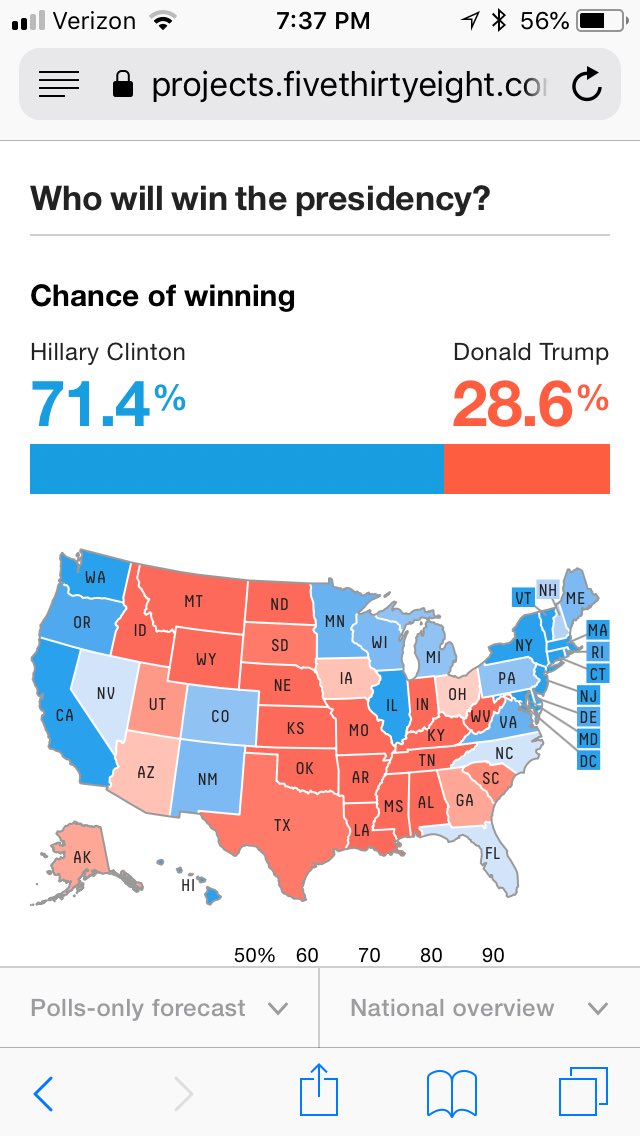
2016ProjectionI see this graphic on Twitter a lot in Nate Silver’s feed.  The implication here is that Silver “predicted” that Clinton would win the White House and so, 538 “got it wrong.”  That’s not what this says at all.  This is a probability.  What this says is that, if you could repeat the election a bunch of times, Clinton would only win about 71.4% of the time.  In 28.6% of the “elections” Trump would be elected.  A Trump election isn’t surprising.

Imagine tossing a coin twice.  Would you be surprised if you got two tails?  You shouldn’t be.  The probability of that outcome is 25%.  Sure, it’s more likely that one of the other three outcomes will happen, but it isn’t surprising at all.

The Trump victory, according to this analysis, is slightly less surprising than throwing two tails. The difference is that most people are not emotionally invested in the coins toss.

So, what’s the point?  Vote anyway.

Do you want the Democrats to win the Senate?  Current estimates say there’s only a 1 in 6 chance of that happening.  Vote anyway.

Do you want the Republicans to retain control of the House?  Fivethirtyeight says they’ll “need a systematic polling error” for that to happen.  We’ve seen those before.  Vote anyway.

Do you want Heitcamp to get reelected in North Dakota, but you’re afraid she’s fallen too far behind?  Vote anyway.

Do you want DeSantis to win the Governorship in Florida but think Gillum has pulled too far ahead? Vote anyway.

Not interested in the winner of the marquee race in your state?  The down-ballot races and the initiatives are at least as important.  Vote anyway.

Can’t bring yourself to vote for either of the major party candidates?  You don’t have to use your vote to help determine the winner.  For example, here in New York, the results of the Governor’s election determine which parties get dedicated ballot access.  You could vote to help the Working Families Party or the Conservative Party or the Green Party or the “The Rent is Too Damn High” Party get on the ballot.  Vote anyway.

Elections are important.  We’d be a profoundly different country if everyone who could vote did vote.  But to quote Arron Sorkin, Benjamin Franklin, or any number of people, “Decisions are made by those who show up.”  This one is really important.  No matter what you think is likely to happen, vote anyway.

What if Captain America became President?

Cap for President

First Published on Quora, 14 October 2019.

CaptainAmerica250

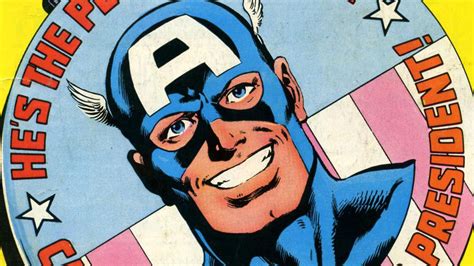
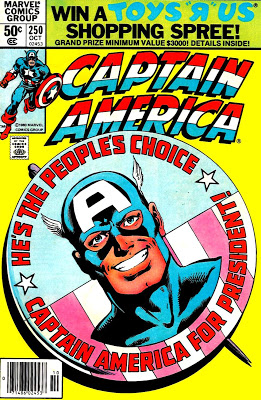
It’s worth pointing out here that this very idea has already been played around with in the comics. In Captain America 250 (October 1980) Steve is approached by the New Populist Party and asked to be their candidate for president. He gives it serious thought and spends most of the issue debating the pros and cons with his friends, Avengers and otherwise. The ending of the issue is bittersweet; Steve, of course, decides not to run for president and the enthusiasm that had been building within the NPP turns to a profound disappointment.


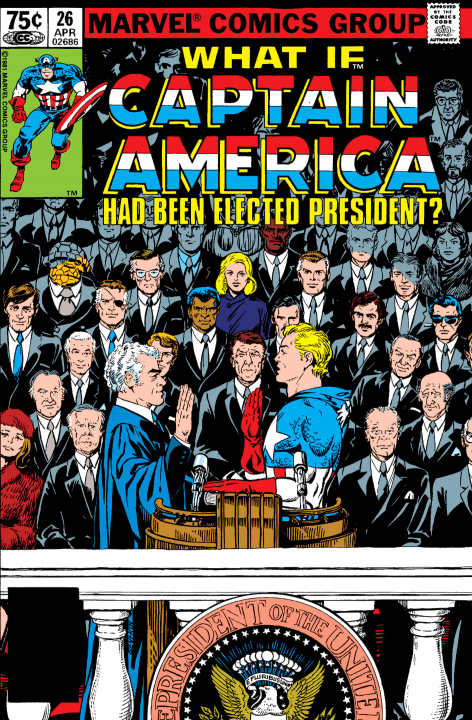
About six months later, Marvel itself answered this question in What If? #26. Of course, we don’t know whether WI#26 tells us what “really” would have happened in the Marvel Universe, but it’s at least as valid as what anybody else would have said. And in some sense, that’s the ultimate answer to the question at hand. It really depends on who gets to write the story.

Cap #250 is a classic. What if #26 is pretty good. Both are worth checking out and are available on Marvel Unlimited.

 
what-if-26.png

In my opinion, there are two things I think are worth addressing, how Steve would have governed and how the public would have been likely to respond.

Politically, I think Steve is likely to be a New Dealer. He was born in 1920 and came of age around 1940; FDR was popular and won a fairly lopsided electoral victory that year, although not nearly as lopsided as in 1936. I think what we’ve seen from Steve over the years bares this out, from Englehart’s run in the ’70s to his reason for stepping out of the role in “Captain America No More” to his stance in Civil War and beyond (Hydra-Steve notwithstanding). In foreign policy, he would be an excellent diplomat, able to find common ground with other nations and move forward productively. He would certainly be more apt to use military force than Jimmy Carter, but not nearly so apt as either of the Bushes. He would be relentlessly ethical.

However, the public’s response to Steve as president would be more indicative of his legacy as Commander-in-Chief than his political positions.

If he had been elected President in 1980 when “Cap for President” first hit the stands, conservative or liberal, I think President Rogers would have been a transformational figure. Six years out from Watergate and a bit more than a year after Carter’s malaise speech, the American Electorate was in flux. “Reagan Democrats” were becoming a thing while there was a candidate for the Republican nomination, John Anderson, who was arguably more liberal than the Democrats’ eventual nominee. If there’s one constant in all the portrayals of Steve Rogers, it’s in his ability to lead and inspire. Cap as president in the early 1980s would have changed the political landscape for a generation or more.

On the other hand, had Steve been elected in the current political climate, I don’t think any of that would have mattered. Ed Brubaker (I’m pretty sure, I haven’t been able to locate the quote) made a relevant remark about the time Steve “died” in the aftermath of Civil War. He said that it was tricky to write Cap. One side of the political spectrum mainly wants to see Cap beating up terrorists, while the other side likes to see him giving speeches about rights and fairness. If anything, this aspect has gotten more extreme over the past 11 years. Steve, as president in the 21st Century, probably presides over a lackluster presidency with one side of the aisle lauding his accomplishments and the other condemning his inadequacies, justly or unjustly.

And that, I think says much more about the state of politics in America today than it does about Captain America.

References:

Captain America #250 (October 1980)

What If? # 26

Captain America – Wikipedia