Harris Has the Momentum
Hello! Thanks for joining me!
I’ve been publishing election projections for a few years now and I’ve been meaning to start publishing projections for 2024. With the big shake-up in the race, this seemed the ideal time to start.
This will actually be my second projection for this election. I did the first for my appearance on WETM’s Political Pundit Night on 9 May. At that point, Donald Trump would have had about a 66% chance of winning the election had it been held on that day.
But let’s get down to brass tacks as they say.
The State of the Race
It’s been a tumultuous few weeks after the race had been pretty stable for quite a long time. Of course, the tremors started with the first debate. You can read my analysis of that here. What’s the bottom line? President Biden gambled that a strong debate performance would shake things up and allow him to go on the offensive. That was not at all what happened.
At the debate, President Biden, coming off an exhausting travel schedule and with a cold, seemed feeble. Still, he mostly made sense. Trump, in contrast, spewed a torrent of falsehoods. His voice however sounded confident and assertive. The narrative coming out of the debate was heavily skewed toward the candidates’ presentation rather than the content of their answers. Calls began for Biden to withdraw from the ticket and that received the lion’s share of the media’s attention. Trump’s lies deserved equal attention.
The Trump campaign was uncharacteristically disciplined as the Democrats tried to regain their footing after the debate. By the time their convention rolled around the GOP thought they were riding a wave of inevitability to certain victory. This only intensified after the assassination attempt. They pandered to the fringe of their party by picking the problematic J. D. Vance as their vice-presidential candidate and some Republicans over-reached by trying to blame the assassination attempt on democratic rhetoric. None of that, amazingly, moved the needle very much.
That all changed when President Biden stepped aside and, as he put it, passed the torch onto a new generation by endorsing Vice President Harris. Over the last ten days, the Democrats have achieved a level of enthusiasm they have not reached in quite some time.
Results:
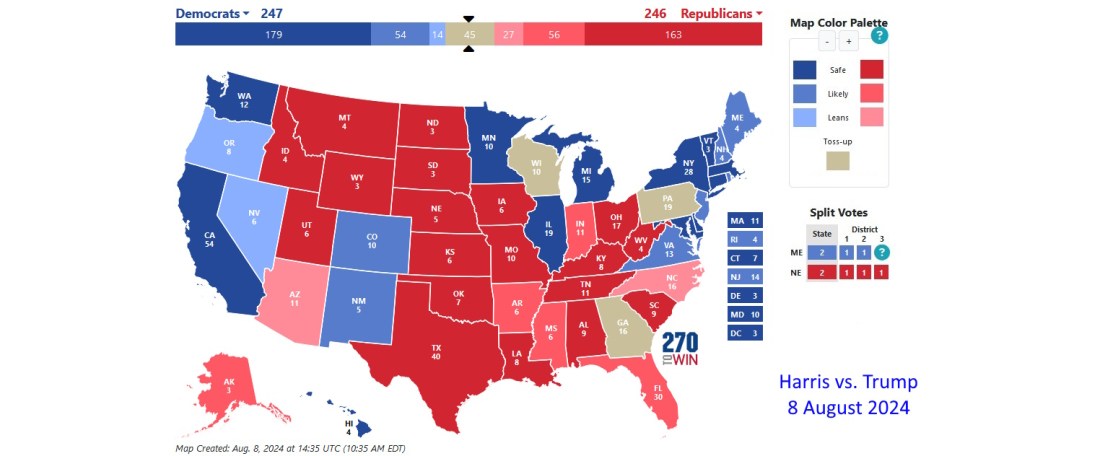
After entering the polling data into our model and running 40,000 simulated elections it appears that if the election were held today, Former President Trump would have about a 45% chance of winning. In contrast, Vice President Harris would win with a probability of 54%. The remaining results were electoral college ties.
I wouldn’t put too much faith in the units’s digit in those probabilities. Indiana, for example, landed in the “leaning Republican” category because of a single poll that was taken back in April. If it were in the “strongly Republican” category the probability of a republican victory would be somewhat but not dramatically better.
The bottom line is that this is now a competitive race with the two major candidates having about equal odds of victory.
Trends: What a Difference 10 Days Make
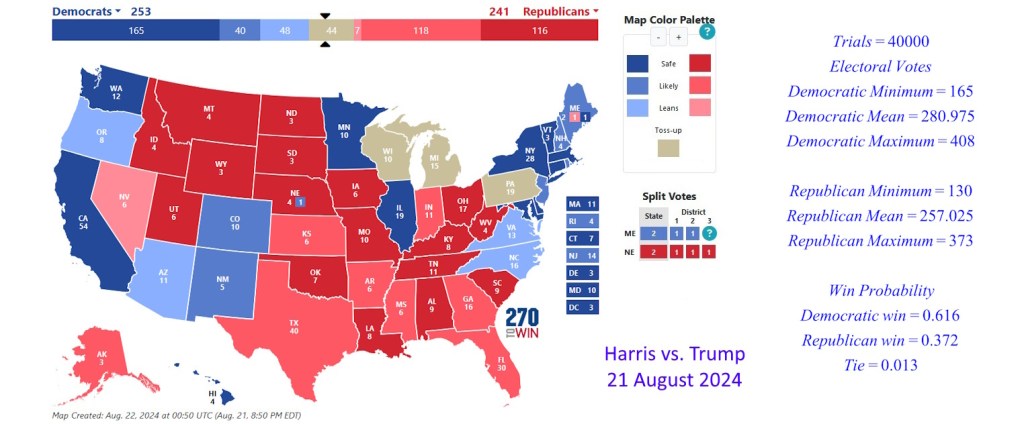
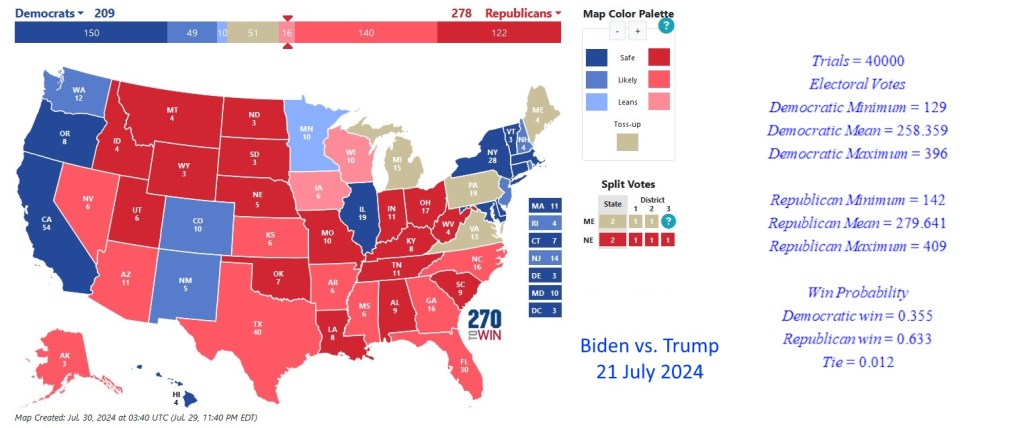
To get an idea of how the race is changing, let’s look at where the race was on 21 July, the day President Biden ended his candidacy.
At this point, Trump had about a 63% chance of winning the election. This was down a bit from the 8 May projection mainly because on 21 July despite the setbacks on the democratic side there were more states in the “Strongly Democratic” category and fewer that were “Strongly Republican.” This is mainly due to minor changes in my methodology for processing the polling data.
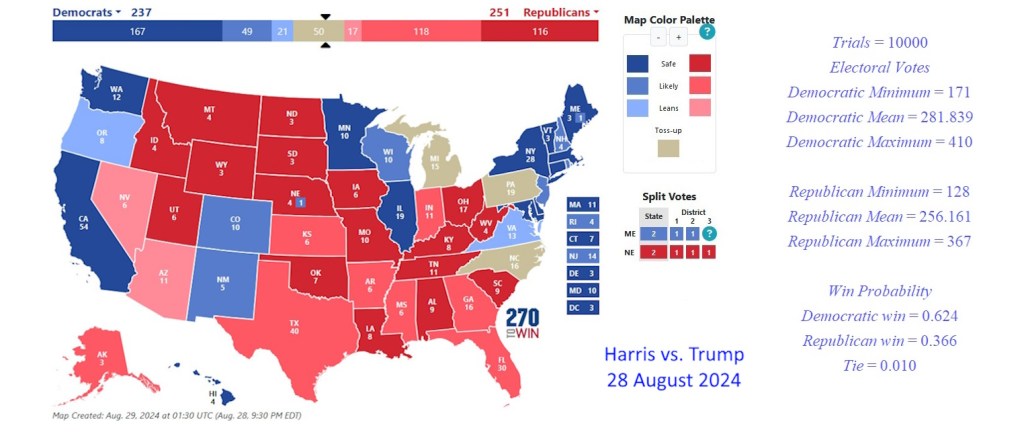
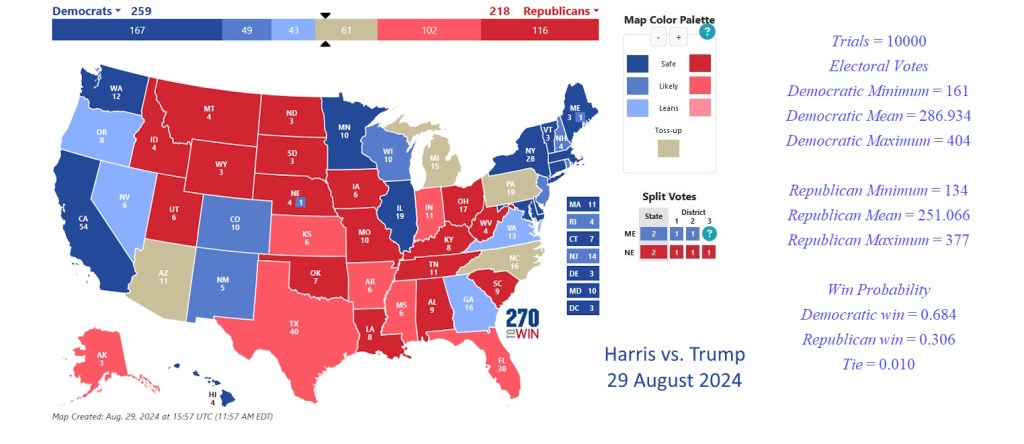
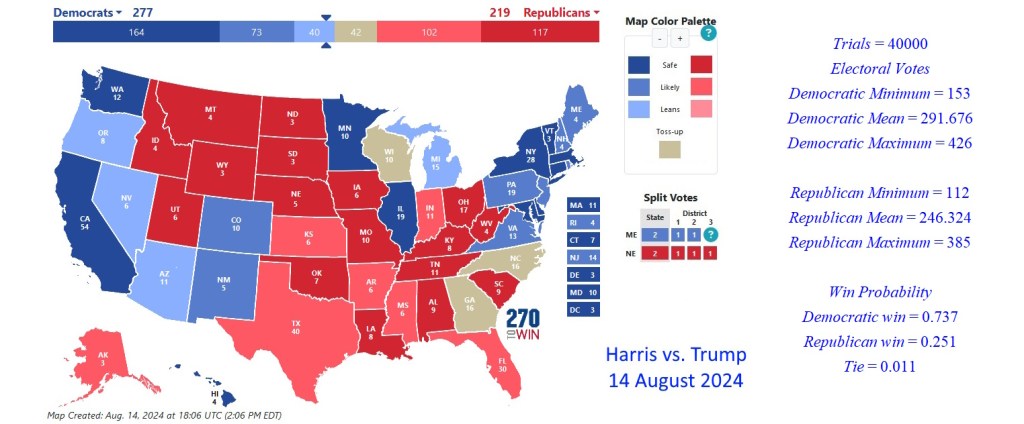
The best way to parse this is that the probability of a Trump victory fell from about 2/3 to roughly 1/2. This is a significant change in favor of Vice President Harris and at this moment the momentum is clearly on her side. This might settle down at this level in which case we would be looking at a close election. There are plenty of reasons to think that the momentum in Harris’s direction will continue for a while. Her pick for Vice President is imminent and the Democratic Convention follows quickly. The Republican Convention had little effect on the state of the race but we’ve known Donald Trump for years now. Harris though is still introducing herself and the data here indicates that voters like what they’ve seen so far. The Democratic Convention could move the needle dramatically as people get to know her and her Vice Presidential pick.
Methodology
The Polling Averages:
I took polling data from Electoral-Vote.com which avoids using partisan polls.
For the July 31st estimate: I took the mean of all the polls released after 21 July to get each state’s polling average. If a state had no polls after 21 July the most recent poll was used.
The July 21st polling averages were determined by taking the mean of the four most recent state polls or the mean of all the state polls after 1 April if there were fewer than four.
The polling averages were fed into a US Presidential Election Calculator; an earlier version of which can be found at MapleSoft Application Center.
The calculator runs a large number of simulated elections. The probability of each candidate winning is estimated by the percentage of the simulations won by each candidate.
The Map:
The colors on the map are determined by The polling estimate rather than by the probability that a candidate will win a state.
In each state, we use the polling estimate to find the conditional probability that an individual voter would choose either the Democrat or the Republican assuming they are voting for one of the major party candidates. Thus, to find, for example, the probability that a voter would choose the Democratic candidate, assuming they are voting for a major party nominee, we would calculate the following.
The colors on the map are determined as follows:
- Solidly Democratic (Dark Blue) 100% > P(D|D or R) > 55%
- Leaning Democratic (Light Blue) 55% > P(D|D or R) > 52%
- Weakly Democratic (Pale Blue) 52% > P(D|D or R) > 51%
- Toss-Up (Gray) 51% > P(D|D or R) > 49%
- Barely Republican (Light Red) 51% < P(R|D or R) < 52%
- Leaning Republican (Light Red) 52% < P(R|D or R) < 55%
- Solidly Republican (Dark Red) 55% < P(R|D or R) < 100%
If a candidate is polling at 55%, the probability that he or she will win the state is actually quite a bit better than that.
For future installments, we’ll move this technical information to its own page and establish a consistent policy for creating state polling averages going forward.
Last Words
Although the Trump Campaign was smart to keep quiet as the Democrats argued over whether President Biden should withdraw from the race their response to having Harris at the top of the ticket has ranged from befuddled to panicky to weird. I didn’t expect that. It seemed to me the smart move would have been for Trump to declare victory. Something along the lines of “I’ve already beaten Joe Biden! He knew he was going to lose and he was too scared to stay in the race! I’ll beat the Democrats’ second choice just as easily.” That wouldn’t have been true but it’s a position of strength that would have been more effective than what we’re watching.
Waffling on the second debate was an unforced error. That’s a position of weakness that the Harris Campaign has been able to exploit. What would have been better? “Of course, I’ll debate Kamala. And you know what? I debated Biden and he was forced out of the race… who’s their next candidate going to be after I force her out of the race too?” This would take guts because if Harris wins that debate, and I think she will, it would be devastating. And there’s the rub. I believe that Trump is genuinely scared to debate her. Still, I’m happy to be wrong about Trump’s response to Biden’s withdrawal.
Where do we go from here? Trump and his campaign spent the Republican Convention trying to fire up their base. JD Vance was a choice intended to appeal to the right-wing fringe of the Republican Party. Vance isn’t going to bring any new voters to the Trump campaign but I suspect there are some Republicans who might feel motivated by his “childless cat-lady” comments.
With Harris at the top of the Democratic Ticket, the Trump Campaign needed to pivot and try to attract new voters. They should be walking back these comments. Instead, Vance doubled down on them.
And Donald Trump’s interview with the National Association of Black Journalists on Wednesday is more of the same. Trump was rude and belligerent. He attacked Harris for ‘changing her race’ whatever that means. We should, as a nation, collectively recoil from Trump’s remarks. Will we? This will not bring new voters to the Trump Campaign but Trump himself must think it will appeal to someone; he continued the racial attacks on Harris on Thursday. Even if we don’t recoil en masse, these remarks will repel most voters. If Trump doesn’t figure out how to run against Harris her momentum will continue and we’ll be looking at a landslide in November.





















 Comics, the Universe, and Everything